I decided back in December that I wanted to go the Black Hills for Memorial Day weekend this year. My husband had never been there, and aside from one quick (and soggy) day a few years back, I hadn’t been there since I was a kid. So I put together an itinerary and booked a campsite, and we were all set.
As you may recall, though, I was posting about the Black Hills last month – well before Memorial Day. That’s because when my husband and I unexpectedly had a full week off work at the same time, we decided to do a last-minute roadtrip to not just the Black Hills, but also Devils Tower, some national monuments in Nebraska, and the Badlands. I’d figure out a new plan for Memorial Day later, I decided.
You may also remember that that trip largely fell apart due to a family situation. Luckily, I hadn’t actually gotten around to canceling our Memorial Day campsite, which meant we could pivot back to our original plan.
Thus begins South Dakota: attempt #2.
I didn’t realize until later that, amidst everything, I had missed the opening day for reservations to Wind and Jewel Caves, two of the items on our itinerary. All the Wind Cave tours were sold out at the time, though I was eventually able to snag two tickets to the Fairgrounds Tour off someone else’s cancellation.
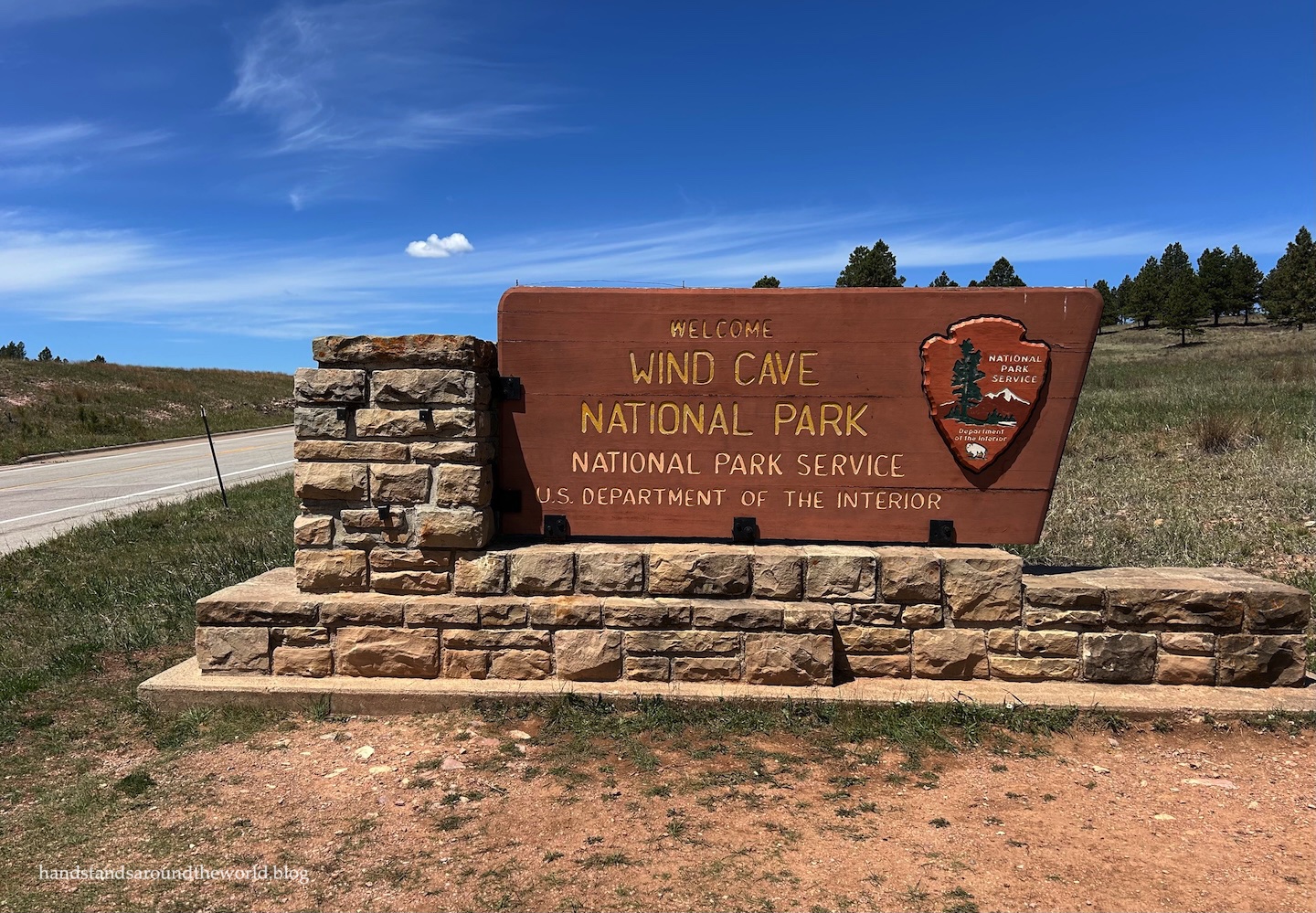
Our tour was scheduled for 1:00pm, which meant an early morning start for us. So we loaded up the car and headed off, arriving at Wind Cave National Park just before noon. This gave us the perfect amount of time to check in for our tour, take a look around the visitor center, and eat some lunch before our ninety minute stint underground.
Shortly before 1:00pm, we headed over to the elevator building, where we met up with our ranger tour guide, who gave us a quick rundown of cave safety and tour expectations and then began shuttling us down to the cave entrance in groups of 8.
To clarify, we would be going in through a manmade entrance. The natural entrance to the cave is very small – barely large enough for a person to squeeze through, actually – and no longer used. However, it is how people entered the cave back when it was first discovered.

Who could have imagined that this little hole in the ground would lead to more than 170 miles (274 km) of passageways?! And those are just the ones that have been mapped so far. Based on studies of airflow in the cave, it’s estimated that only 10% of the passageways have been explored.
And speaking of airflow, the Lakota name for Wind Cave is Maka Oniya, or “breathing earth,” due to the flow of air into or out of the cave, based on the outside air pressure. At times, you can actually feel the wind. Sadly, we didn’t experience this.
Wind Cave is also central to the origin story of the Lakota people. The ranger shared the story with us, which was very interesting. She was an excellent tour guide. Caves are plenty neat on their own, but she really enhanced the experience.
Anyway. After multiple trips up and down the elevator to get our whole tour group to the underground entrance, we stepped through the doors and into the cave.

During our drive to South Dakota, my husband had confessed that the cave tours were the part of the trip he was least excited for because, as he put it, “we’ve seen other caves and I kind of feel like they’re all the same.” Within a few minutes of entering Wind Cave, he realized he was going to have to eat his words.
While most caves do in fact share some similar features, there are also features that make each cave unique. For Wind Cave, this featured is called boxwork. Wind Cave is home to more boxwork than any other cave in the world.

Interestingly, unlike most other cave features, which are formed by water and mineral seepage, the boxwork actually formed before the cave. Geological evidence suggests that the boxwork formed when calcite seeped into cracks in the limestone, which at the time sat beneath an ocean. Later, long after the ocean receded, the Black Hills were uplifted by tectonic activity. Water from precipitation, mixed with carbon dioxide from the atmosphere, began seeping into the ground, its mildly acidic pH enough to gradually dissolve away the limestone but not the calcite and leave behind the fragile spider web-like structures that fill the cave today.


Boxwork is unlike anything I’ve seen in any other cave. Conversely, the things you commonly see in caves – stalactites, stalagmites, etc. – are scarce in Wind Cave. That said, we did see a few other cave features.


Due to its former location beneath an ocean (which makes sense; that’s how limestone forms, after all), Wind Cave is also home to fossils. Our tour route led right past a collection of brachiopod fossils in the ceiling.

(you may need to zoom in)
Truthfully, I think that’s all I have to say about the cave itself. However, two days later, on our way home from the Black Hills, we returned to Wind Cave National Park for an above-ground adventure. While the park is named for the cave, it also encompasses ponderosa pine forest, grassland, prairie dog towns, and bison. Our hike up Rankin Ridge gave us a glimpse of all of these things.
Rankin Ridge Trail is in the northwest corner of the park; reaching it required us to leave the main road and drive the narrow, winding Route 87 through a prairie dog town and past a handful of bison. After a few miles, we turned off onto a side road (there is a sign) and followed it a short distance to our trailhead.


Rankin Ridge rises to an elevation of approximately 5000 feet (1525 m) and is actually the highest point in Wind Cave National Park. Given this status, a lookout tower was built here many years ago. While it’s no longer in use today, nor is it accessible to hikers, a 1 mile (1.6 km) loop trail ascends through a lovely ponderosa forest to the base of the tower, providing semi-panoramic views of the park.


Right: Pudgey at the summit


It felt good to stretch our legs a bit before sitting in the car for the drive home, and this hike was a nice scenic way to wrap up our visit to Wind Cave and the entire Black Hills region.
The Black Hills are such an underrated destination.
Up next: South Dakota highpoint redemption
The Important Stuff:
- Getting there: Wind Cave National Park is located in the southern portion of the Black Hills of South Dakota. Cave tours depart from the visitor center, which is on a paved road and can be reached by any car.
- Fees and passes: entry to the park is free, but entry to the cave requires purchase of a tour ticket. There are various cave tours offered throughout the day year-round, with more options in the summer. Tickets cost approx. $15/person. About 50% of tickets are available online 60 days in advance, while the remaining 50% are available at the visitor center beginning at 8:00am (Mountain Time) the day of the tour. All day-of tickets were sold out when we arrived around 12:00pm, so definitely plan to arrive early to secure one.
- Hiking: while the cave tours vary in difficulty, all involve navigating stairs, uneven ground, and low ceilings at an elevation of roughly 4500 feet (m). Those with mobility and/or breathing difficulty may find these tours difficult, especially the longer one. We took the Fairgrounds Tour, which only covered about 0.5 miles (0.8 km) but involved 450 stairs. After the difficult leg workout I’d done the day before our trip, my legs were very unhappy about this.
- Where to stay: there is one campground in the park, available by reservation in the summer and first-come-first-serve the rest of the year. We didn’t stay here so I can’t provide specific details about it. There are many other campgrounds within 30 minutes of Wind Cave National Park, as well as cabins, hotels, and other accommodation options in the nearby towns of Hot Springs and Custer.
- Other: while navigation through the park is easy, with good signage and paved roads, Wind Cave is home to large herds of bison, which may cross the road (or simply stand in the middle of it) at any time. Be sure to plan adequate time to get stuck in a bison-induced traffic jam and still make it to your cave tour on time (check-in is 30 minutes before your tour begins).


Leave a Reply