Visiting Wyoming’s capital city was not plan A for this particular outing. But when weather thwarted plan A, we found ourselves spending the weekend in Cheyenne.
Prior to our departure, some friends warned us that Cheyenne was lame and to prepare to be disappointed.
Perhaps they enjoy different things when they travel or went in with different expectations than we did. Either way, we found Cheyenne to be a worthwhile place to spend a weekend.
Our time in Cheyenne can mostly be divided into two categories: government and railroads.
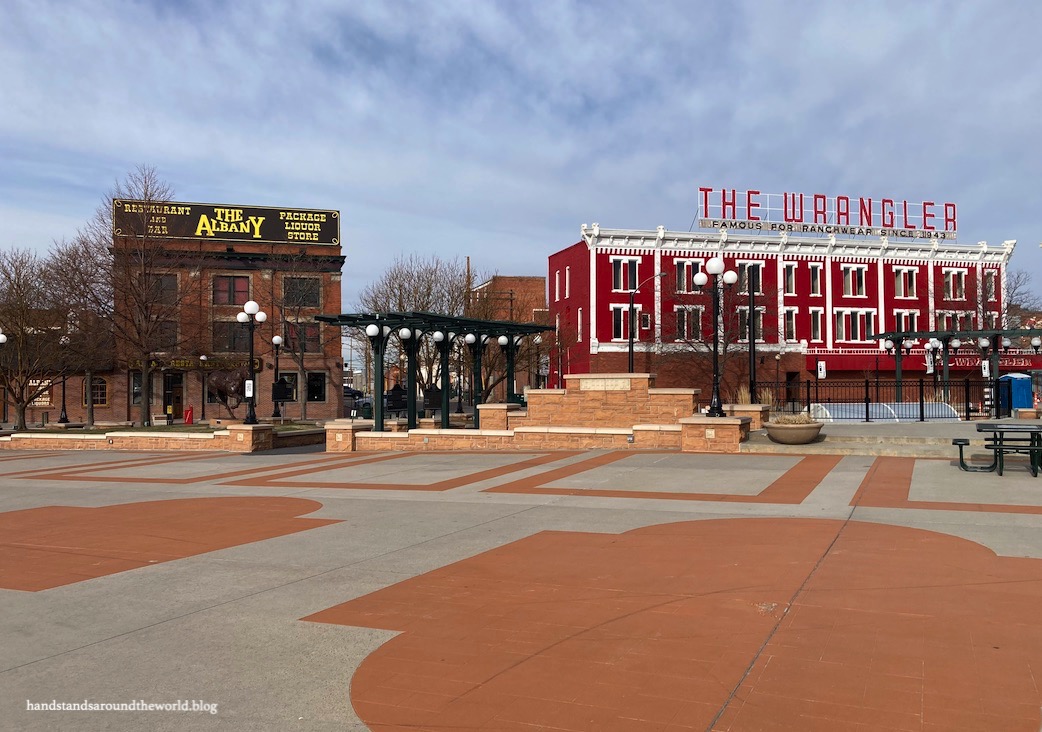
What began in the mid-1800s as a small railroad town quickly ballooned into a large railroad town and later became the home of the territorial – and ultimately state – government. Cheyenne is still a relatively small city, with a population of about 65,000 people and a downtown area that has very much retained its old west vibe (though the road construction detracted from this and made for terrible photos).
In Wyoming, though, it’s the most populous city and therefore the site of many of the state’s attractions. We began our tour of Cheyenne with a visit to the tallest and most visible structure in town: the state capitol.


The Wyoming State Capitol was built in 1888 and expanded in 1890 and again in 1917. Since then, it hadn’t undergone any significant renovations. As a result, not only was the exterior beginning to crumble and deteriorate, but the interior was also drastically out of date and not up to code. Finally, some much-needed money was appropriated and renovations began.
It was a massive project that took four years and involved major remodeling of many areas. Where possible, the original materials were retained. In some places, paint was stripped off to reveal the original designs underneath. In other areas, the original designs were reconstructed as exactly as possible. The result is a lovely, newly-restored Capitol building that we enjoyed touring.
The government was not in session when we visited so the building was nearly empty. With the exception of private offices, we were able to wander around most of it. Some of the highlights are below.


Wyoming was the first state to grant women the right to vote. They even wrote it into their constitution. They were also the first state to elect a female governor, justice of the peace, and superintendent of public instruction.
Because of this, they really lean into the whole equality thing. Wyoming’s nickname is even The Equality State. I find it rather ironic, given that their elected officials have been predominantly male since day one (and for other reasons that I won’t get into since this is a travel blog). I’m in no way minimizing the importance of women’s suffrage or their presence in elected office. I just think that as a state they maybe overplay this hand a little bit.
Anyway.
Next on the itinerary was the historic Governor’s Mansion. It was built in 1904 and used until 1976, during which time it housed 19 first families. More recently, it was renovated and opened for the public. We were able to walk through the house on our own, poking our head into each of the many rooms.
This was not the first restored old house I’ve ever visited, but this one did have some things I hadn’t seen in previous houses including a laundry room and a fallout shelter (which was added during the Cold War).


There are also multiple museums in Cheyenne. We had neither the time nor the desire to visit all of them, so we picked the two that interested us the most.
The first was the Wyoming State Museum, which focused less on Cheyenne and more on the state as a whole. It was larger than we expected and I think we spent at least two hours there. The museum has many diverse collections and exhibits, including native animals, state history, mining (fun fact: 90% of the baking soda used in the US is mined in Wyoming), Native American artifacts, and Wyoming’s national parks and monuments. By about the halfway point I gave up on reading every word; there was just too much information. But I learned a lot about Wyoming.


The other museum we chose was the Depot Museum.
The history of Cheyenne is inexorably intertwined with the railroad. Cheyenne was chosen as the division point for a proposed railroad line between Omaha and Sacramento, the location where the plains meet the foothills but where a feasible path existed through the Laramie Mountains. Thus, a railroad town was born.
As Union Pacific set up its headquarters in Cheyenne, the town flourished. After two original depots were lost to fire, the current depot was built by Union Pacific in 1888. It was intentionally located in view of the Capitol to remind lawmakers of the importance of the railroad to the history and economy of Wyoming.


While there was a lot of information contained within these exhibits – and we learned a lot – some of it wasn’t presented well. The sections that looked like normal museum exhibits were easy to view. The sections that looked like a collection of posters from a middle school history project, with bright colors and varying fonts, were difficult to read and far too dense. For a museum that charges an admission fee, I would expect better.

Located just a mile down the road at Holliday Park is one of the few remaining Union Pacific ‘Big Boy’ steam engines. At 132 feet (40 m) long and weighing 1.2 million lbs (544,300 kg), just 25 of these behemoth engines were ever constructed. Only a handful remain today, so seeing one of them was pretty neat. This particular engine was in operation for 17 years, during which time it traveled roughly 440,000 miles (708,000 km) on the route between Cheyenne and Odgen, Utah.
As impressive as it was, I can see why these steam engines never caught on. They were expensive to build and, honestly, they’re just ridiculously enormous. The wheels are as tall as I am. I have to assume that the size and expense rendered them highly impractical. And once gasoline-powered engines were developed, steam power quickly became obsolete.


The other place we enjoyed was the Cheyenne Botanic Gardens. A multi-story indoor area houses quite a collection of tropical plants and was the highlight, in my opinion. I’m sure the outdoor section would be pretty in spring and summer when the plants are in bloom, but during our visit everything was still pretty dead and brown.


Actually, there was a third theme of our time in Cheyenne as well: beer. Cheyenne isn’t necessarily known for its craft beer scene. In fact, upon learning we were visiting from Colorado, one of the bartenders asked us why we came all the way to Cheyenne for beer.
And yes, the craft beer market in Colorado is thriving. But we visited three breweries in Cheyenne and ordered flights at each one and largely enjoyed all the beers. The horchata stout from Freedom’s Edge Brewing Company was our favorite, and the cornflake-breaded chicken sliders with mango jalapeño salsa from Accomplice Brewing were absolutely delicious!


And of course, no visit to Cheyenne is complete without locating the Big Boots. Twenty five of these giant cowboy boots (they’re taller than me) are scattered throughout the city, each painted to tell a story from Wyoming. We didn’t go out of our way to track them down, but we did stumble across nine of them en route to our other destinations.


Is this completely silly and tacky? Yes.
Did I look like a tourist as I took photos of all of them? Most likely.
Do I care? Nope.
The Important Stuff:
- Things to see:
- Wyoming State Capitol: free, open Mon-Fri 8:00am-5:00pm
- Wyoming Historic Governor’s Mansion: free, hours vary throughout the year (schedule)
- Wyoming State Museum: free, open Mon-Sat 9:00am-4:30pm
- Cheyenne Depot Museum: $8/person, hours vary (schedule)
- Botanic Gardens: free, hours vary (schedule)
- Cheyenne Big Boots brochure
- Getting around: Cheyenne is a small city. You can easily park in one place and walk to many of these locations. Most are just a couple minutes apart by car. I don’t think it ever took us more than 15 minutes to get anywhere..
- Parking: There is free parking at the state museum, from which you can easily walk to the capitol and mansion. Parking in the downtown area (near the depot) is free for 2 hours. The botanic gardens have free parking onsite.
- Where to stay: we stayed at the Best Western which was just off the interstate and only a few minutes from the downtown area. We found it a suitable place to stay. The highlight was the continental breakfast. The downside was some highway noise.


Leave a Reply