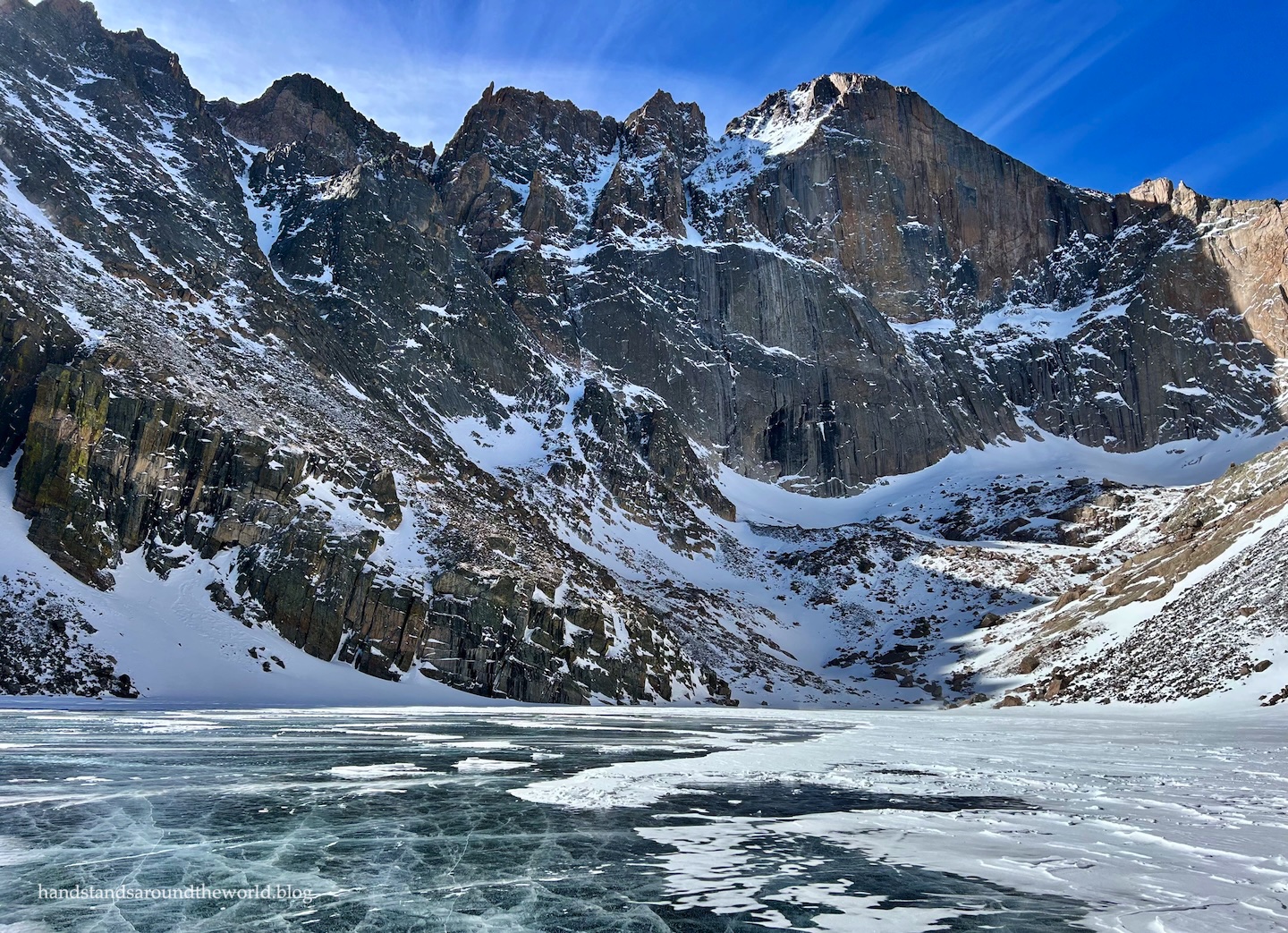
I’ve wanted to see Chasm Lake in the winter pretty much since the moment I first laid eyes on it.
That was in the summer, nearly eight years ago. Since then, I’ve made two summertime return trips. But I’d never made it there in the winter, mostly due to the fact that one section of trail travels across a slope with potentially high avalanche risk. Since we don’t own avalanche gear and have minimal avalanche training, we’ve never felt safe tackling it.
But the one upside to the utter lack of snow in Colorado this past winter is that avalanche danger has been lower.
I was still hesitant, and we were waffling back and forth up until about an hour before bedtime the night prior. Yes, avalanche danger was low on this particular weekend, and the week-old photos of the trail that I could find online showed a startling lack of snow. I was pretty sure we’d be fine.
But it had snowed since those photos were taken, and no one had posted any updated photos or trip reports, so we didn’t know for sure what we were getting into, and that made me nervous.
I’m so glad I didn’t let my anxiety get the better of me, though, because we would have missed out on an absolutely amazing day in the mountains. I’m not even a little bit sorry for the number of photos I’m about to share. When you see them, I think you’ll understand why.
The trail to Chasm Lake begins at the Longs Peak parking area. In the summer, parking fills before dawn. In the winter, when almost no one is climbing Longs Peak, it never fills. We arrived just before 8:00am to find only 5 other vehicles in the lot.
The weather was sunny and calm, and the trail appeared snow-covered but packed down. Nonetheless, we brought along extra layers, donned our microspikes, and strapped our snowshoes to our packs. This is an 8.4 mile (13.5 km) hike with 2800 feet (855 m) of elevation gain – plenty challenging in summer conditions. We absolutely did not want to be caught unprepared in winter.
The first 2.5 miles (4 km) is a steady ascent through the trees, gaining nearly 1600 feet (490 m) in the climb to tree line. Being my 4th time hiking this trail, you’d think I would’ve remembered how relentlessly up this section is. I did not.

As we reached treeline, around 10,800 feet (3290 m), we were greeted with expansive views and a surprising lack of wind. With the wide open landscape, wind was one of the main forecast details we’d considered when making our decision. There’s no shelter from here to the lake. A windy day up here would be absolute misery.


From here, we continued 0.8 miles (1.2 km) and another 600 feet (180 m) to Chasm Junction, alternating between packed snow and dry ground. It looked more like October than February, which was frightening. Barring massive amounts of moisture in the next couple months, it’s going to be an awful summer.


From Chasm Junction, the trail continues to the left, dipping down and curving around toward the lake. This is the part of the route we were most concerned about. From a distance, though, it looked okay.
For the most part, it was. There was one section with a bit of a dropoff (and we’d opted to leave our hiking poles in the car since we were already carrying snowshoes – we definitely should have brought them), but everything else was fine through the first stretch.


(visible here, just left of center and partially in the shade)

Then came the sketchiest part: the snowfield. This is the part that, in a typical winter, presents the biggest avalanche risk. Today, it was totally fine. The snow was only about a foot (30 cm) deep and stable. The first hiker of the day had kicked in footsteps as he made his way across, and the groups in front of us had done the same, so we had a solid path. I do wish the people breaking trail had worn snowshoes and created a wider, flatter path, but that ship had sailed.


Safely across the slope, we crossed Chasm Meadow, in search of my favorite sign in Rocky.


When a trail sign points straight up, you know you’re in for an adventure. So up we went, kicking our boots into the snow for the initial ascent and then doing a bit of scrambling near the top.
And finally, after 3 hours of hiking through the snow, a frozen Chasm Lake came into view. It was everything I’d hoped it would be. The sheer cliff face of Longs Peak – called The Diamond – loomed above the turquoise ice. It’s such a majestic mountain, and I will never stop being in awe of it.


And then there was the ice.
We stepped out onto the lake and immediately found ourselves fascinated by the patterns on the frozen surface. We couldn’t stop taking photos. I will never understand how water freezes this way, but it’s incredible!


Unfortunately, the near calm we’d enjoyed for most of our hike was rapidly disappearing. At first, it was just the occasional gust of wind whipping down the mountain and across the lake. But soon, it became steadier and stronger. One gust blew me completely off balance.


Right: one last glimpse
So we waved goodbye and made our way back over the rocks, sledded our way down the hill (I wish we’d gotten a video, it was a lot of fun!), and crossed Chasm Meadow.
Unfortunately, the wind meant the sketchy slope was now covered in a thin – and very slippery – layer of blown snow. This crossing was much worse the second time around, and I was really regretting not bringing hiking poles. Lesson learned.

But we made it, climbed back up to the junction, and then made our way back through the tundra as quickly as possible. The wind was still whipping across the landscape, flinging blowing snow at us. Even with it at our backs, it was not exactly pleasant.

The trees brought shelter, but also a reminder that 2.5 miles (4 km) of snow still lay between us and our car. I always forget how much more tiring it is to walk on snow as compared to flat ground. Our legs were very tired. As I’m writing this the next day, my legs are very sore.
But despite it all, this is a trail I will willingly hike over and over again – summer or winter – without complaint (okay, so maybe I’ll complain a little when I’m trudging up the endless hills with the wind in my face). The scenery is absolutely unparalleled.
There’s a reason this is my favorite summer hike in Rocky. It’s now my favorite winter hike in Rocky as well!
The Important Stuff:
- Getting there: Chasm Lake is reached from the Longs Peak Trailhead at the end of Longs Peak Road off CO Highway 7. In the winter, a pre-dawn arrival is not necessary.
- Fees and passes: there is a $30/car daily or $35/car weekly entrance fee to RMNP; America the Beautiful passes are accepted. Since there is no entrance station, you’ll need to display your pass on your dashboard. No timed entry permit is needed in the winter.
- Hiking: 8.4 miles (13.5 km) round-trip with 2800 feet (855 m) of elevation gain; this is a strenuous hike, especially in the winter.
- Camping: note that Longs Peak Campground, located adjacent to this trailhead, is closed in the winter.
- Other: the second half of this hike is entirely above treeline; there is no protection from wind, sun, blowing snow, etc. And, as mentioned above, the stretch of trail between Chasm Junction and Chasm Meadow is prone to avalanches. I would only recommend this hike when avalanche danger is low. CAIC releases daily avalanche risk forecasts here.
- For more information on visiting Rocky Mountain National Park, click here


Leave a Reply