Fall in Colorado has become a nightmare.
From mid-September through early October, the Colorado mountains are painted with large swathes of yellow, interspersed with the occasional bursts of red and orange, as our many aspen groves and a handful of other trees and bushes begin to change color. It’s no New England autumn, but it’s beautiful in its own way.
Unfortunately, I’m not the only person who feels this way. And so, for a few weeks at the end of September, thousands of Coloradans – and tourists too, I’m sure – flock to the mountains on weekends to see the leaves. It’s gotten so bad that hour-long traffic delays are not uncommon, and trying to find parking anywhere after about 9:00am is damn near impossible.
I’m at the point of not wanting to venture out on weekends anymore, and I told myself I was okay with just not really experiencing the fall colors this year.
But then autumn rolled around, and the perfect combination of weather in August and September led to one of the most spectacular displays Colorado has had in years, and FOMO got the best of me.
I still wasn’t going to venture out on a weekend, though, so we took advantage of the fact that we both have Fridays off (I mean, technically I should have been working from home…) to squeeze in a fall colors hike. We also opted for a relatively unknown trail in an attempt to escape the crowds.
We were absolutely successful on that front, encountering only two other people on our hike.
But let’s rewind a bit and talk about how to get to the Geneva Creek iron fens. The trailhead is off the southern half of Guanella Pass near Georgetown, Colorado. The pass itself is one of the most popular spots to see the aspens, but few people venture off the paved scenic byway.
We did, turning onto Forest Service Road 119, which almost immediately turns to dirt and becomes rough and rocky. Our Subaru did great, but anything with less than 6-8 inches (15-20 cm) of clearance probably wouldn’t make it.


About 3 miles (4.8 km) down this road is the Shelf Lake Trailhead (which, by the way, is also a good autumn hike). This is where we parked, though with a 4WD high-clearance vehicle you can continue beyond this point.
From Shelf Lake Trailhead, we continued up the road on foot. It’s not the most exciting walk since it’s just a road, but there were some lovely sections of vibrant yellow aspens shimmering in the sunlight.


There was also one slightly tricky creek crossing, but the logs were grippy enough that, coupled with our hiking poles, we didn’t have any issues.


About 2 miles (3.2 km) above Shelf Lake Trailhead, we reached a fork. For the iron fens, stay left. The road is gated here, so if you’re still driving you’ll need to park and walk the rest of the way. From the junction it’s just over 1 mile (1.6 km) to the fens.


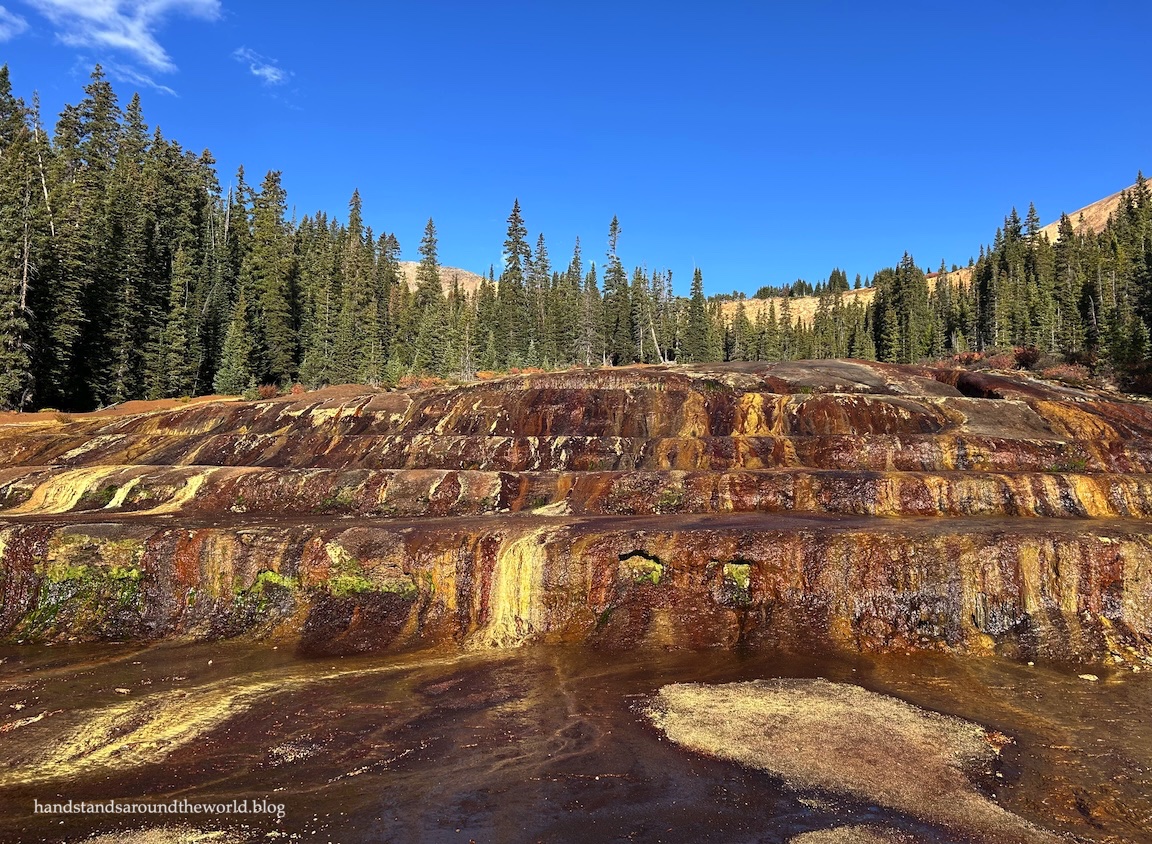
I knew, from looking at photos in advance, roughly what to expect here. But I had no idea the fens were so large!


(the fact that my outfit matches the fens was unintentional)
A fen is typically described as a wetland environment fed by groundwater rich in minerals. The minerals often accumulate with other organic matter to form the fragile structure of the fen. Fens are found in many locations around the world, and we previously hiked to one here in Colorado.
Iron fens, however, are much more unique, and develop due to high levels of iron in the water, which precipitates out to form the terraced structure seen here. Iron fens are also extremely fragile, thus we were careful to step only on the dirt and gravel, and not in the water or on the terraces.


We weren’t sure it was safe to taste the water, but it smelled very metallic. It was also weird for my brain that the water was cold; having visited Yellowstone many times, I associate colorful terraces with boiling hot water.
We plopped down on top of the hill at the base of the fen to eat a snack while admiring the fen and the fall colors, which were almost glowing in the sunlight.

After about half an hour, it was time to head back to the car. It was an easy walk along the road once more, the route entirely downhill, albeit a bit rocky. We were back to the car by 10:30am or so, at which point we bumped and bounced our way back to Guanella Pass Scenic Byway. Back on the pavement, we headed up and over and down the other side, taking the slightly longer (but less trafficky) route home.


And as an added bonus, this route took us right past Beau Jo’s, our favorite Colorado pizza restaurant, where we stopped for a post-hike lunch.
All in all, a successful and non-crowded fall colors outing!
Up next: Snapshots from the sky – Colorado to Montana
The Important Stuff:
- Getting there: Shelf Lake Trailhead is located about 3 miles (4.8 km) up FS Road 119 off Guanella Pass. High-clearance needed. The road is rougher beyond this point, but with the appropriate vehicle it is possible to drive all the way up to the gate, which is approximately another 2 miles (3.2 km) beyond this point. The fens are a protected natural area, so no vehicles are allowed beyond this point.
- Fees and passes: none.
- Hiking: the length and elevation gain of this hike will depend on where you park. If you can drive all the way to the gate, it will be just over 2 miles (3.2 km) round trip with only 500 feet (150 m) of elevation gain. From Shelf Lake Trailhead, it was 6.4 miles (10.3 km) with 1265 feet (385 m) of elevation gain.
- Where to stay: this can easily be done as a day hike from the Front Range. There are a few established campgrounds along Guanella Pass Scenic Byway, including one right at the turnoff to the trailhead (though the gate was closed when we went at the end of September). There are also a bunch of labeled dispersed campsites along FS 119; beware that any type of camping in this area must be in a marked site. Creating your own campsite is not allowed.
- Other: as mentioned above, the fens are very delicate; please don’t step on them, and if you hike with your dog please be sure to keep them off the fens as well.


Leave a Reply to kagould17Cancel reply