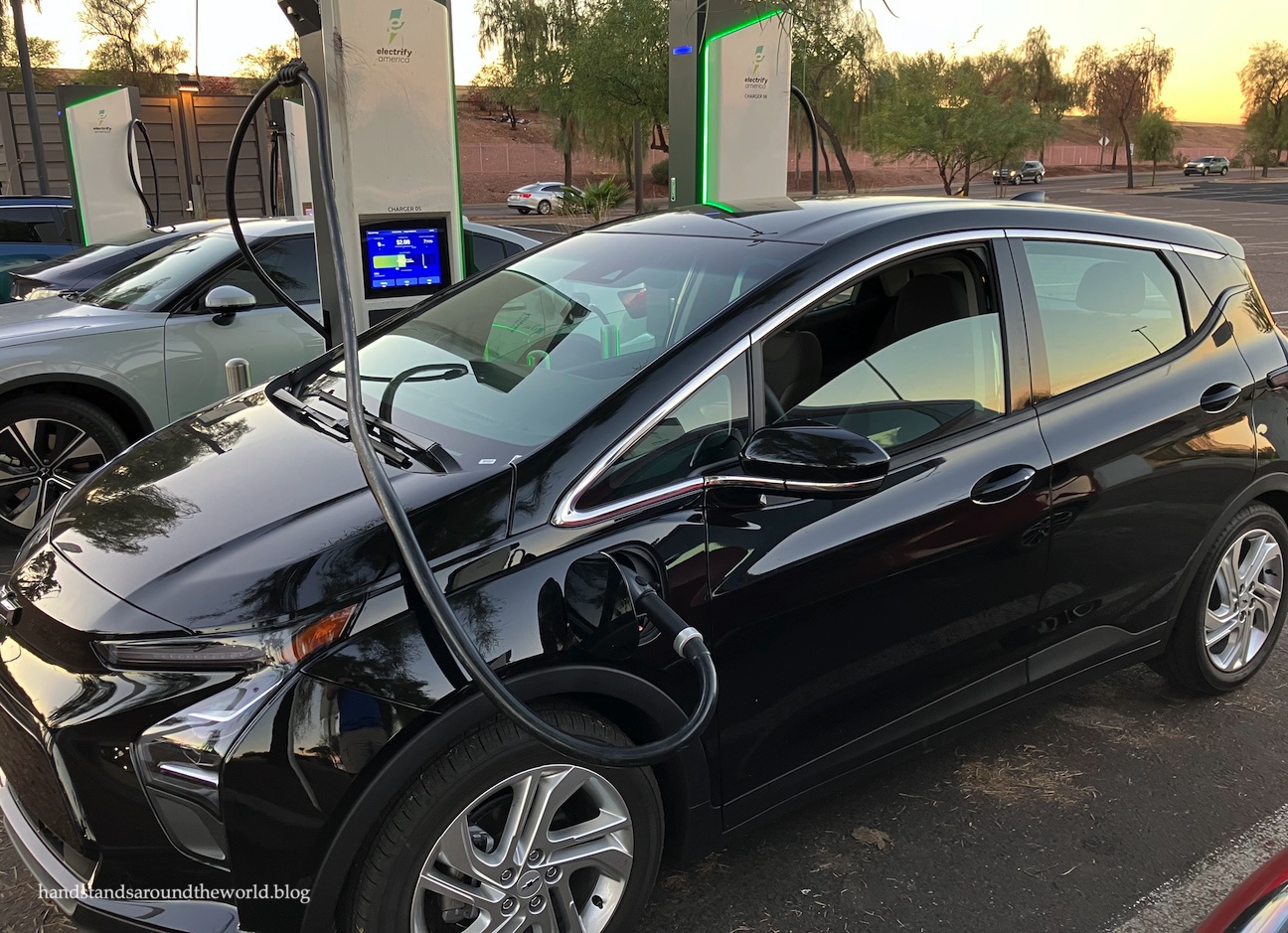
When I pulled up rental car listings while planning our trip to Phoenix, I was surprised to see that the least expensive options were electric cars. When I mentioned this to my husband – who is very excited to own an electric car someday – he immediately suggested we give it a try.
While I was also somewhat interested, I was concerned that our entire vacation would then revolve around battery ranges and charging stations. So I tasked him with researching the charging infrastructure in and around Phoenix. Finding it to be satisfactory – or so it appeared, but more on that in a minute – we booked a hotel next to a mall with multiple charging stations and then reserved the car.

In the aftermath, I have a lot of feelings – both positive and negative – about the experience. But overall, I’m glad we gave it a try. This was an ideal trip for it, given that our home base for the entire time was a large metropolitan area and we never had to drive more than 100 miles (160 km) per day. It was a great way to learn about electric cars without committing to leasing or buying one, and to get some actual experience and insight into the pros and cons of the vehicles themselves as well as the infrastructure to support them.
I took a lot of notes throughout the trip, tracking everything from the cost of charging to the accuracy of the range estimates to battery usage at different speeds. So whether you’re interested in renting an electric car, or even buying one someday, I hope what I’ve learned can help you out.
Driving the car
I actually didn’t do any of the driving, so this is based on my husband’s experiences as the driver and my observations as a passenger.
(By the way, the car was a Chevy Bolt, which is a budget electric vehicle with a battery range of about 250 miles/400 km per charge.)
The first thing to know is that electric cars have the option to use regenerative breaking – that is, capturing the momentum of the vehicle during deceleration and using it to recharge the battery. One piece of this that took some getting used to is that taking your foot off the gas is equivalent to stepping on the brake. Rather than slowing down slightly, an electric car will decelerate quickly. It was a bit of a jerky ride at first while my husband worked to get the hang of it. With no engine noise or vibration, though, once he mastered the accelerator it was a very smooth ride.
Another benefit of regenerative braking is battery life. With all the stop and go movement in city traffic, electric vehicles actually have a better battery range in city driving than on the highway – the opposite of non-electric cars. During the first three days of our trip, we drove a total of 100 miles (160 km) and used just 25% of the battery.
On the other hand, traveling at high speeds and going uphill use the battery more quickly and will reduce your range between charges. For comparison’s sake, the following day we drove 90 miles (145 km) mostly at highway speeds and this used about 35% of the battery.
Charging the car
Knowing we would be driving nearly 100 miles (160 km) the following day, we charged the car that night at an Electrify America charging station, which is powered by renewable energy. The battery was sitting around 40%. After 50 minutes of charging, it was up to 80%.
The cost for this charge was $12.95. For the sake of comparison, I did some quick math. We’d driven 185 miles (300 km) which, for my own personal car, equates to about 6 gallons of gas. At current prices, that would have been about $18; per mile, then, electricity was cheaper.


By far, the biggest downside to the Chevy Bolt was the charging speed. While many high-end electric cars could have achieved this level of charge in 15 minutes or less, the Bolt is not capable of that. The maximum capacity of the charging station was 350 kW. The maximum capacity for the Bolt was 44kW, though my husband said the actual speed fluctuated throughout the charging session.
Battery life
The following day, we set off on the interstate again for our 70-mile (113 km) roundtrip drive. The previous day, on the same stretch of road, my husband had set cruise control at 70 mph (113 kmh). Today, he set it at 65 mph (105 kmh) so we could compare. We did in fact use less battery at the slower speed, and it seems even slightly lower would have resulted in improved efficiency.
We also compared the gradual but steady uphill drive to the downhill return trip, and the difference was surprising. Driving 35 miles (56 km) uphill depleted 40 miles (64 km) of range, according to the battery screen on the dash. Driving 35 miles (56 km) downhill used only 26 miles (42 km) of range. It all averages out in the end, but if you were planning a mostly uphill trip, you wouldn’t be able to go nearly as far between charges.

Out of curiosity, my husband also at one point tried flooring it just to test the car’s acceleration capability. It was surprisingly good, but we also promptly lost 2 miles (3 km) of range while traveling about 200 feet (60 m). Gentle driving at city speeds is clearly the sweet spot, at least for the Chevy Bolt.
For me, I think the biggest thing to get used to with an electric car would just be managing the battery charge. In many ways, I suppose it’s similar to keeping an eye on the gas gauge. The two main differences are that charging stations are fewer and farther between than gas stations, and that every fluctuation in range is shown on the dashboard – which I found to be very stressful when we were driving uphill and the numbers started dropping more quickly.
(To be fair, I have a lot of car-related anxiety in general thanks to being stranded on the side of the highway by broken-down cars multiple times in the last few years. My car never gives me any warning that it’s about to break down. It just… does. I hate it. But I digress.)
Charging the car, round two
All in all, it was a pretty positive experience.
Until the very last day.
Just as you would return a rental car with a full tank of gas, we had to return the car with at least 80% battery. We didn’t have to be to the airport until 8:00pm, so at around 5:00pm we headed in that general direction. I had discovered during the trip that Apple Maps shows charging stations, and there was another Electrify America one not far from the airport. Our plan was to eat dinner while the car was charging and then drop it off with plenty of time to spare.
It did not go according to plan.
As it turns out, Apple Maps shows all charging stations, not just publicly accessible ones, and it doesn’t differentiate between them. We ended up outside a gated parking garage, and then got called out by a security guard for trespassing when we pulled into a space in the parking lot outside the garage to search for a different charger.

(We’ve since learned that there are apps to help locate public charging stations)
When the next three attempts all turned out to also be inaccessible, we gave up and drove back to the one near our hotel, even though it was in the opposite direction. Upon arrival, we found ourselves the fourth car in line. Apparently, it was a busy place this evening. Luckily, we’d given ourselves plenty of time.
Or so we thought.
After a 15-minute wait, we pulled into a charging space and plugged in the car. The battery was sitting at about 25%. Estimated time to 80%: 6 hours, the screen read.
We looked at each other in confusion. What? How can it take 45 mins to charge from 40-80% and 6 hours to charge from 25-80%?
As we were about to learn the hard way, the availability of electricity is also a factor in charging speed. A major factor, in this case. Our best guess is that the difference stemmed from the time of day; previously, we charged the car when the sun was up. This time, it was dark. And Arizona gets a lot of its electricity from solar power.
When the charge hadn’t increased by even 1% after 10 minutes, we gave up. We only had about an hour before we had to drop off the car and there were no other charging stations nearby, so we ended up returning it as is and paying the $30-something fee. I was actually expecting the fee to be higher, but it still would have been cheaper to charge it ourselves.
Takeaways
In the end, we came away from this experience with pretty similar feelings: we were glad to have the chance to try it out, but we’re not ready to buy an electric car just yet. Setting aside the fact that neither of us needs a new car, the technology is still advancing rapidly and the infrastructure isn’t fully there.

Electric cars can actually be plugged into a regular outlet at home. They charge extremely slowly this way, but it can be done. If, for example, you commuted 40-50 miles (65-80 km) per day and then came home and plugged your car in overnight, by morning the battery would probably be mostly recharged. As a commuter car, it could work. The batteries do struggle some in colder weather, though, so it might be a little more challenging to maintain that level of charge in the winter.
And I would certainly not plan to take a roadtrip in an electric car. There simply aren’t enough charging stations and the charging – at least, for the car we had – was far too slow to be realistic. Stopping every 200-250 miles (320-400 km) for an hour would be a very slow and annoying way for us to travel.
So for now, we’ll keep our non-electric cars.
But I would consider renting an electric car again in the future, if we would be spending our trip in an urban area with plenty of public charging stations.
And I hope that eventually the technology and infrastructure improves to a point that roadtripping in an electric car would be a realistic option.


Leave a Reply to LookoomCancel reply