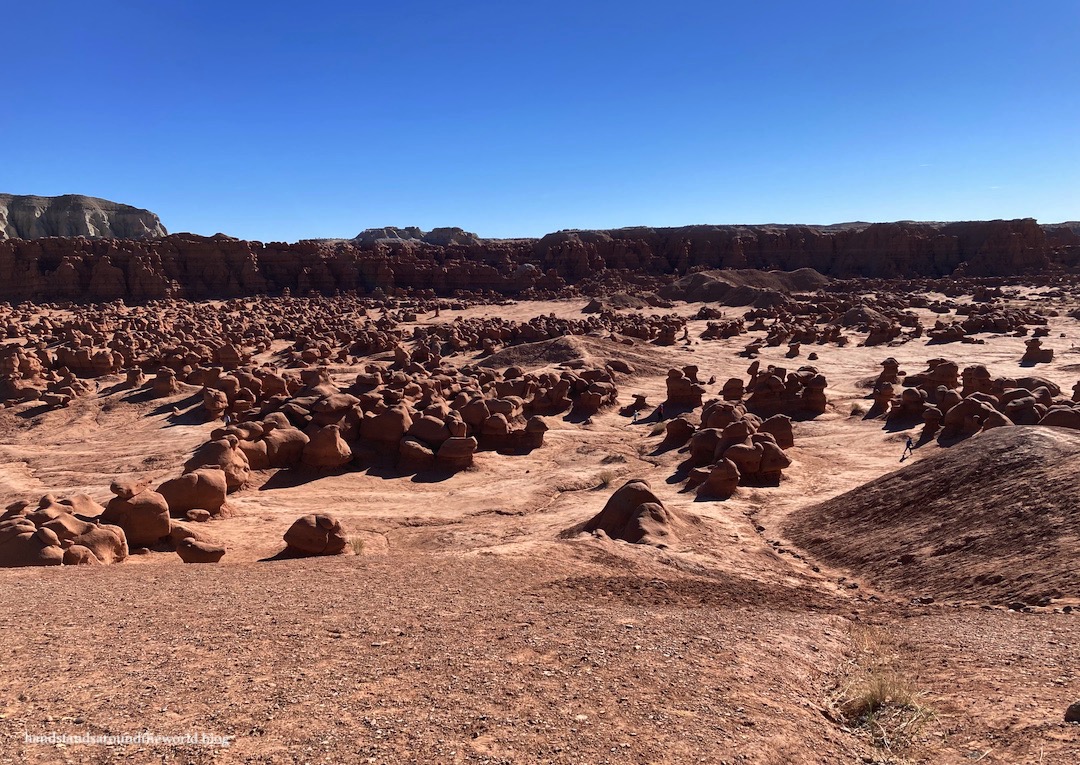
We pulled into the mostly empty parking lot around 8:30am and stepped out into the chilly November air to take in the view.
On the way to the overlook, we stopped to read a sign. “Like nowhere else,” it read.
I looked up at the bizarre landscape in front of me.
Back down at the sign.
Back up.
It’s an accurate statement.
One hundred and seventy million years ago, what is now Goblin Valley was a tidal flat along the shore of an inland sea. Alternating layers of sand, silt, and mud were deposited here by the ebb and flow of the water; geologists now call this the Entrada Formation.
Since then, wind and water have eroded away the softer layers of the Entrada Formation while the slightly harder sandstone remains more fully intact. A process called spheroidal weathering then smooths out any sharp edges of the sandstone, forming the rounded hoodoos – also known as goblins – of Goblin Valley.
I’d been wanting to visit Goblin Valley for years and I’d seen many photos of it, so I knew what to expect. But we’d also just spent time amongst the hoodoos of Bryce Canyon, and a small part of me was afraid Goblin Valley wouldn’t live up to my expectations.
I needn’t have worried.
The two parks actually have very little in common.
For one, the hoodoos at Goblin Valley are uniformly colored, unlike the many colors visible at Bryce. Many of them stand alone, unlike the parallel rows of hoodoos at Bryce. The goblins are also much shorter and fatter than the hoodoos at Bryce; some of them do in fact resemble wrinkly little creatures.
But perhaps the largest difference between the two parks is that at Goblin Valley we weren’t required to stay on the trail. In fact, there is no trail. From the parking area, you simply walk down into the Valley of Goblins and then go wherever you want. You can walk around the hoodoos or you can walk between them. You can even climb on them.
So we grabbed our gear and headed down the stairs into the valley, walking in a fairly straight line heading east. The Valley of Goblins is actually three sequential valleys, but they’re all connected. I’m fairly certain we walked through Valley One and ended up in Valley Two, but I’m not entirely sure. The good news is you’re almost always in view of the parking lot so it’s difficult to get lost.


We had a lot of fun pointing out shapes in the hoodoos as well. Does anyone else see the old man face in the center hoodoo in left photo below? Or how about a chimpanzee head in the photo on the right?


Our plan was to spend the entire morning at Goblin Valley, and I assumed all of that time would be spent exploring the valley. But after about an hour, the novelty of climbing around the hoodoos had worn off and we headed back toward the car.
We weren’t done, though. Although there aren’t any trails into the hoodoos, there are a couple trails elsewhere in the park. By far the most intriguing was the Goblin’s Lair Trail… so off we went.
The hike begins on the northern rim of the Valley of Goblins on Carmel Canyon Trail. Fairly soon, it connects to Goblin’s Lair Trail which descends and curves around behind the valley. The round-trip distance is 3.4 miles (5.5 km) with about 600 feet (180 m) of elevation gain; it doesn’t sound like a terribly difficult hike. It’s very sandy, though, which makes it more challenging. The park is also at about 5000 feet (1500 m) of elevation and there is no shade along the trail.


After a sandy but pretty walk along the back side of the valley wall, we reached a sign pointing up at the rocks… so up we went. As we approached the rock wall we couldn’t see anything resembling a lair, and I was beginning to wonder if this hike was going to be a giant bummer. But as we scrambled up and over a haphazard pile of boulders, we suddenly found ourselves gazing down into a fairly sizeable sandstone cavern.


A little further along the trail is a second slightly smaller cave called Goblette’s Lair. (Apparently a goblette is a female goblin.)


Reaching both caves requires climbing steep sandy hills followed by some scrambling. Entry into the caves requires additional scrambling. We didn’t find it to be overly difficult, although I did have to drop my backpack at the top and climb down into the caves without it. Young children and those wary of heights or exposure may struggle with this part of the hike.
The Goblin’s Lair Trail can be hiked as an out-and-back or as a lollipop loop. Upon returning to the Carmel Canyon Trail, we took the other half of the loop back to the trailhead. I would recommend the loop, as this half of the trail actually goes through Carmel Canyon. In places it almost felt as though we were hiking through a slot canyon… which was an excellent prelude to our next destination and the final stop on our Utah road trip: Little Wild Horse Canyon.


I’ll wrap up our Utah adventures next week with a post devoted to Little Wild Horse Canyon… but for now, here are a few more photos from the bizarre landscape that is the Valley of Goblins.


The Important Stuff:
- Getting there: Goblin Valley State Park is located about 30 mins west of Highway 24 between Hanksville and Green River, Utah. Follow the signs, it’s well marked. All roads are paved and accessible by any car.
- Fees and passes: $20/car for a 2 day pass, or free with a Utah State Parks pass.
- Hiking: To explore the Valley of Goblins just wander around at your leisure, there is no trail and the parking lot is almost always visible so it’s hard to get lost. For actual hikes on trails, there are a couple options in the park. Here is a trail guide.
- Where to stay: There is a small campground at Goblin Valley that costs $35/night; reservations are highly recommended. There are also various dispersed camping options on the surrounding public lands. For hotels, the nearest towns are Torrey, Hanksville, or Green River, although none of them are super close. We stopped here en route from Torrey to Green River.
- Other: Although you’re allowed to climb on the hoodoos, please do so with care. Every footstep causes a little bit of erosion, which accelerates the destruction of the hoodoos. Also, sandstone is fairly soft and pieces may break off beneath your feet at any time.


Leave a Reply to tanjabrittonwriterCancel reply