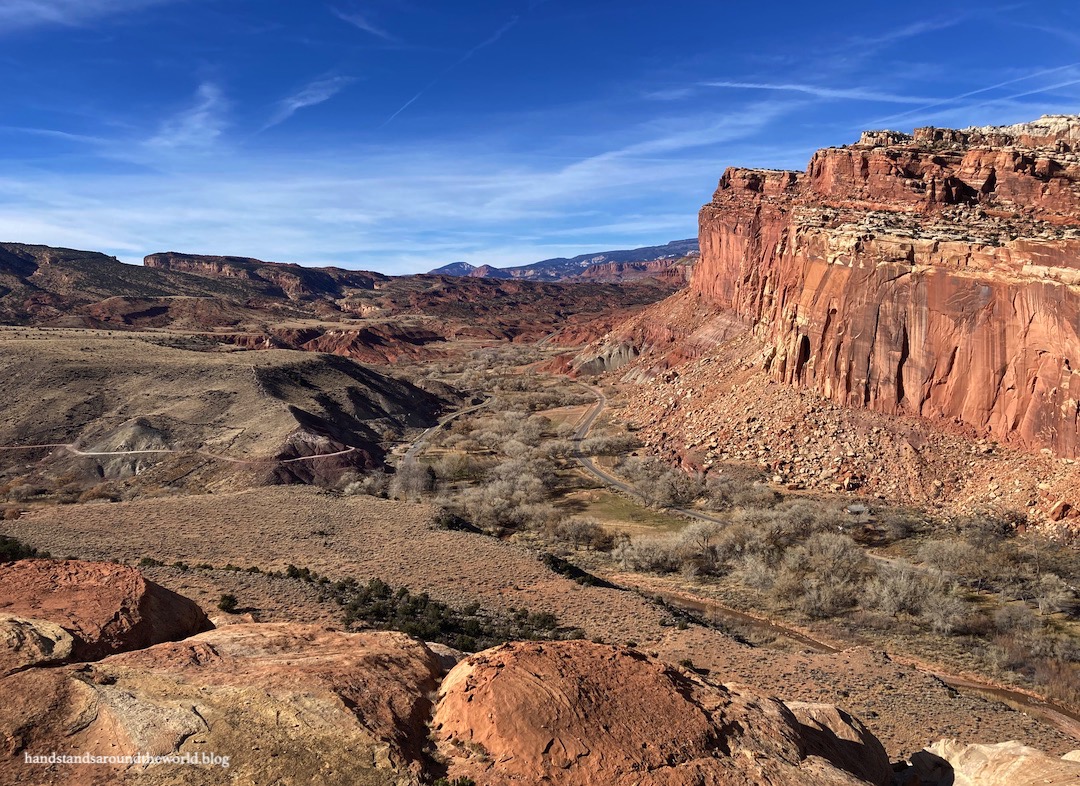
Capitol Reef National Park is the least visited and most underrated of Utah’s “mighty five.” And I sort of understand why. It’s not as archey as Arches or as canyoney as Canyonlands. It doesn’t have Bryce’s hoodoos or Zion’s Angel’s Landing.
But you know what? Capitol Reef is a really cool place that is absolutely worth a visit. You may even stumble upon some arches and canyons while you’re there. We did!
Capitol Reef is the second largest of Utah’s national parks. We spent 2.5 days here and that was enough time for us to hike most of the trails in the central (Fruita) district of the park, but we didn’t even touch the northern (Cathedral Valley) or southern (Waterpocket Fold) districts.
It’s a long skinny park that’s mostly accessible via unpaved and often 4WD-only roads. The northern and southern districts especially are very primitive. One day, I’d like to venture down those back roads and see parts of the park that most people never lay eyes on. But for this trip, we remained in the developed Fruita district.
The town of Fruita was founded in the 1880s by Mormon pioneers who were traveling west in search of religious freedom. Here at the confluence of the Fremont River and Sulphur Creek, they settled at the base of the towering red cliffs of Capitol Reef… so named because, from a distance, this 100-mile (160 km) long wrinkle in the earth’s crust looks like an impenetrable barrier (AKA reef) topped with white sandstone mounds that resemble the dome of the US capitol building.

Prior to the arrival of the settlers, Capitol Reef was the home of the Hopi, Zuni, and Paiute tribes. Visible evidence of their habitation remains today in the form of petroglyphs that range in age from 700-1700 years old. These petroglyphs can be seen throughout the park, including from a viewpoint right off Highway 24. There are spotting scopes at the viewing platform, but we opted to bring our own binoculars.

From here, there’s also a boardwalk along the river that leads to additional petroglyphs. These petroglyphs are unmarked so you have to search for them as you walk. Unfortunately the sun was casting long shadows on the cliff faces; this made it very difficult for us to spot the petroglyphs. Even so, I enjoyed the short stroll.


Parts of the town of Fruita remain as well and are preserved within the park. This includes the old one-room schoolhouse that was built in 1896 and also served as a church, meeting hall, and gathering place for other social events. Here, we listened to a recording from a former schoolteacher in Fruita. It was very interesting to hear a first-hand account of the difficulties of life in Fruita, as well as the challenges and loneliness that came with being the only teacher in such a remote location. Most didn’t stay long before moving on in search of civilization.


We also poked our head into the old blacksmith’s shop. In addition, a barn, a farmhouse, and an old cabin still stand. The barn houses the park horses and the farmhouse has been turned into a small museum and shop.


Perhaps the most obvious remnant of Fruita is the orchards. One probably doesn’t usually think of ‘Utah desert’ and ‘orchard’ in the same sentence, but thanks to the mild climate and the river – and an irrigation system the settlers built – trees actually grow quite well here. The settlers planted apple, peach, pear, apricot, plum, cherry, walnut, and almond trees.
Today, the National Park Service still maintains about 2000 of these trees using the same traditional techniques used by the settlers. In the summer you can actually pick the fruit, but since it was November all we could do was walk around while trying not to step in deer poop.


Across the street from the barn and horse pasture is the Cohab Canyon trailhead. The trail climbs steeply up the hillside, providing excellent views of Fruita and the red rock cliffs before turning 90° and entering Cohab Canyon. This relatively shallow canyon is an excellent place for some close-up views of the bizarre geology of Capitol Reef. While the climb up to the canyon is challenging, the walk through the canyon itself is fairly flat.


After walking through Cohab Canyon, the landscape opens up and the trail forks, leading to the edge of the cliff and two viewpoints. We opted for the south overlook, and the views were excellent!


We also hiked up to the top of the cliffs north of Fruita on the Navajo Knobs Trail. From the parking area off Highway 24, we climbed first to a natural arch called Hickman Bridge and then continued to Rim Overlook. This was a steep hike, climbing over 1000 vertical feet (305 m) in just over 1 mile (1.6 km). It was worth it, though, for the expansive views.


I suppose that’s where I’ll leave off for now. More hikes and scenery in Capitol Reef to come next week…
The Important Stuff:
- Getting there: The main entrance to Capitol Reef National Park is in Fruita, located on Highway 24 between the towns of Torrey and Hanksville.
- Fees and passes: $20/car for a 7-day pass to enter the Fruita district. America the Beautiful passes are accepted. No fee is required to drive Highway 24 across the park.
- Hiking: There are hundreds of miles of trails in Capitol Reef. We managed to hike most of the trails in the Fruita district and enjoyed each one. Cohab Canyon was probably my favorite. A Fruita hiking guide with trail information can be found here.
- Where to stay: There is one developed campground in Fruita (reservations are recommended in the summer but not available in the off-season). Hotels and other lodging is available 11 miles (17 km) west in the town of Torrey. We stayed at the Noor Hotel… which was okay but I probably wouldn’t stay there again.
- Safety: Never ever enter into the canyons or washes in a vehicle or on foot if there is any chance of rain in the vicinity of the park; flash floods are sudden, dangerous, and can be fatal.
- Other: Capitol Reef is relatively remote and less developed than most national parks. Although amenities are available a few miles away in Torrey, within the park there is no gas or food, only a few bathrooms and water spigots, and limited phone service. Be sure to plan ahead and bring everything you’ll need for the day, including sun and rain gear year round and warm clothes in the off-season.


Leave a Reply to ThebeerchaserCancel reply