Thank you to Ken Burns’ The National Parks: America’s Best Idea documentary series for this gem of a quote. If you haven’t watched this series, I highly recommend it. We really enjoyed it!
The quote is attributed to Ebenezer Bryce, a Mormon pioneer who homesteaded near Bryce Canyon in the 1860s and began taking visitors on tours. Eventually it became known as Bryce’s Canyon, a name which was retained (minus the possessive) when it was designated a national monument in 1923.
Bryce Canyon would indeed be an unfortunate place to lose a cow. Or any other animal. Or yourself.
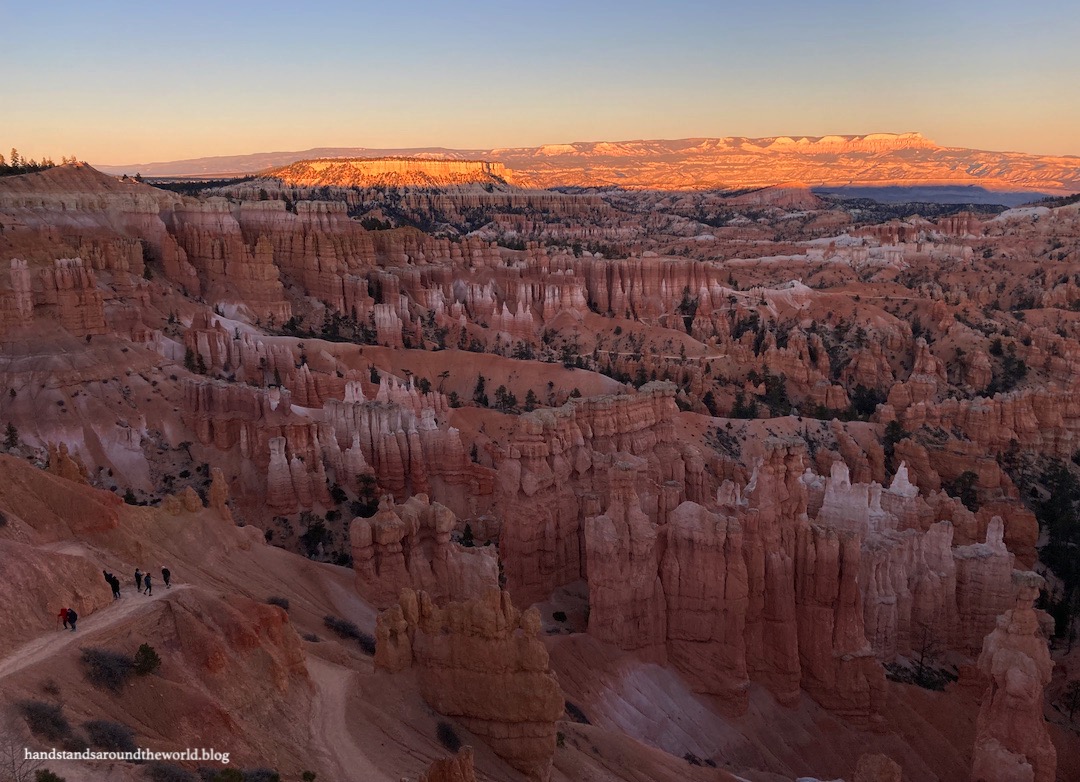
An approximately 60 square mile (155 square km) maze of red rock hoodoos, Bryce is my favorite of Utah’s “mighty five.” It’s a place I’ve been eager to return to since my first visit when I was a kid. We barely scratched the surface on that trip, and my fiance had never been to Bryce at all. It was high time to remedy that, and Thanksgiving week was the perfect time to do so.
It was a loooong drive to our hotel in Bryce Canyon City, made even longer when we got stuck behind a semi going 40 mph that decided to pass a semi going 39 mph (in an area where the speed limit was 75 mph).
At one point, we also travelled through a 110 mile (177 km) stretch of I-70 with no services, including gas. It’s important to plan ahead when driving across Utah, as there are vast expanses of nothingness. It’s wild and beautiful nothingness. But if you run out of gas, food, or water, you’ll be out of luck (and probably also out of phone service).


We arrived in Bryce Canyon City just in time to drive into the park and watch the sun sink below the horizon from the appropriately-named Sunset Point.


On each of the next two mornings, we were up fairly early and headed into the park for a day of sightseeing.
(But first, I want to give a shout-out to Ruby’s Inn in Bryce Canyon City, at which our “continental breakfast” consisted of a voucher for the all-you-can-eat buffet at the on-site restaurant. Highly recommend.)
Rather than write about things in the order in which we saw them, I’m going to mix and match over the course of this post and the next one so I can group similar things together. For today, the focus will be predominantly on sightseeing from the rim of Bryce Canyon.
We began at the visitor center, which contains exhibits explaining the history of the region, geology of the hoodoos, the flora and fauna we might see, and what to expect as we made our way through the park.
Our strategy for seeing the park was to drive all the way to the end of the road and work our way back, as this is the opposite of what most people do and allowed us to avoid the crowds a little. All the way at the end of the 18 mile (29 km) Scenic Southern Drive is Yovimpa Point, Rainbow Point, and the Bristlecone Loop Trail. From the visitor center, it took about 30 minutes to reach the end of the road.

We were excited to see bristlecone pines, so after taking in the views we bundled up and set off on this 1.3 mile (2.1 km) loop along the canyon rim. And honestly… it was kind of a bummer. The largest bristlecones were dead – or at least, they looked dead – and the smaller ones just looked like any old pine tree. I’ve seen better in multiple other locations. I probably wouldn’t recommend this trail, at least not for the trees. The views were nice, though.


From here, we began making our way back toward the park entrance, stopping at the many viewpoints along the way.


Our second hike of the day, departing from Bryce Point, was to the Hat Shop, a small collection of hoodoos topped with precariously-balanced rocks. These are called cap rocks. A cap rock is a rock that is harder than those beneath it, resulting in erosion of the layers below while it remains mostly intact. As the layers erode away, the cap rock is left balanced on top… until eventually so much erodes beneath that it topples to the ground. We saw some of each at the Hat Shop.
This was also our first venture down into one of the amphitheaters. This section of trail (called the Under-the-Rim Trail) isn’t in the main amphitheater and we didn’t have too many up-close views of the hoodoos from here. However, it was a neat hike and we only saw about five other people on the trail, so if you’re looking to get off the beaten path in Bryce Canyon I would recommend this hike. I’d rate it as moderate-difficult; 4.6 miles (7.4 km) round trip with 1150 feet (350 m) of elevation gain, much of which is at the end as you climb back up to the rim.


Back at the trailhead, we enjoyed the view from Bryce Point.


Next was Inspiration Point, which ended up being my favorite view. Walking up to the edge and gazing down at a 180° vista containing thousands of hoodoos filled me with a sense of awe that’s hard to describe.


One final hike, completed as we were departing Bryce Canyon, was to Mossy Cave. Which is, as the name suggests, a cave filled with moss. In the summer, there’s also water dripping down. The water originates in an underground spring and is responsible for the erosion that created the cave. As it was November, most of the water was frozen.
The Mossy Cave trail departs from Utah Highway 12. It’s about a 10-15 minute drive from the main part of the park out to this trailhead, so this makes a good stop on the way into or out of Bryce Canyon. From the parking lot, it’s a short 0.8 mile (1.3 km) hike along a creek to Mossy Cave. The final climb to the cave is steep and may be icy in the off-season.


And this is where I’ll leave off for now. Stay tuned for next week’s post in which I’ll talk more about the geology of Bryce Canyon and our hikes down into the main amphitheater of hoodoos.
The Important Stuff:
- Getting there: Bryce Canyon is located on Utah Highway 12 in southwestern Utah; any maps app should get you there.
- Fees and passes: there is a $35/car park entry fee that’s good for 7 days; America the Beautiful passes are accepted (more info here).
- Hiking: There are dozens of miles of trails within the park, ranging from simple walks along the rim to steep descents into the hoodoos; an overview and list of the hiking trails can be found here.
- Where to stay: In the summer, there are 2 campgrounds and a lodge within the park, in addition to campgrounds, lodges, and hotels immediately outside the park in Bryce Canyon City and a few miles further away in the towns of Tropic and Panguitch. In the off-season, many of these are closed and options are much more limited. We stayed at Ruby’s Inn in Bryce Canyon City (about $90/night in the off-season) and would do so again.
- Other: Given the surrounding desert-like environment, it’s easy to forget that Bryce Canyon is a high elevation park. The canyon rim ranges from 8000-9000 feet (2440-2740 m) above sea level. Summers are hot with intense sunlight and afternoon thunderstorms. Winters are cold and snowy. Come prepared for exposure to the elements, keep an eye on the weather, and remember that the air is thinner up here, making hiking more difficult.


Leave a Reply to Cheryl, Gulf Coast PoetCancel reply