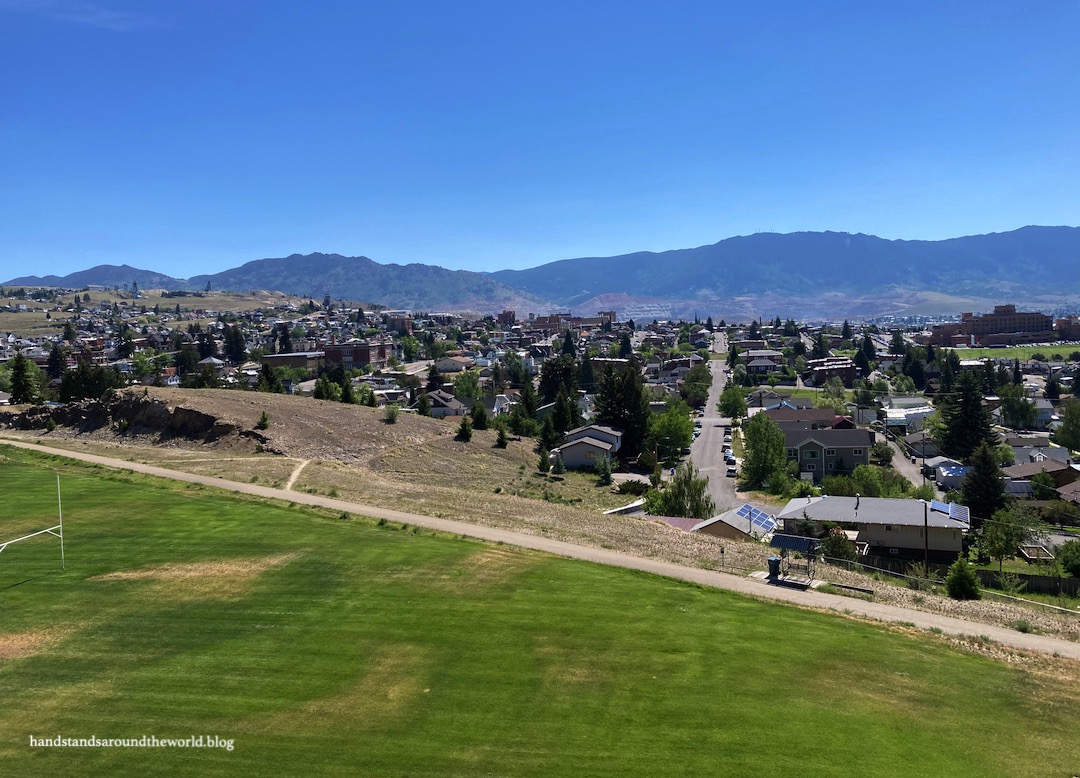
In Montana, the license plate on your car reveals where you live. The numbers were assigned numerically based on population; back in the day, Butte was by far the most populous city in Montana so it was assigned #1.
Although it retains its #1 license plate designation, Butte is no longer the largest city in the state. But it’s certainly the one with the richest history.
The main feature in town is the Berkeley Pit – an enormous abandoned open-pit copper mine filled with highly contaminated water. It’s so contaminated, in fact, that one year some migrating birds landed in it and died. To prevent this from happening again, they have sirens and other noise makers that go off when birds approach to scare them away.
The water in the Berkeley Pit is highly acidic (pH 2.5), full of toxic heavy metals (including cadmium, cobalt, and arsenic), and larger than I can even comprehend, despite having visited it. It’s 7000 feet (2135 m) long, 5000 feet (1525 m) wide, 1800 feet (550 m) deep, and contains over 40 billion gallons (151 billion liters) of water. It was in operation for nearly 30 years and in that time it produced 1.4 billion tons of copper ore. Photos can’t capture the immense scale of the pit, but I tried.


For years, the water level in the pit was constantly rising because the drainage system had been shut off. To prevent it from rising any further and contaminating the entire town’s water supply, a pump has been installed that removes millions of gallons per day, filters it as best as possible, and dumps it into a nearby creek. I have to imagine that creek is pretty gross. Butte is also home to a watershed contaminated with high levels of arsenic and lead. Both of these are among the largest superfund sites in the country; it’s not hard to see how Butte earned the nickname “the butt of Montana.”
But it turns out there’s more to Butte than a huge toxic pit. A lot more.
Butte is a mining town, through and through. It was founded on mining, it survived on mining for over a hundred years, and there’s no escaping the mining history when you’re there. The city was the largest producer of copper in North America and among the largest in the world, producing $48 billion in copper ore and earning it the much more appealing nickname “the richest hill on earth.” Old mining structures are still visible throughout the town and on surrounding hillsides. The Berkeley Pit, of course, is visible from pretty much every street corner. The infrastructure was built to support mining… in its heyday Butte was home to about 100,000 people. Today it has a population of only about 35,000 but many of the old structures remain.
Since its founding, Butte has been home to a very high population of Irish immigrants and to this day has the highest per capita population of Irish Americans in the US. There was a fairly large population of Chinese immigrants back in the day as well; most didn’t work in the mines but instead ran many of the crucial businesses such as restaurants, laundromats, and dry cleaners.
The other thing Butte is known for is labor unions. Unions were extremely active in Butte, splitting off from one general union to form multiple unions specific to different lines of work. Almost every worker in town was a member of a union, including women. There were multiple strikes and clashes over the years between union workers and the mining companies, many of which sparked due to low wages and/or poor working conditions (some things never change, it seems).

We learned all of this and more from our day exploring the city. We began our day with visits to two museums: the Montana Mineral Museum and the World Museum of Mining.
The Montana Mineral Museum is housed on the campus of Montana Tech University. This place blew me away! I was expecting a few small samples of different minerals. I was certainly not expecting to see thousands of different minerals I’d never heard of in all variety of sizes and colors. We spent over an hour here oohing and ahhing at all the colorful crystals and bizarre shapes. A few of my favorites are below.


The World Museum of Mining is built on the site of the Orphan Girl Mine, a 3200 foot (975 m) deep mine that operated from 1875-1956. Shockingly, the main metals produced here were silver, lead, and zinc rather than copper. It is possible to actually go down into the mine, but it was pretty expensive and we didn’t feel like paying for it. Instead, we purchased general admission tickets and spent some time walking through the reconstructed 1900s mining village. While many of the buildings are from that era, this is not their original location. They were brought in from other areas of the state and are now on display here.


Some of the old mining equipment is on display here as well. Though we couldn’t descend into the mine, we were able to walk into one of the adits and also see the machinery used to transport ore and workers in and out of the mine shaft.


With so much mining comes the potential for huge disasters, and Butte certainly suffered its fair share. Over 2500 men died in mining accidents between 1870-1983. The largest occurred when 168 men died on June 8, 1917 in the Granite Mountain-Speculator fire after flames broke out in the mine shaft 2000 feet (610 m) underground, trapping many of the workers beneath the surface with no hope of escape. The Granite Mountain Memorial pays tribute to the lives lost at this and other local mining disasters.


After a thorough tour of all the mining history, we spent some time walking around downtown Butte to see some of the historic buildings. Most of downtown is on the National Register of Historic Places. It’s been nicely preserved. Some of the highlights are below.


A local suggested we pop into the Silver Bow County Courthouse and I’m glad we heeded this recommendation because it’s beautiful inside! I’d never seen pink marble architecture before.


Dinner was recommended to us by a local as well and it was a very unique experience. The old Metals Bank & Trust Company building has been converted into a restaurant called Metals Sports Bar & Grill, complete with a table inside the bank vault. When we arrived the table was available, so we ate our dinner inside a bank vault!
We ended our day at the Copper King Mansion. This Victorian mansion is the former home of William Andrews Clark, one of Butte’s three “Copper Kings.” Clark, along with the other two – F. Augustus Heinze and Marcus Daly – made enormous sums of money off mining operations in and around Butte and were hugely influential.


Today, the Copper King Mansion is open for tours and is operated as a B&B. We decided to splurge a little bit and actually spend the night here. We booked the family room… which I somehow didn’t take a photo of, despite the fact that I took a photo of probably every other room in the mansion.
Our stay included a free tour of the house. We really enjoyed seeing the luxurious rooms and learning the history of Clark and the more recent occupants of the house. Breakfast was delicious, the hosts were lovely, and it was a great final night of our road trip!


The Important Stuff:
- Getting there: Butte is located at the junction of I-15 and I-90 in southwest Montana.
- What to do: Spend the day soaking in the history… walk or take a trolley through downtown to view the historic buildings. For mining history, visit the Berkeley Pit, World Museum of Mining, and Granite Mountain Memorial. For culture, visit the Mai Wah Society Asian History Museum. For geology, check out the Montana Mineral Museum.
- Fees and passes: the Montana Mineral Museum is free, the World Museum of Mining is $9/person, the Berkeley Pit is $3/person, and a tour of the Copper King Mansion (if you aren’t staying there) is $10/person.
- Where to stay: there are dozens of options in Butte, ranging from campgrounds and RV parks to hotels and B&Bs; we stayed at the Copper King Mansion and really enjoyed it.


Leave a Reply