We could stay in Colorado for the rest of our lives (personally, I have few objections to this!) and probably never run out of places to backpack in Rocky. There are so many options. I haven’t actually counted, but I’m fairly certain that at least ¾ of the trails in the park extend more than 5 miles (8 km) into the backcountry. Since we usually cap our day hikes at about 10 miles (16 km), all these trails are future backpacking trips.
Backpacking in Rocky requires a permit, and permits are unbelievably competitive. They sell out in minutes, particularly for weekend dates. In fact, in 2020 I applied for a permit at exactly the minute they became available and didn’t get it. I didn’t get our second choice either. Then COVID happened and all our summer plans went up in flames anyway, and I was resigned to the fact that there would be no Rocky backpacking adventures in 2020.
And then plans changed again.
Since acquiring all the necessary gear, my mom has made it her goal to backpack at least once per summer (we did 3 days on the AT two years ago and Browns Creek Falls last year). So I scoured Rocky’s list of available backcountry campsites and, amazingly, found a mid-week opening!
Our permit was for one night at the North St. Vrain backcountry site, located 3 miles (4.8 km) from the Wild Basin trailhead. We took the shorter Campsite Cutoff trail on the way up to our site and the main trail on the way down the next morning. The main trail is more scenic and passes Ouzel Falls and Calypso Cascades, while the cutoff trail bypasses these.
Funny story: we thought we’d seen Ouzel Falls when we hiked this trail the previous summer. Then I saw someone else’s photo of the falls a couple months later… a photo that was not depicting what we’d seen. Long story short, to see Ouzel Falls you have to follow the path behind the sign rather than stopping at the sign.


Anyway. After setting up camp my mom and I donned our day packs and continued up the Wild Basin Trail. From here, the options are Thunder Lake (which I visited the previous year) or Lion Lakes. Our goal was Lion Lakes.


From our campsite, it was an additional 1.5 miles (2.4 km) of fairly gradual hiking on the Wild Basin Trail followed by 2 miles (3.2 km) of steeper hiking on Lion Lake Trail. The beginning of the Lion Lake Trail in particular is brutal; it climbs very abruptly. But eventually the grade moderates somewhat as the trail weaves through the forest. Just before Lion Lake #1, the forest opens to reveal a small pond – which I dubbed Lion Lake #0 – and a meadow.


Lion Lake #1 is set in a beautiful wide open meadow at the base of Mount Alice and Chiefs Head Peak. It’s a fairly large lake for 11,000 feet (3350 m) and we really loved the vast expanse. Many types of wildflowers colored the meadow. We followed the trail around to the opposite end of the lake and found a nice flat boulder for a snack break.


This marks the end of the official maintained trail. However, an unmaintained trail continues another 1 mile (1.6 km) and 450 vertical feet (135 m) up to Trio Falls, Lion Lake #2, and Snowbank Lake. As you look up at the headwall you’ll have to climb, it looks daunting. However, it really wasn’t too bad. The trail weaves rather than climbing straight up, and the only somewhat challenging parts are a creek crossing and a couple sections that require some mild scrambling. Earlier in the season, there may have been some snow to navigate as well.


Lion Lake #2 is nearly as big as Lake #1 and very deep. As we stood on the shore, we could see how rapidly the lake bottom dropped off. As we climbed above it on our way to Snowbank Lake, it became even more evident.


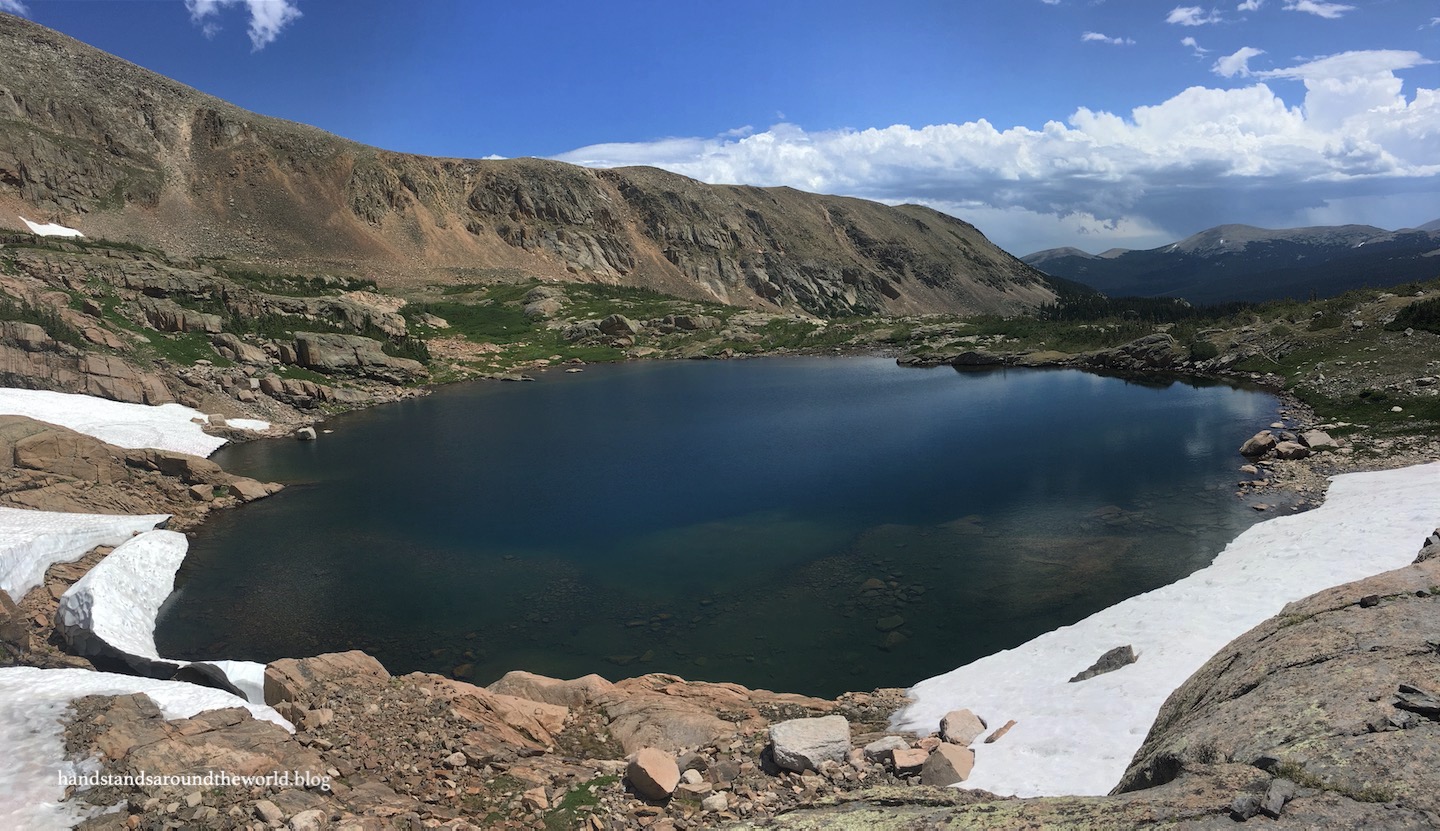
The largest of the three, Snowbank Lake sits just over 11,500 feet (3500 m) and lives up to its name. There was a large bank of snow on the far edge. There’s also a rock peninsula jutting out into the lake, so we walked out onto it and enjoyed the view from there.


The best part was that we had all three lakes almost completely to ourselves! Once we turned onto the Lion Lakes Trail, we only saw 6 people. And not a single other person made the climb up to the upper lakes while we were there. In a park as popular and crowded as Rocky, this was very unexpected.
It almost makes me not want to publish this post. After all, social media exposure is one reason why so many outdoor places are now seeing record crowds.
Instead, I’ll say this: if you do visit Lion Lakes, please do absolutely everything you can to keep it quiet and peaceful and pristine. Please stay on the trail, don’t step on plants or pick wildflowers, and pack out all your trash. Please be courteous of other visitors and don’t disrupt their solitude. Let’s keep this place the beautiful mountain oasis that it is so everyone else can enjoy it as much as we did.
The Important Stuff:
- Getting there: this hike leaves from the Wild Basin parking lot in the southeast corner of Rocky. From Highway 7, follow the brown signs to Wild basin. Arrive early, parking often fills by 7am.
- Fees and passes: there is a $30/car daily or $35/car weekly entrance fee to RMNP; America the Beautiful passes are accepted. From May-Oct, if you arrive between 9:00am-2:00pm you will also need a timed entry permit to access this trailhead if you plan to day hike or a backcountry permit if you plan to backpack.
- Permits: backpacking in Rocky requires a backcountry permit. Permits can be reserved in advance (recommended, as they are highly competitive) or you can try your luck with a walk-up permit on the morning of your hike. Permits are site-specific and cost $36 (this is in addition to the park entry fee).
- Hiking: round trip distance to Lion Lake #1 is 14 miles (22.5 km) + 2850 vertical feet (870 m) if you stay on the main trail or 12.8 miles (20.6 km) if you take the campsite cutoff; add 2 miles (3.2 km) + 450 feet (135 m) round trip for Lion #2 and Snowbank Lakes.
- Other: hard-sided bear canisters are REQUIRED for all overnight stays in Rocky. Canisters should contain all food, toiletries, sunscreen, garbage, and any other scented items except DEET, must be closed all the way when not in use, and be placed at least 70 adult steps away from your tent when you’re not at your site.
For more information, see my posts on visiting Rocky Mountain National Park and backpacking


Leave a Reply to wanderlustigCancel reply