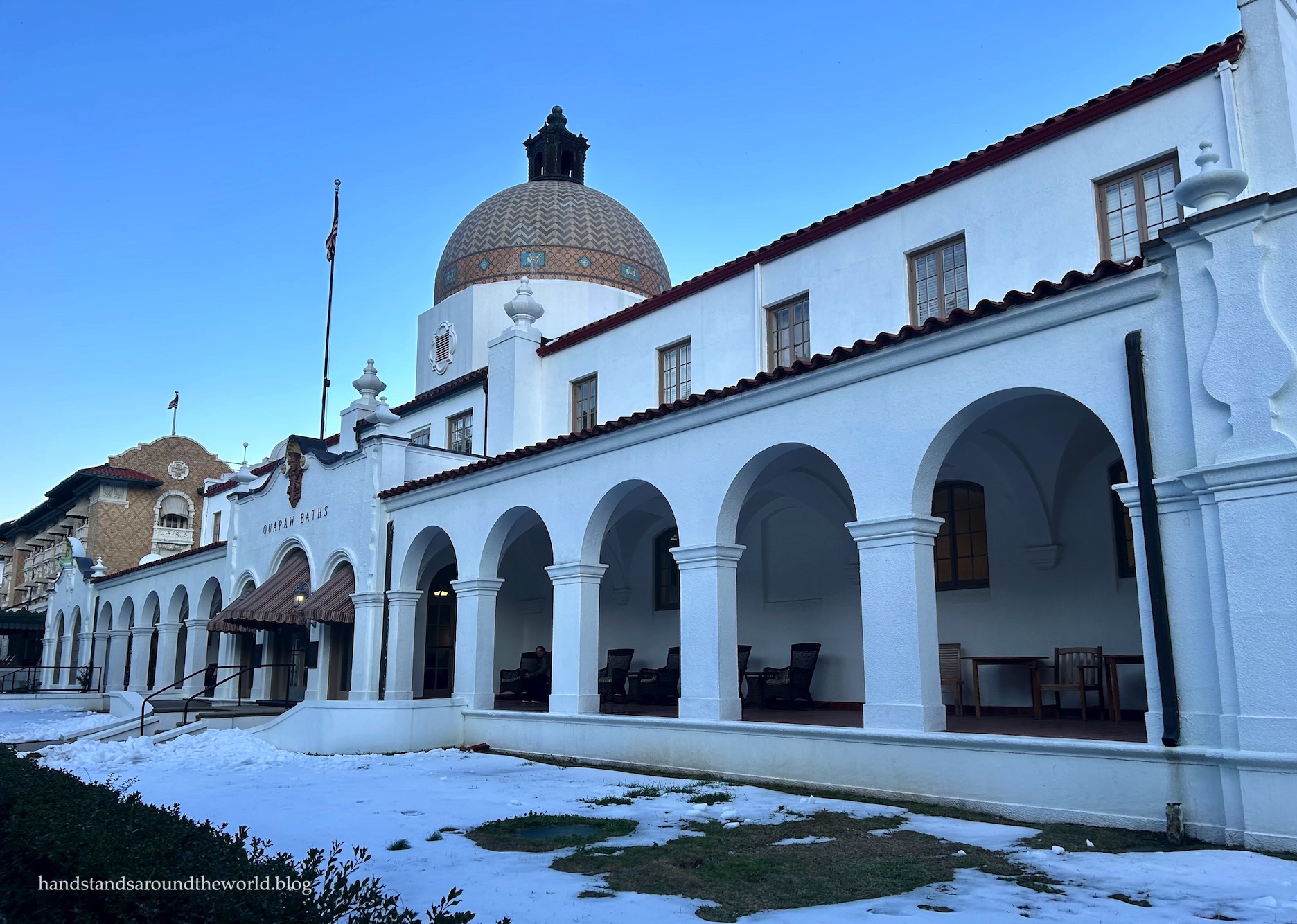
If ever there was a time to visit a national park where you’re allowed to actually soak in its natural hot spring water, it was the end of January 2026.
We arrived in the aftermath of a massive winter storm, snow and sleet and ice still coating the sidewalks and even some of the roads. The temperature had scarcely climbed above freezing in a week. The overnight lows were nearing the single digits.
Sinking into a pool of steaming mineral water never felt so good.

Hot Springs National Park is unlike any other national park I’ve been to. At first glance, it’s easy to wonder why it’s even classified as a natural park. Most National Parks in the US are designated based on their natural and/or ecological value. And there’s certainly nothing natural about the row of historic bathhouses that line the main street of the town of Hot Springs, Arkansas.

The hot springs themselves, though, are natural. In fact, there are 47 of them that bubble up to the surface on the slopes of Hot Springs Mountain. This water fell as precipitation 4500 years ago and has slowly made its way down through the earth’s crust, to a depth of about 1 mile (1.6 km). As it travels, it’s heated by a geothermal gradient, increasing in temperature until it reaches a fault through which it’s forced back up to the surface.
Each day, roughly 700,000 gallons (2.6 million liters) of water bubbles up at a temperature of approximately 143°F (62°C), meaning it actually must be cooled for soaking.
Back in the mid-1800s, not long after white explorers first came upon the springs and began to develop them, an underground system of pipes was installed to harvest the water, cool it, and pump it into bathhouses, where it was used for therapeutic purposes.
Today, the water still reaches the surface in a few small pools within the park. However, most of it travels through this network of pipes and into the two remaining operable bathhouses.


These two bathhouses operate today as hot spring and spa facilities. However, back in the 1800-1900s, the hot water was believed to have therapeutic properties, thus the purpose of the bathhouses was healing. People came from all over the world with all sorts of ailments, hoping the hot mineral water would provide a cure.
In fact, the land that is now Hot Springs National Park was the very first land ever protected by the US government, to ensure it remained available for all to access. Yellowstone was the first land to officially be designated a national park, but the protection of Hot Springs predated that by 40 years.
The original bathhouses were built of wood, so you can imagine the outcome after years and years of constant exposure to steam. The row of bathhouses that stands today were built between 1910-1930 and form the centerpiece of the national park.
It’s very bizarre, because one side of Main Street is Bathhouse Row and the national park, and the other side is the downtown area which is not within the park boundary.


The three mountains surrounding the town are also part of the park. Unfortunately, due to the lingering snow and ice, access was severely limited. I was hoping the road up Hot Springs Mountain would reopen before we had to leave so we could drive to the summit and climb up the viewing tower, but it was not to be.
We made the most of our time in the park, though, seeing pretty much everything that was open, and I feel like we had a very thorough Hot Springs experience. In fact, on our way out, a park ranger called us over and presented us with honorary Junior Ranger badges as a thank you for being so interested in the park.
Which I guess brings me to the part of the post where I stop talking about history and start talking about our visit. We arrived Friday afternoon with just enough time to explore 1 of 4 floors in the visitor center. The visitor center is in the Fordyce Bathhouse, which is named for Samuel Fordyce, who provided tremendous financial support to turn Hot Springs into a world-class health destination.

I recommend allotting 2-3 hours to see the visitor center. It’s fascinating! It’s also 90% original. In the basement, you can see some of the old plumbing and heating systems.


Right: old plumbing machinery
The first floor has a couple rooms with exhibits about the history and geology of the park, but is mostly still set up as a bathhouse. As mentioned, though, these bathhouses weren’t just for relaxation. They were medical facilities. Doctors would prescribe certain soaking regimens and other treatments for everything from physical injuries to depression to syphilis.
In addition to the bathhouses, there are many walking paths on Hot Springs Mountain, because spending time in nature and taking part in gentle physical activity was part of the prescription for many patients.


While you can tour the visitor center yourself, ranger-guided tours provide a lot more context. We joined one on the first floor of the visitor center and learned so much about the bathhouses themselves, but also about the workers who operated them.
(The short version is that most of them were Black, paid poorly, had to use their meager salary to purchase their own supplies, and were not even allowed to use the bathhouses due to the segregation laws in place at the time.)


Right: a therapeutic shower with lots of nozzles


After the tour, we headed up to the second floor, where we found a variety of old medical equipment.


Swedish physician Gustav Zander was an expert in what was, in the 1800s, called medical gymnastics – the application of resistance by an assistant while the patient performed certain movements designed to help them regain strength. Zander realized it would be much more efficient to create machines capable of applying various levels of resistance, and did exactly that. His machines and methods proved highly effective and are the foundation for modern-day physical therapy and exercise machines.

And finally, on the third floor were various rooms and a gym. The gym took me back to my elementary school gym class days and also my years of gymnastics – though with much older equipment.


After thoroughly exploring the Fordyce, we ate a quick lunch and then headed to Quapaw Bathhouse to soak. Phones are prohibited in the pool area, so I don’t have any interior photos, but the banner at the top of this page shows the soaking pools.
(Note that, for women, soaking while on your period is also prohibited. I don’t know how or if they actually enforce this. I was never questioned, nor did I hear anyone else get asked. I’m also unclear as to why such a prohibition exists or how it’s legal.)
Anyway. There are 4 pools of different temperatures, ranging from comfortable for a long soak to hot enough that I was done after a couple minutes. It was a nice relaxing afternoon, and we were toasty warm and relaxed by the end. That being said, a couple hours was enough for me. By the end, I was starting to get bored.

Our final stop was just a short distance up Bathhouse Row at Superior Bathhouse, which actually remained open until 1983, long after all the others had closed (thanks to the discovery of antibiotics, soaking in hot water was no longer the predominant medical treatment for most maladies). Today, Superior operates as a restaurant and brewery. It’s the only brewery located within the boundary of a US national park and also the only brewery in the world to make their beer from hot spring water.

I know at first glance that might sound awful, because most hot spring water contains sulfur and smells like rotten eggs. But because these hot springs are not volcanic in origin, they are sulfur-free. The water is rich in 12 other minerals, though, which I’m pretty sure means this was the healthiest beer we’ve ever had!
That’s what we’re telling ourselves, at least, to justify the amount of it we drank. The brewery offers what’s called a beer bath: a flight containing one pour of each beer on the menu. Obviously, we had to order it.
Oh, and did I mention their menu contains 18 beers?

As you can probably imagine, we spent the evening lazing around in our hotel room. The beer was really good, though. Of the 18, there was only 1 I didn’t like. The burgers and fries we ordered to go with our gallon of beer were pretty tasty too.
And that’s our visit to Hot Springs National Park.

In total, I’d estimate we spent about 8 hours in the park. It’s small, and the closures made it even smaller. But because the visitor center, bathhouses, and brewery were open, we were able to thoroughly explore Bathhouse Row and learn the history of the park.
And honestly? We really enjoyed it! It was a very different national park experience than I’m used to, but one that was very worthwhile.
Up next: the highest point in Arkansas
The Important Stuff
- Getting there: Hot Springs National Park is located in the town of Hot Springs, Arkansas. Highway 7 runs right through the park and the turnoffs from the interstate are well-marked. The park does not operate any parking lots, so you’ll need to pay to park on the street or in various lots in town. We parked on Fountain Street for $1/hour.
- Fees and passes: Hot Springs National Park is free to visit. However, as mentioned, you will have to pay for parking. Also, if you want to soak or take part in spa treatments at Buckstaff or Quapaw Bathhouses, additional (not inexpensive) fees are required.
- Where to stay: there are many hotels in Hot Springs, including in the Hale Bathhouse (though it’s very expensive). We stayed about a mile from the park at a place we really enjoyed. If you’re planning to visit Hot Springs as a day trip, you could also stay in Little Rock, about 1 hour away.
- Food and drink: there are fountains in town where you can fill your waterbottle with cooled hot spring water. It’s safe to drink but very mineral-rich; I didn’t personally like the taste. Since the park is right in the middle of town, there are also plenty of places to eat. Superior Bathhouse Brewery is on Bathhouse Row and is also a full-service restaurant. Other restaurants can be found in the surrounding blocks.
- Hiking: there are numerous trails crisscrossing Hot Springs Mountain. The easiest is the Grand Promenade that travels behind Bathhouse Row. Due to the closures, we didn’t hike any of the others.
- Other: due to the historic nature of the Fordyce Bathhouse Visitor Center, the temperature inside is kept lower than normal. In the summer, I’m sure it feels really nice. In the winter, not so much. If you get cold easily, bring a jacket to wear inside.


Leave a Reply to Lynette d’Arty-CrossCancel reply