Welcome back to my Yellowstone saga! Today, we’re going to pick up where I left off last week and continue south on the Lower Loop of Grand Loop Road from Madison Junction to the famous Old Faithful. This can be found on the west-central portion of the map below.
This 16 mile (26 km) stretch of road is definitely the most crowded in the entire park, as it connects the busiest entrance station (West Entrance in West Yellowstone, Montana) to Yellowstone’s most popular attractions. Though the crowds can be off-putting and the parking situation is often a disaster, this area of the park is busy for a very good reason: it’s home to a majority of Yellowstone’s hot springs and geysers.
It’s well worth visiting.
That being said, my advice is to get an early start and come prepared to spend an entire day surrounded by the characteristic sulfur-scented steam rising from the hundreds – literally hundreds – of thermal features.
(Many people liken the smell to rotten eggs, which I suppose is accurate, but to me, it just smells like Yellowstone.)

Table of Contents
- Firehole Canyon Drive
- Fountain Flat
- Fountain Paintpot
- Firehole Lake Drive
- Midway Geyser Basin
- Biscuit Basin
- Black Sand Basin
- Old Faithful
Firehole Canyon Drive
Just south of Madison Junction is a turnoff on the right to Firehole Canyon Drive. This is a short, narrow road that runs along the edge of the canyon above the Firehole River and then returns to the main road. Note that it’s a one-way road, so there’s only one entrance. If you miss the turnoff you’ll need to turn around in the next pullout and backtrack.

Fountain Flat
Back on the main road, we’re still roughly parallel to the Firehole River, which gets its name from the fact that hot water runoff from the geyser basins drains into the river. This raises the water temperature, often quite substantially. On cool mornings, you may see steam rising from the water’s surface.
Just a few miles beyond Firehole Canyon is Fountain Flat. Here, a short road branches off and travels out to a few hot springs at the river’s edge. There’s also a short trail here to Ojo Caliente.


This is also the northern terminus of the bike path that connects to Midway Geyser Basin. If you have a bike and some free time, and want to avoid the crowds, this is an alternate route to Midway. There are no amenities, so you’ll need food, water, and warm clothes for the day. Geysers and hot springs don’t deter wildlife, so be sure to also pack your bear spray!
Fountain Paint Pot
Back on the Lower Loop road and heading south, our next stop is the colorful mud of Fountain Paint Pot. Instead of plain old water, mud bubbles up to the surface here. It sounds kind of gross but it’s actually really cool, and the boiling mud makes a very strange gurgling sound. Iron and other minerals in the mud give it varying yellow, orange, and pink hues.

There are a few hot springs and geysers here as well.


Firehole Lake Drive
The other worthwhile detour in this section of the park is Firehole Lake Drive, which passes a handful of hot springs and geysers en route to some very large hot springs.
(Not as large as the one at our next stop. But probably the biggest ones we’ve seen up to this point.)


As of last summer, Firehole Lake Drive was closed to vehicular traffic. My understanding is that it’s still open to foot and bicycle travel, but that’s liable to change.
Midway Geyser Basin
And finally, we’ve reached what is probably Yellowstone’s second most popular and famous attraction: Midway Geyser Basin, home to Grand Prismatic Spring – the largest hot spring in the US and third largest in the world.


Grand Prismatic Spring is enormous. It’s difficult to grasp its size because it’s so huge that it’s not possible to see all of it at once while walking through the basin.
That being said, I do recommend walking through the basin. The ground in thermal areas is generally thin and fragile, which is why staying on the boardwalks is required. Here at Midway, they must have done some in-depth scientific surveys of the ground, because they’ve managed to build a boardwalk right through the middle of the cluster of hot springs. This is one of the best places in the park to get an up-close look at the colorful mats of thermophilic (heat-loving) bacteria that cover the ground.

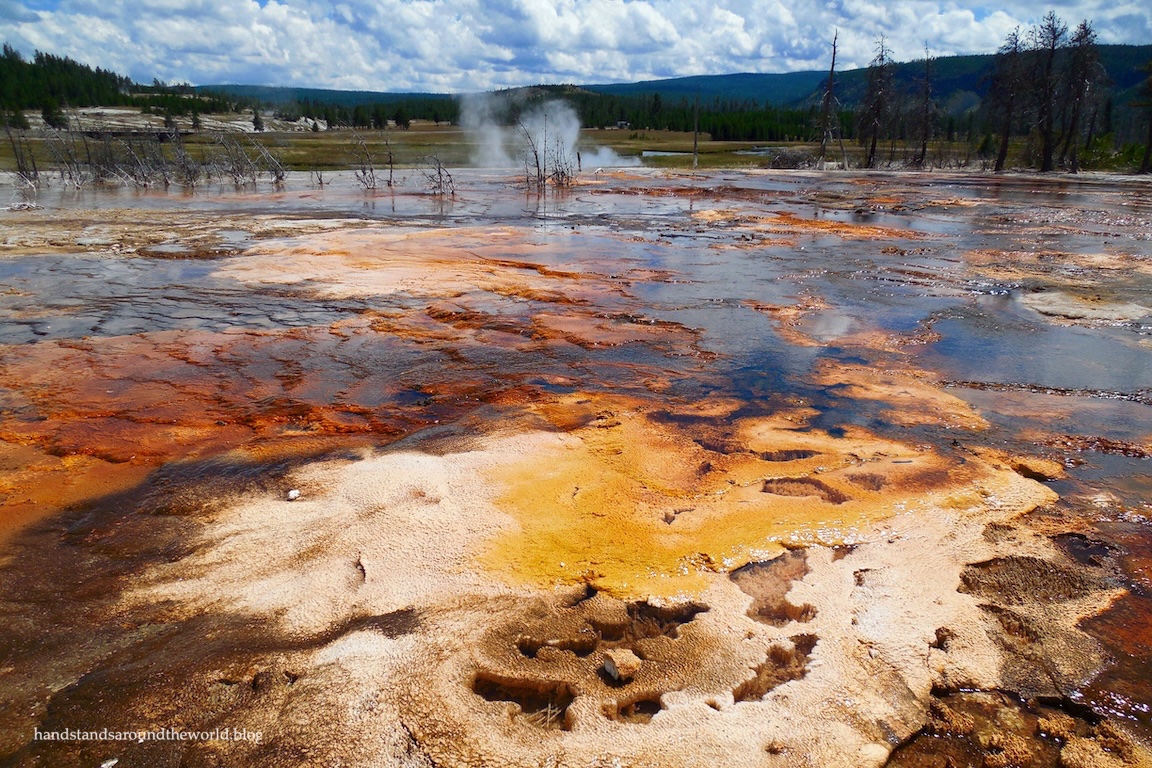
I mentioned in my previous post that the different colors are indicative of different species of bacteria that thrive in particular water temperatures. This gradient is particularly visible here at Grand Prismatic Spring, with the brilliant blue of the deeper, hotter center and the edges ringed with yellow and orange of the species that live in slightly cooler water.
If you catch the light just right, you can even see these colors reflected in the steam as it rises from the surface.

As neat as it is to walk over a hot spring, I think the best way to experience Grand Prismatic Spring is from above. Just south of Midway Geyser Basin is the Fairy Falls Trailhead. While this trail has existed for a while, a few years ago the park put in an overlook of Grand Prismatic Spring.
It’s only 0.7 miles (1.1 km) from the trailhead to the overlook, but the last 0.2 miles (0.3 km) climbs about 150 feet (45 m). If you can make it up, it’s absolutely worth it!


For the first time ever this past summer, we actually continued on to Fairy Falls.
Despite how much time I’ve spent in Yellowstone, I’ve done very little hiking. Compared to many other parks, Yellowstone is pretty accessible. Many of the highlights are relatively close to the road, which means hiking isn’t necessary. But there are hundreds of miles of trails in the park to all sorts of off-the-beaten-path destinations, and I know I’m missing a lot by not doing more hiking here.
But anyway, back to Fairy Falls. It’s about 5 miles (8 km) roundtrip with 370 feet (115 m) of elevation gain to this tall, skinny waterfall. It was a nice hike.


One last tip: of all the places mentioned in this post, parking at Midway is the worst. The lot overflows by mid-morning, and when we drove by in the middle of the day last summer, cars were parked along both sides of the road for at least 0.5 miles (0.8 km) in each direction.
For best results, make this your first stop of the day.
Biscuit Basin
By this point, we’re pretty much in the middle of the densest thermal area. As you drive along, you’ll notice spots of steam off in the distance. Not all of Yellowstone’s hot springs and geysers are reachable by road, or even on foot.
Just ahead, though, is another accessible area. Sort of. In July 2024, Biscuit Basin experienced a hydrothermal explosion. These events are actually somewhat common in Yellowstone. They’re also very violent. Thankfully, there were no injuries this time – a fact that’s even more amazing when you learn that there were about 100 people present and refrigerator-sized boulders went flying through the air.

Biscuit Basin has been closed since that day. Scientists are monitoring the basin, and it will remain closed until it stabilizes and the risk of future explosions declines.
In the meantime, here are a few older photos from Biscuit Basin.


If you cross the road on foot and follow signs toward Upper Geyser Basin (more on this later), a trail leads to a few hot springs and geysers that are also known as the Cascade Group.
Black Sand Basin
Just up the road is Black Sand Basin. The most unique aspect of this basin is the many hot springs and geysers that sit right on the banks of Iron Springs Creek. I always enjoy the contrast of the colorful hot springs right up against the blue water.


Black Sand Basin is fairly small, but I still think it’s worth the stop. You can also reach this area on foot from Upper Geyser Basin, though it’s a pretty long walk.

Old Faithful
Last but not least is the main attraction of Yellowstone: Old Faithful.
Old Faithful is neither the tallest nor the largest geyser in the world, or even in Yellowstone. However, compared to the majority of the geysers in the park, Old Faithful’s eruptions are tall, frequent, and predictable.
That being said, eruption predictions are not exact, so be sure to plan accordingly. You might arrive at Old Faithful, walk over to the geyser, and see it erupt 5 minutes later. Or you might arrive just after an eruption, meaning you’ll be waiting as much as 95 minutes for the next one.
The good thing is, if you do have to wait, there are many other things to do in this area. But more on that next week. For now, I’ll leave you with this video of Old Faithful.
One last thing: there are a few picnic areas and plenty of bathrooms along this stretch of road, but those are the only amenities between Madison and Old Faithful. Water, groceries, gas, restaurants, and medical care can be found at Old Faithful.
Also, the only campground in this part of the park is at Madison and the only hotels/cabins are at Old Faithful (and they’re expensive). The best place to stay will depend upon your budget and itinerary.
Everything in this post could theoretically be seen in one (very long) day, but I recommend spending two days in this area, which means no matter where you stay, you’ll have to do some backtracking.
Up next: Yellowstone National Park, part III: Old Faithful and Upper Geyser Basin


Leave a Reply to Caleb CheruiyotCancel reply