If you’ve seen Forrest Gump, you’ve seen Monument Valley, at least from a distance.
But seeing it onscreen isn’t the same as being there in person. And I’d wanted to visit Monument Valley in person for a really long time!

(Taken from Highway 163 north of Monument Valley)
From Canyon de Chelly, we headed north toward our final campground of the trip. Like so many other places we went on this roadtrip, Monument Valley is pretty remote. There is some phone service and a few amenities, but not a lot of camping options, and most of them are very expensive. However, my mom managed to find a more affordable (and truly stunning) campground through HipCamp, a website we’d never used before but which ended up working out pretty well.

Arrowhead Campground is a collection of 7 campsites on the owner’s land, located down a packed sandy road. When we inputted the campground name, my maps app took us to the wrong place; however, when we inputted the actual address, it got us there.
The owner and his adorable dog came out to greet us not long after we’d arrived, giving us the rundown on the available water and bathrooms and some ideas of what to do while in the area. But other than that, we were left to our own devices in the mostly-empty campground.

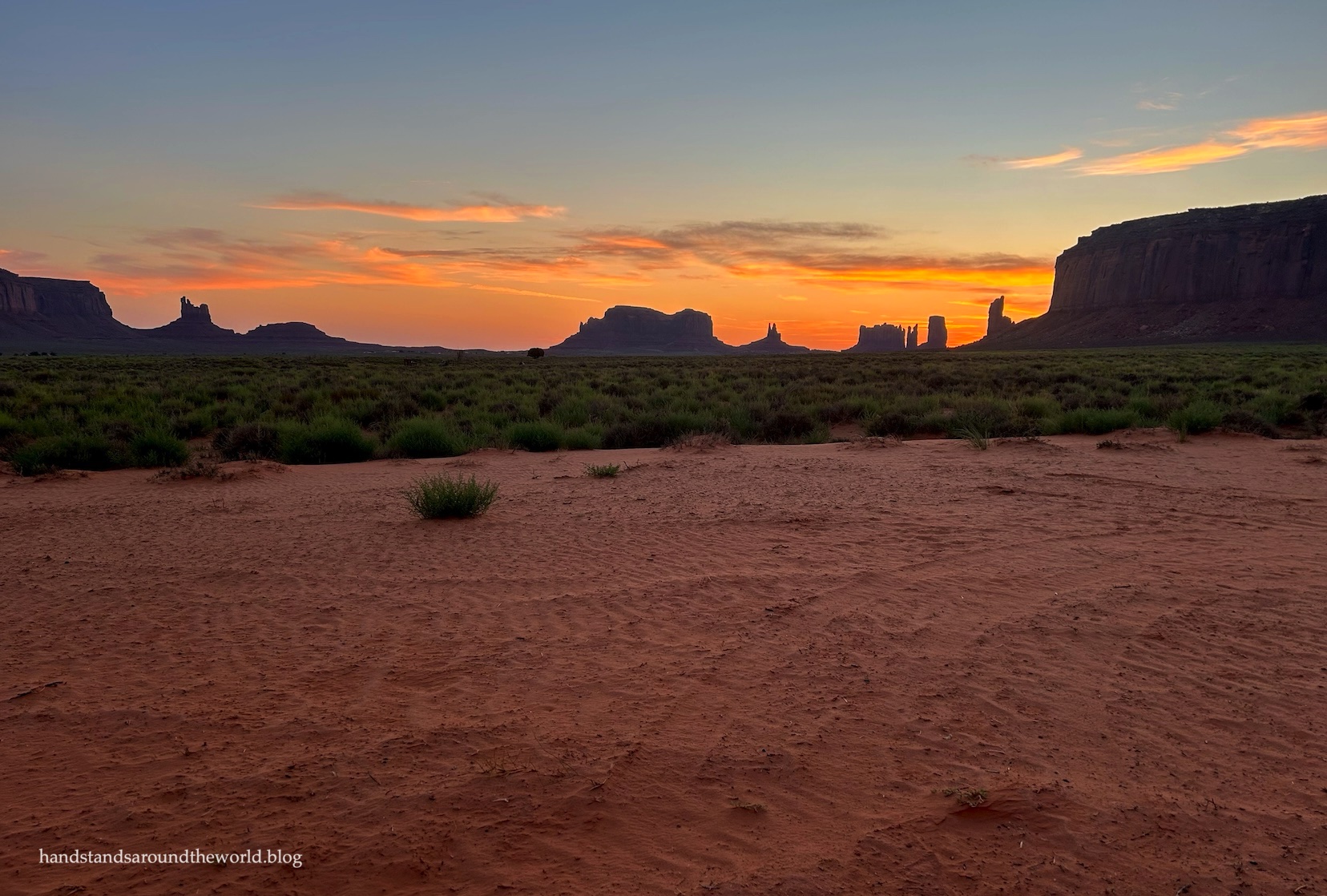
The highlight of this campground is the scenery. This was definitely one of the most beautiful places I’ve ever pitched a tent, and watching the sunrise and sunset over Monument Valley was amazing.


It was so hot that we all struggled to sleep, but the upside was that we were all awake around midnight and took a few minutes to look up at the stars, which were plentiful due to the lack of light pollution.


We were up early the next morning for the drive through Monument Valley. This park is on Navajo land and is designated as a Tribal Park. Entry is $8 per person and the website mentions possible long wait times so we opted to get an early start, arriving at the entrance station just after the 7:00am opening. As it turned out, we could have slept in a bit (something we all would have relished after a sweltering night of poor sleep). On the other hand, we had the road and all the viewpoints basically to ourselves, which was nice.
Our first stop, beyond the entrance station, was the visitor center.


From here, we continued onto the 17-mile (27 km) lollipop loop drive through the towering red formations. The website also warns of the roughness of the road, and this part was accurate. We saw one person attempting to navigate it in their sedan, and I’m honestly not sure how far they made it. We didn’t have any issues with our Subaru, but it was definitely rough in a few sections. In wet weather, it may become impassable.


They gave us a pamphlet at the entrance station that supposedly corresponded to the pullouts along the way, but the pamphlet was numbered and the pullouts weren’t, so it was difficult to tell what was what. Nonetheless, all the pullouts are obvious, and it’s worth stopping at all of them.


The one downside to our early morning start was the lighting. You enter Monument Valley facing east, so the buttes are all backlit with very long shadows. Some of my photos didn’t really turn out.

The Navajo name for Monument Valley is Tse’Bii’Ndzisgaii (tseh-beenh-dzis-guh-ee), which roughly translates to ‘the streaks that go around in the rocks.’ It’s easy to see the origin of this name.


It only took us a couple hours to complete the visitor center and the loop drive, so this is a pretty quick stop. We had other plans for the rest of the day (more on that in the next post) and then headed back to our campsite for the final night of our trip.
While the sandy landscape hadn’t been too problematic on our first night, the same could not be said for the second. Shortly before dinner, dry thunderstorms began to roll in and, with them, gusty winds. Unfortunately, wind + sand + tent camping is a truly awful combination. Despite having a full-coverage rainfly that was completely zipped up, this is what the inside of our tent looked like after the first round of heavy gusts.


The weather forecast was predicting continued storms and strong winds for the next few hours and, to be completely honest, we were all exhausted and so sick of the desert heat by this point in the trip, so we decided it was time to pack up and find a hotel.


With sand still in our noses and mouths and ears, we pulled into a hotel in Moab three hours later to find a gentleman we’d seen earlier at Monument Valley checking in as well, though in his case it was due to a lack of air conditioning in his camper.
And that was it.
Our roadtrip in the desert had come to a hot, sweaty, sandy end. Emphasis on the penultimate word of that sentence, because despite our best efforts to shake everything off before we packed it up, a truly incredible amount of sand made its way home with us. In fact, the next day I was doing laundry and when I went to clean the lint trap in the dryer, I found it coated in a layer of sand.
And when we were trying to clean up our gear, our vacuum cleaner decided it had reached the end of its life and started spewing smoke, leaving us with sandy air mattresses and a living room that smelled like burnt rubber.
Three weeks later, as I sit down to start writing this post, we have a new vacuum cleaner and I think we’ve finally gotten rid of all the sand.
Up next: a wrap-up of our southwestern roadtrip
The Important Stuff:
- Getting there: the entrance station to Monument Valley Tribal Park is on Monument Valley Road, located off Highway 163 near the Utah/Arizona border. With Verizon, we had enough phone service to use our maps app, and it got us there without issue.
- Fees and passes: entrance to the park is $8/person and is good for the entire day.
- Where to stay: there are a handful of small campgrounds, a lodge inside the tribal park, and a lodge a few miles to the west, but overall there aren’t too many options. You could also just spend a couple hours in Monument Valley as you’re passing by and spend the night elsewhere. Moab is about 2.5 hours north and the Grand Canyon is about 4 hours southwest.
- What to do: without hiring a guide, the only options are one hike (Wildcat Trail, 3.8 miles/6.1 km roundtrip) and driving the loop road. With a guide, there are longer driving tours, horseback riding, and other hiking opportunities.
- Other: note that while Arizona does not observe daylight savings time, the Navajo Reservation does. If you’re arriving from southern or western Arizona, you will lose an hour when you cross onto the reservation. If you’re arriving from Colorado, New Mexico, or Utah, there will be no time change.


Leave a Reply to Midwest MarkCancel reply