After three days in New Mexico’s Chaco Canyon, our desert southwestern adventure continued at Petrified Forest National Park in Arizona. It was a bit of a drive, though we’d be gaining an hour because Arizona does not observe daylight savings time.
I’ll admit, after visiting Escalante Petrified Forest State Park in Utah a few years ago, I was equal parts excited and nervous to visit this park. We loved Escalante, and I was excited to see more of the same here. At the same time, I was worried it wouldn’t live up to expectations.
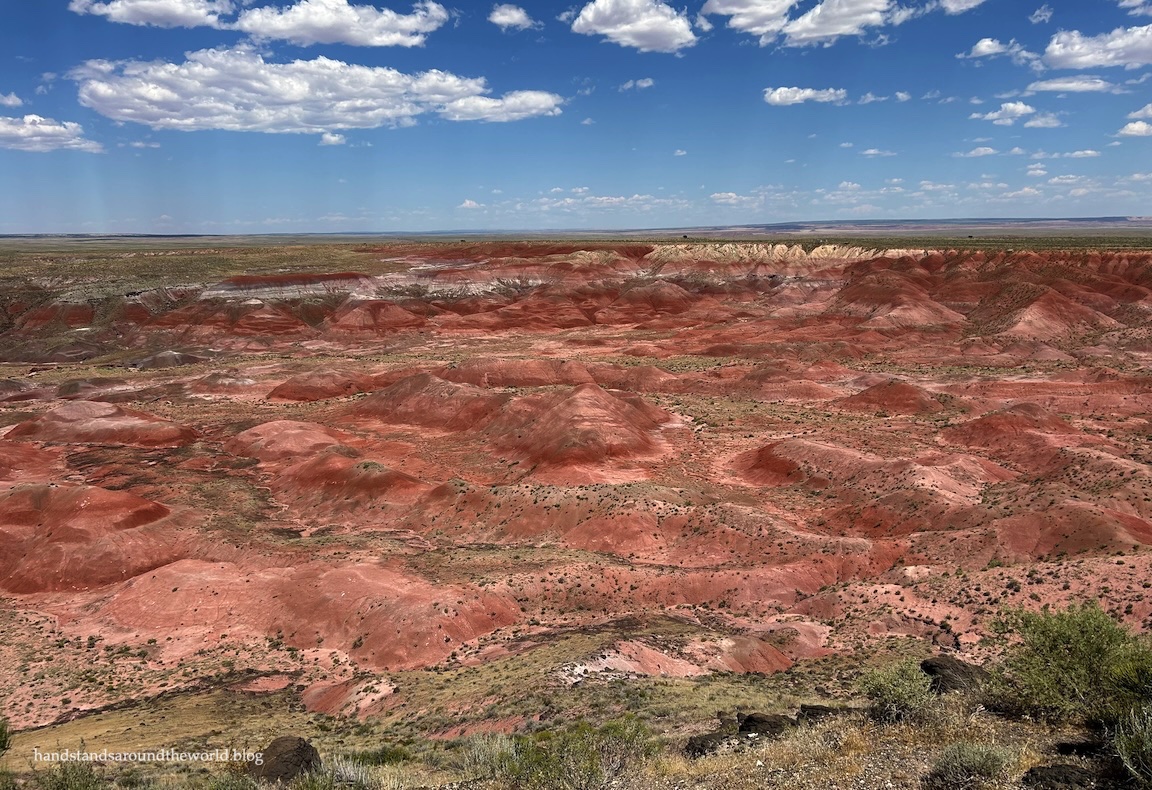
My fears turned out to be completely unfounded. Not only is Petrified Forest National Park filled with a truly astounding amount of petrified wood (one of the largest accumulations in the world, in fact), but it’s also home to the most colorful badlands I’ve ever seen!
The badlands were formed by layers of sediment deposited millions of years ago when present-day Arizona was located near the equator and home to a wet subtropical climate. Compression of these layers, followed by irregular erosion, resulted in the strange topography we see today. Over time, minerals in the sediment underwent chemical reactions, leaving them in various states of oxidation that lend a variety of colors to each layer.
The petrified wood, on the other hand, has been dated to between 210-227 million years ago. While most dead trees simply decompose, the right sequence of events can result in petrification instead. This sequence is as follows:
- A tree is covered by sediment shortly after its death. Possible sources include a mudslide, flood, or volcanic eruption.
- Complete burial of the tree results in a lack of oxygen and microorganisms, which halts the process of decomposition.
- Minerals from the surrounding sediments and groundwater seep into the wood and slowly replace the wooden structure.
- Erosion exposes the petrified wood for all to see.


Photos of the park from various points in history show that, surprisingly, most visitors have been very good about not taking the petrified wood home with them. If you want some as a souvenir, you can visit any of the stores outside the park, which sell wood collected from surrounding private lands.
Table of Contents
- Visiting Petrified Forest
- The Painted Desert
- Puerco Pueblo
- Blue Mesa and Blue Forest Trail
- Agate Bridge
- Jasper Forest
- Crystal Forest
- Rainbow Forest
Visiting Petrified Forest
Petrified Forest is bisected by Interstate 40, though from 1928-1956 it was Route 66 that ran through the middle of the park. Today, the line of telephone poles and an old Studebaker mark the former roadway.

Due to the interstate, the park only has two access points. Exit 311 leads to the northern end of the only road through the park. The southern terminus of this road will deposit you onto US Highway 180 about 20 minutes east of the town of Holbrook, from which you can regain access to the interstate at Exit 285. Entry to the park is $25/vehicle. America the Beautiful passes are accepted.
There is no lodging available in the national park; we spent the night at the KOA in Holbrook.

We actually ended up driving the length of the park road twice; once from north-to-south the afternoon of our arrival, stopping to see what we could given the time of day and the 100°F (38°C) temperatures, and then from south-to-north the following morning, stopping to see everything else and hike the trails when it wasn’t quite as hot.
Had we arrived first thing in the morning, we could have seen the whole park in one day. If you’re not interested in hiking, or only plan to walk a couple of the shortest trails, half a day here would probably be plenty.
The Painted Desert
Though this isn’t the exact order of our itinerary, I’m going to talk through the park from north to south, as that’s the most common direction of travel. Beginning at the north entrance, our first stop was the Painted Desert Visitor Center followed by a series of overlooks. There’s a trail connecting the first couple overlooks, but given the time constraints and the temperature, we opted to skip it and just drive to them.


Our next stop was at the Painted Desert Inn. You can no longer spend the night here, but today the inn is a National Historic Landmark and museum with an ice cream parlor on the ground floor (and boy did that taste good following a morning of desert hiking)!


Puerco Pueblo
Evidence of human occupation in the region dates back nearly 13,000 years, though most of what remains is from the Ancestral Puebloans who lived in the area from around 1200-1380 CE and built tools and dwellings from the abundant petrified wood. Over 1000 original structures are present in the park. We were able to hike to two of them, as well as to some petroglyphs.
Puerco Pueblo was built around 1260 CE and occupied until 1380 CE. It is partially excavated with just a few of its 100 rooms visible.


Ancestral Puebloan ruins are not what the park is known for, nor are these the best examples in the desert southwest, but it was certainly an unexpected sight.
Blue Mesa and Blue Forest Trail
In general, the northern half of the park is the badlands section and the southern half is the petrified wood section, with a bit of overlap in the center. One of the best places to see this overlap is at Blue Mesa. The Blue Mesa Road is a short lollipop loop that branches off the park road and travels atop the mesa.

For the opportunity to walk among the colorful hills, the 1 mile (1.6 km) Blue Forest Trail descends into the badlands and loops through them, ending with a 100 foot (30 m) climb back to the parking lot. It was a hot hike, but I’m glad we did it because it was also a really neat hike.


Agate Bridge
Here, a short trail leads out to a petrified tree that was deposited across a gully to form a bridge. Concrete supports have been build beneath it to hold it up, as erosion threatens to send it tumbling down.

Jasper Forest
And finally, we’ve reached the most abundant collections of petrified wood. The colors weren’t surprising; after all, it’s similar to what we saw at Escalante. It was the sheer amount of it that blew me away. Not only were the pieces enormous, but they were so numerous. Across miles and miles of the desert, it was as though someone picked up hundreds of thousands of chunks of petrified wood, threw them into the air like confetti, and left them wherever they landed.
As far as the eye could see, they covered the ground. In some places, fully intact trees stretched across the landscape.


Crystal Forest
While the Jasper Forest overlook provided a view of the petrified wood from afar, the remaining trails in the southern half of the park would allow us a much closer look. Crystal Forest Trail is a 0.8 mile (1.3 km) accessible loop. This is the shortest and easiest way to get up close and personal with the colorful beauty of the petrified wood.


The specific minerals involved in petrification determine the color of the wood. The main component is silicon dioxide, otherwise known as quartz. However, quartz often contains impurities, including iron (responsible for the pink, red, orange, and yellow), copper (responsible for the blue and green), and manganese (responsible for the purple and black).


Rainbow Forest
Our final stop was at Rainbow Forest Visitor Center on the southern end of the park. In addition to the visitor center and gift shop, the Giant Logs and Long Logs/Agate House trailheads can be found here.
As the name would suggest, the Giant Logs Trail passes by some truly enormous petrified trees, including the largest one in the park. They’ve named it Old Faithful, though I’m not a fan of this name. The real Old Faithful is in Yellowstone.


Both the Long Logs and Agate House Trails can be hiked on their own. However, the first section of both hikes is on a shared trail, so it’s easy to combine them into a 2.5 mile (4 km) loop.
Agate House is a petrified wood pueblo. It was neat, but would have been neater if it was an actual ruin rather than a reconstruction.

The Long Logs Trail, meanwhile, is a final opportunity to hike past lots of large petrified logs. It may admittedly feel a bit redundant to hike the Long Logs, Giant Logs, and Crystal Forest Trails. After all, petrified wood is petrified wood. However, we all very much enjoyed nerding out over the petrified wood and found that each piece was unique in its own way.


Suffice it to say, every single hike took us much longer than anticipated because we were stopping every 30 seconds to ooh and ahh at the colors and take far too many photos. I’ve tried – and very obviously failed – to narrow it down for this post.
Moral of the story: if you’re ever in the area, Petrified Forest National Park is absolutely worth a visit!
Up next: history and culture at Canyon de Chelly National Monument


Leave a Reply to WanderingCanadiansCancel reply