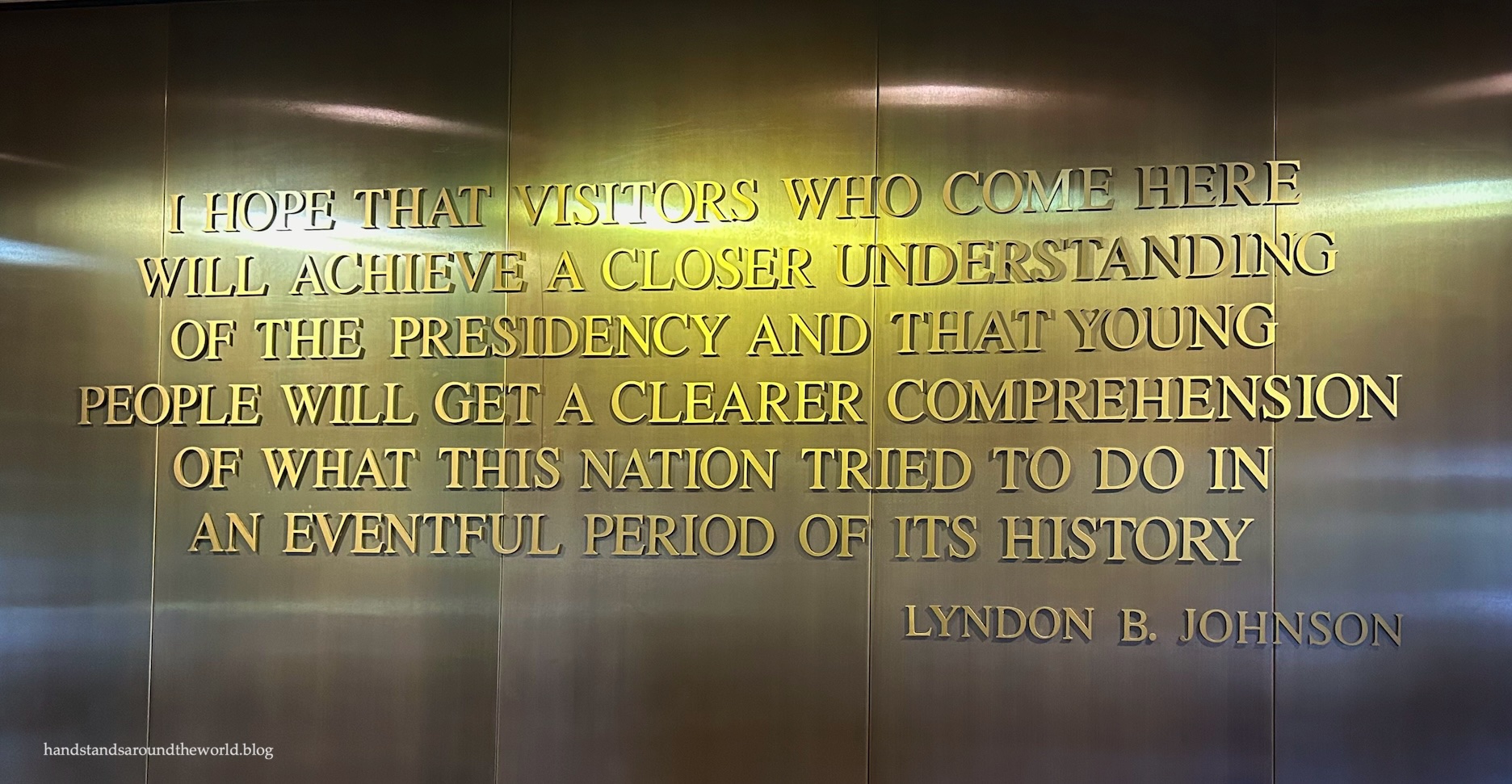
Despite falling somewhat in the middle of the “which state is home to the most US presidents” list, Texas actually tops the list of “which state has the most presidential libraries” with three. Of those three, though, only one commemorates a president who was actually born in Texas: Lyndon Baines Johnson or, as he’s commonly known, LBJ.
In addition to the library in Austin, relics of LBJ’s early life in Texas remain and have been preserved by the National Park Service as the LBJ National Historical Park and by the state of Texas as LBJ State Park. The National Historical Park is in two separate units: the family ranch near Stonewall where he was born and later returned to, and his boyhood home in Johnson City, where his family moved when he was five.
While it might be possible to combine all three of these into one day, they’re located in different places so it would involve a decent amount of driving. We visited the first two after hiking at Balcones Canyonlands and the third during our day in Austin.
Table of Contents
LBJ Boyhood Home
LBJ was born on a Ranch in Stonewall, Texas, before moving with his family to nearby Johnson City at age 5. However, we began our visit at the Boyhood Home portion of the park because this is where the main visitor center is located. There is actually quite a lot to see here, but we focused on the visitor center/museum and the boyhood home, opting to skip the walking tour for the sake of time… and because we’d already hiked quite a few miles that morning.

The house itself was not open during our visit, but we were able to see in most of the windows so we got an idea, at least, of what it looked like inside. It has been restored to its appearance during the 1920s, when LBJ was a teenager. We were also able to walk around the grounds, pausing beneath the shade of some beautiful old trees.


Growing up where and how he did greatly influenced who LBJ was as a person, as well as his beliefs and his drive toward a career in politics. It was interesting to learn about these early life experiences here and then to see – later on at the presidential library – how these informed the decisions he made while in office.


The Important Stuff:
- Hours: the visitor center is open daily from 9:00am-5:00pm, though the grounds remain open until sunset for self-guided tours. Guided tours are offered throughout the day, weather permitting.
- Fees and passes: none
- Important information: please don’t touch anything, stay out of restricted areas, and obey all signs in order to preserve these historic structures.
LBJ Ranch
About 15 minutes west of Johnson City is the LBJ Ranch, a large swath of land on the banks of the Pedernales (pronounced PER-de-NAL-iss) River. The ranch was established by LBJ’s grandfather, Sam Ealy Johnson. Though the family lost the ranch for a time and moved to Johnson City, LBJ was able to re-purchase it later in life. He spent time here during his presidency, thus the ranch was often referred to as the Texas White House. He and his wife, Lady Bird Johnson, lived here after his time in office as well, and she remained after his death.
After stopping at the visitor center to pick up our free driving permit, we set out on the driving tour. The first stop was at Trinity Lutheran Church, which LBJ attended. Next was the Junction School, which he also attended.


The next stop is his birthplace, though the house has since been reconstructed and was later used as a guest house for visitors to the ranch. It’s not identical to the original home, but it’s close and is furnished with some of the family’s belongings. It was not open for tours when we were there but, as with the boyhood home, we could see through the windows.


Generations of the Johnson family are buried here in the cemetery.

The original farmhouse his grandfather built still stands and is, I believe, original. This one is not open to the public, nor could we approach.


The next stop is the Texas White House complex, which was unfortunately closed for major construction and rehabilitation. We weren’t able to see it at all, which was a bummer because from photos it looks like it would have been the highlight.
The tour then took us out and around toward the barn and past some cattle, which are descended from the family’s original herd of Herefords. This is actually still a working ranch.

There’s also an airstrip, and we were able to catch a glimpse of one of the jets that transported him to the ranch, which LBJ apparently jokingly referred to as “Air Force One Half” due to its smaller size.

This section of the park is actually a combined National Historic Site and State Park. We didn’t visit the state park due to lack of time.
The Important Stuff:
- Hours: the visitor center is open daily from 8:00am-4:00pm.
- Fees and passes: there is no fee to visit, but you must stop at the visitor center and pick up a free permit for the driving tour. Hours for the tour are 9:00am-4:30pm daily, after which the gate will be closed.
- Important information: please don’t touch anything, stay out of restricted areas, and obey all signs in order to preserve these historic structures.
LBJ Presidential Library
The LBJ Presidential Library is located on the campus of University of Texas at Austin and is free to visit. I’m slightly embarrassed to admit that until this trip, I didn’t know what a presidential library was. I assumed it was just a regular library with the president’s name on it. I had no idea it was actually a museum and archives of an entire presidency.
As we walked through, we saw memorabilia from his campaigns, gifts received while in office, letters, speeches, pens, and countless other items. In addition, there were videos and many signs recounting his entire life.


Given that I was not alive when LBJ was president, visiting these places – especially the library – was a very different experience for me than it was for my mom and uncle. While they relived these memories from their early lives and reminisced about where they’d been when certain events occurred, I learned everything I didn’t know about LBJ – which, as it turns out, was pretty much all of it.
As a kid and even as a young adult I never liked history, mostly because the majority of my history classes were more focused on memorizing names and dates than actually learning and understanding what happened. But places like this make it so much easier for me to engage with our nation’s history and learn about these pieces of our past, and I really enjoyed my visit.
I think I would even enjoy visiting other presidential libraries in the future!
The Important Stuff:
- Hours: open 362 days per year from 9:00am-5:00pm.
- Cost: $16/person for adults, with discounted rates for children, seniors, and a few others (ex: military, teachers). There are also a few free days each year. Admission can be purchased onsite or online in advance, and more information can be found here.
- Parking: free parking is available at Lot #38 on the UT Austin campus.
Up next: back to Colorado we go for my first 14er of the year!


Leave a Reply