After somewhat of a lull in hiking in the latter portion of 2023, my 2024 hiking pursuits began just three days into the new year when S invited me on a snowshoeing excursion to Forest Lakes. These lakes had been on my to-do list for a while but never seemed to make it close enough to the top for me to actually make plans, largely due to the fact that the starting point – East Portal/Moffat Tunnel trailhead – is ridiculously popular.
There are numerous lakes back in this area, and the parking lot typically fills by 6:00am in the summer. And while I always prefer to get an early start to beat the crowds, I don’t necessarily always feel like starting quite that early. As a result, this was only my second trip to the Moffat Tunnel, a route that allows for passage of both water and trains through the continental divide. It’s very noisy, and we had to hike at least half a mile (0.8 km) to escape the roar.
I didn’t take many photos along the trail, but it was mostly just a fairly well-trodden path through the woods. The hike begins on the South Boulder Creek Trail and ascends fairly gradually for about 1.8 miles (3 km) to the junction with the Forest Lakes Trail. Follow signs to the right, and prepare for the elevation gain to begin in earnest. It’s a pretty steady climb for the next 2 miles (3.2 km) to the lakes.

We didn’t see many people on the trail (granted, it was a Wednesday), and we also didn’t need our snowshoes until about a mile shy of the lower lake. Despite the soft snow, the path was visible most of the way and we didn’t really have to do much route-finding.
Lower Forest Lake is the smaller of the two, set in a clearing just below tree line.

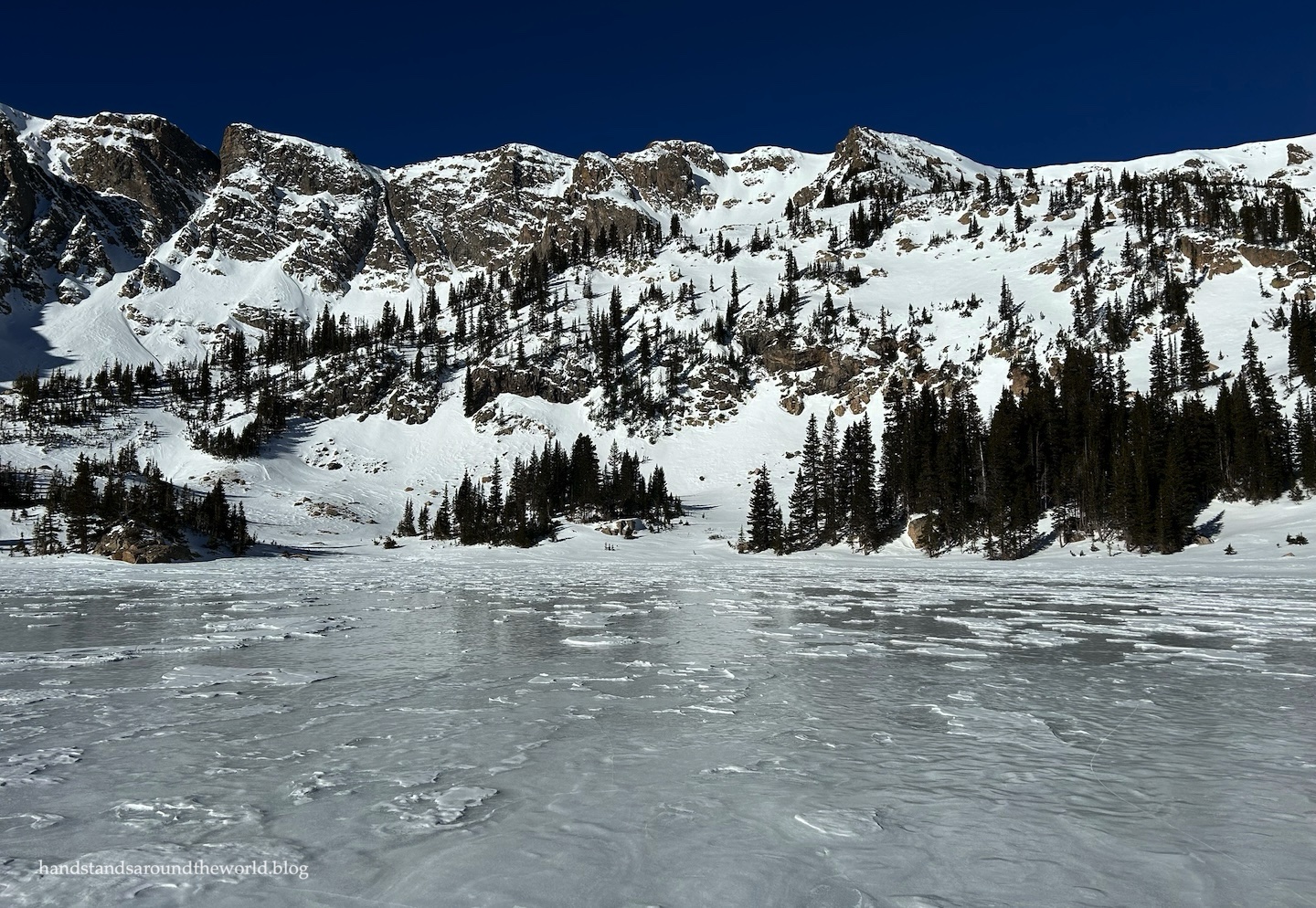
Upper Forest Lake is about 0.5 miles (0.8 km) and 200 vertical feet (60 m) above the lower lake. We did have a little trouble locating the actual trail, but using our GPS apps we were able to pick out the approximate route and make it to the upper lake. As is usually the case for me, the upper lake was my favorite. Set right at the base of the continental divide in a little bowl, the lake was frozen solid and shimmering beneath the clear blue sky.


After hanging out at the upper lake for a while – all by ourselves, by the way – we retraced our steps to the lower lake and back down the trail. It was a pretty uneventful hike and, once again, I didn’t take any photos of the trail itself. We were back to the car by lunchtime and back home not long after.
Compared to my previous summer hike from this trailhead, I’d say I definitely prefer winter. It’s much quieter, and we were able to sleep in a bit and start our hike at a normal time.
While there is potential avalanche danger along some of the other trails here, Forest Lakes is pretty safe. The only downside to a winter outing might be reaching the trailhead, as most of the drive takes place on two-lane roads that may be snowy and icy.
But if you can make it there safely, this was a nice, quiet place for a half-day snowshoe adventure.
Up next: Snapshots from the Sky (spring 2024 edition)
The Important Stuff:
- Getting there: East Portal/Moffat Tunnel trailhead is located at the end of East Portal Road (CO Rte 16) near Rollinsville, Colorado. Keep in mind that there is another Moffat Tunnel trailhead on the other side of the divide, as well as at least one other East Portal trailhead further north. There is also another Forest Lakes trailhead off Rollins Pass Road, but this is a 4WD only route and is not the main access point for this hike. Be sure you enter the correct location into your GPS.
- Fees and passes: none.
- Hiking: round trip distance to both lakes is 7.6 miles (12.2 km) with 1735 feet (530 m) elevation gain.
- Where to stay: backpacking is allowed in the James Peak Wilderness and there are a few established campsites in the surrounding national forest (though not along East Portal Road). Alternately, there is lodging nearby in Nederland, or this can be done as a day trip from the Front Range.
- Other: while this is a fairly safe trail in the winter in terms of avalanche risk, it’s still important to be prepared for cold, wind, snow, etc. We also saw moose tracks along the trail (though no actual moose), so be prepared for animal encounters as well.


Leave a Reply