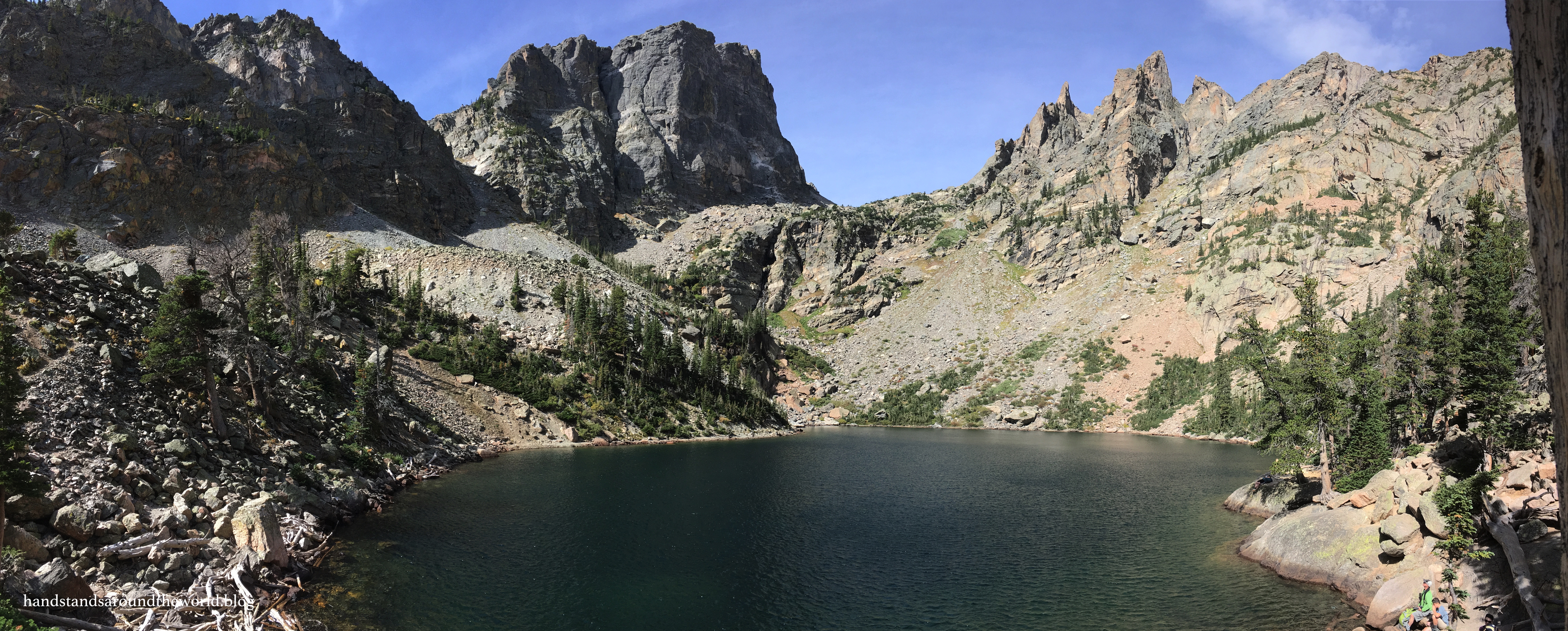
Bear Lake Trailhead to Nymph, Dream, and Emerald Lakes is one of the first hikes we ever did in Rocky, way back when we were barely acclimated and still so new to exploring the park.
It’s a hike we’ve repeated at least half a dozen times since, in all manner of weather and trail conditions. And honestly, it never really gets old. At this point, we mostly steer clear in the summer because, as one of the most popular hikes in the park, it’s always crowded. But we ended up hiking this trail twice in three weeks earlier this winter and I loved it both times.
In light of our many, many hikes to these three lakes, I decided it was high time to revamp this post and share our experiences with this trail in various seasons.
Table of Contents
Getting to Bear Lake
Rocky has a free shuttle that will get you from the Bear Lake Road Park-n-Ride to the Bear Lake trailhead from May through October, and I highly recommend using it. In the summer, this parking lot typically fills by 6:30am every day. The shuttle doesn’t run in the winter, but the parking lot doesn’t typically fill until about 10:00am on weekends and may not completely fill on weekdays.
Note that from Memorial Day to mid-October, you will also need a Timed Entry+ permit to reach Bear Lake, unless you plan to arrive prior to 5:00am or after 6:00pm.
From the shuttle stop/parking lot, Bear Lake is about 100 feet (30 m) up the trail to the right. If you’re looking for a short, easy stroll, a fairly flat trail encircles the lake.

In the winter, you may be able to walk on the lake. However, keep in mind that temperatures are often warmer at Bear Lake than at the higher elevations and the ice may not be stable. Every winter, people attempt to walk on the ice here and fall in. Only once, in the middle of a particularly cold winter, did we walk on Bear Lake. Otherwise, we’ve always kept safely on shore.


Nymph, Dream, and Emerald Lakes in summer and fall
To reach the three upper lakes, return to the parking area and follow signs left. At the next junction just a few steps up the trail, stay right, following signs toward Emerald Lake. Nymph, Dream, and Emerald Lakes are each located about 0.6 miles (1 km) and 300 vertical feet (90 m) apart. In summer and fall, the route is easy to follow.
Nymph Lake is the smallest of the lakes and – beautiful as it is – the least stunning of the three in my opinion.


The trail continues around the east (right) side of Nymph Lake and then begins to climb toward Dream Lake. After turning left and ascending along the base of a rocky section of hillside, there will be a viewpoint on your left with views of Nymph Lake.
The trail then curves right and continues to ascend to my favorite view, looking across to Glacier Gorge and Longs Peak.


Dream Lake lies in the shadow of the recognizable profile of Hallett Peak and its neighbor to the north, Flattop Mountain (from this angle, one would assume that Hallett Peak is actually Flattop Mountain, given its, well, flat top, but this is incorrect).


There is a rocky outcrop on this end of Dream Lake that is a great place to take a break, have a snack, and soak up the views. Please make note of the Restoration Area – Keep Off sign to the left, and stay out of that area to allow it to recover.
You’ll also find birds, chipmunks, and squirrels who are eager to steal your snacks. Please don’t feed them, intentionally or accidentally. When they become habituated, they lose the ability to find food on their own and may not survive the winter. Also, human food is harmful to their health.
From here, the trail continues along the north (right) shore of Dream Lake, all the way to the far end. From here, it’s time for the final push to Emerald Lake, which sits in a second, higher elevation valley beneath Hallett Peak. This is one of the steeper portions of the hike, but it’s well worth the effort.

The trail ends here, though Hallett Peak and Flattop Mountain can be ascended via other trails, and in the winter many ice climbers and backcountry skiers will make their way up the walls of the valley towards the ridgeline.
Nymph, Dream, and Emerald Lakes in winter and spring
As in summer, follow signs left and then right from the Bear Lake parking lot, putting you on the trail to Emerald Lake. Unless it has just snowed, the trail will likely be packed and easy to follow through this section. However, it may be icy, and upper sections of trail may not be as well trodden. From October-May (and maybe even in September and June) it’s advisable to wear microspikes on this hike. You may also want to strap snowshoes to your backpack for later.
The path to Nymph Lake is generally clear and easy to follow, though sometimes there will be a few social trails wandering off in other directions. Most of them will get you to the lake, but if you find yourself veering to the left, you’ve gone off track.


If the ice is frozen solid, you can cut across the middle of the lake. However, it’s important to know that you can’t tell the stability of the ice just from looking at it. It’s often warm and sunny enough during the day to soften the ice, especially in the spring. I personally wouldn’t walk across the ice on a warm day in the winter, and I wouldn’t walk on it at all during the spring.
From here, follow the trail up and around to the left. Again, this part is usually pretty well packed down unless it has recently snowed.


As the trail approaches Dream Lake, there is sometimes some confusion. Not far below the lake, people will often ignore the trail sign pointing right and cut straight across the creek instead. If the snow is deep and stable enough, this is not a problem (since everything is snow-covered, you’re not trampling vegetation by going off-trail). However, it’s always possible to break through the snow and end up with your foot in a creek. We usually stay right.


In the winter, most people will walk right across the frozen lake. This is what we have typically done as well, though in the spring we would stick to the trail. To catch up with the trail, veer slightly right at the far end of the lake. From this point on, you may need snowshoes. Fewer people venture all the way to Emerald Lake in the winter, therefore this section of trail is often not packed down as firmly.
The path to Emerald Lake, while not always packed, is usually at least visible. The steeper sections can be slippery and tricky in the snow. But if you can make it through, it’s worth it. On our most recent hike, we had the lake to ourselves for nearly 15 minutes!


While we’re on the topic of winter hiking, I should take a moment to discuss the very real avalanche danger that exists in Colorado in the winter. At one point back in 2019, there were 346 recorded avalanches in the state in a 7 day period!
This hike is relatively safe as far as avalanches are concerned, but there is a possibility for slides above Emerald Lake. If you don’t carry the proper avalanche equipment (beacon, shovel, and probe), it’s recommended to not travel beyond this point. Rocky is pretty good about keeping their website updated with road, trail, and avalanche conditions, so it’s always a good idea to check before heading out.
Alright, obligatory avalanche safety speech complete.
And if you ever visit Rocky in any season, this is a hike I highly recommend!
The Important Stuff:
- Getting there: this hike departs from the Bear Lake Trailhead at the end of Bear Lake Road; consider leaving your car at the park-n-ride in the summer and taking the free shuttle to the trailhead. From here, follow signs to Emerald Lake.
- Fees and passes: there is a $30/car daily or $35/car weekly entrance fee to RMNP; America the Beautiful passes are accepted. From May-Oct, if you arrive after 5:00am you will also need a timed entry permit to access this trailhead.
- Hiking: one-way distances from Bear Lake are 0.6 miles (1 km) to Nymph Lake, 1.2 miles (1.9 km) to Dream Lake, and 1.8 miles (2.9 km) to Emerald Lake; easy to moderate.
For more information, see my posts on visiting Rocky Mountain National Park and winter hiking tips and safety.


Leave a Reply to The Travel ArchitectCancel reply