Of our four days camped near Flathead Lake, we actually only spent two of them at the lake itself. The other two were spent visiting three of the main cities in the Flathead Valley: Whitefish, Kalispell, and Columbia Falls.
First up was Whitefish, a former railroad town that has become a resort town. The slopes of Whitefish Mountain ski area are visible from town, and the town itself is entirely catered to tourists, specifically tourists who desire vacations that involve shopping, golfing, skiing, and staying at expensive resorts.
As you’re probably aware, we are not that type of tourist and, as such, didn’t find Whitefish itself all that appealing. The view from town is pretty, and the pie from Loula’s – recommended to us before the trip – was indeed very tasty. The small history museum was a good place to spend 20 minutes. But I don’t feel the need to ever return to Whitefish.

Surrounding Whitefish, however, are many small lakes and one large lake, and I enjoyed that part of our day much more than the in-town portions. (Remember how I said in my first post that northwest Montana has so many lakes? For anyone who has been counting, which I’m assuming is no one, we’re closing in on twenty. And those are just the ones we stopped at. There are dozens more.)
The Whitefish Trail is actually an extensive interconnected network of trails through the surrounding hills. If we’d wanted to spend all day hiking, we could have walked many of these trails to glimpse all the lakes.
Since we had other plans for our day, we opted instead to drive to four of the lakes and just do one 2.6 mile (4.2 km) hike from Dollar Lake up to Whitefish Lake Overlook. The Whitefish Trail access roads are fairly well maintained and the trails themselves are signed and easy to follow. I do recommend taking a photo of the trail map (on the trailhead sign) before setting out to help navigate the many junctions.


Whitefish Lake is the largest of the lakes by quite a lot and is a popular recreation spot. Much of the lake shore is private but there are two state parks and some city beaches that allow access. It’s clear, though, that more public access is needed. Whitefish Lake State Park, for example, is in desperate need of more parking and a second boat launch. This was mid-afternoon on a Wednesday and we had to wait for someone to leave to get a spot and we watched as 6-7 groups all waited their turn at the single boat dock.

Les Mason State Park is much quieter and lacks a boat launch entirely, but it’s also pretty small. Nonetheless, we enjoyed some time at the shoreline in both parks. We’re probably the only people who would go on a lake trip that doesn’t involve a bunch of water sports, but oh well. We don’t have the gear for it and my mom doesn’t really enjoy being on the water.

We ended the day about 15 minutes away in Columbia Falls which, from my limited impression, was a little calmer and a lot less touristy. Truthfully we were only there for the beer, as Backslope Brewing sounded better than the Whitefish breweries. I ordered a flight and the nitro chai oatmeal stout was the clear favorite!

Our final day in town was spent in Kalispell, which is the largest city in the Flathead Valley. Kalispell also built up around the railroad and was the original division point for the Great Northern Railroad once it made it through the Rockies. Although the main rail line no longer runs through, the city has managed to survive.
We began our day in Kalispell with a drive up to Lone Pine State Park, perched on a hill west of town. The story goes that in the early 1890s, a leaning pine drew horseback riders and hikers from the newly founded town to “Lone Pine Hill” where they could rest and enjoy the view. It wasn’t clear which tree was the lone pine as there were a handful that fit the bill. Either way, it is in fact a nice view from there.
Unfortunately, wildfire smoke was obscuring the more distant scenery so it wasn’t nearly as expansive as it could have been.


Next up was the first of two museums: the Northwest Montana History Museum. This was by far the best museum we visited on this trip. It was organized, thorough, and overall very well done. Exhibits walked us through the indigenous and white history of the Flathead Valley, from the first known arrivals at least 6,000 years ago to present.

Probably the most surprising thing in the museum was this display of two bald eagles. In 1892, two Kalispell residents founded the Hollensteiner and Bogart Shoe Store. Later that year, a trapper came into the store in search of new winter boots. He didn’t have any money, but he had recently killed two bald eagles (hunting them was legal at the time) which he offered up as a trade. The proprietors accepted his offer, had the eagles mounted and displayed, and renamed their store Eagle Shoe Company. The store remained in business until 1976, complete with the eagles, both of which were then purchased by Hollensteiner’s grandson. Some research on the origin of the eagles led him to numerous organizations, all of which told him the same thing: they weren’t aware of any mounted eagles older than these two. These are likely the oldest in the world!


The second museum was the Conrad Mansion, built in 1895 for Charles E. Conrad and his family, who lived here for 7 years until his death. Conrad made his money through multiple ventures including as a river freighter and trader, before moving to – and founding – the town of Kalispell and opening the Conrad National Bank, the town’s first.


The mansion continued to be inhabited by members of the Conrad family until 1975 when his daughter donated it to the city. Thanks mostly to her propensity for hoarding, 90% of what you see in the mansion today is original! The 13,000 square foot home has three floors and 26 rooms, with indoor plumbing and electricity, and marble sinks in each bedroom.
While it’s very clear the family was exceptionally wealthy, this home wasn’t nearly as extravagant or gaudy as some of the mansions I’ve toured previously. I think that’s probably why I enjoyed it more. Don’t get me wrong, the mansions of a place like Newport are stunning but I find the opulence and excess to be really off-putting.


The food highlights of Kalispell for us were Sweet Peaks ice cream and Bias Brewing, where my mom had a tasty huckleberry seltzer while I sampled a flight that was so solid I actually couldn’t pick a favorite.

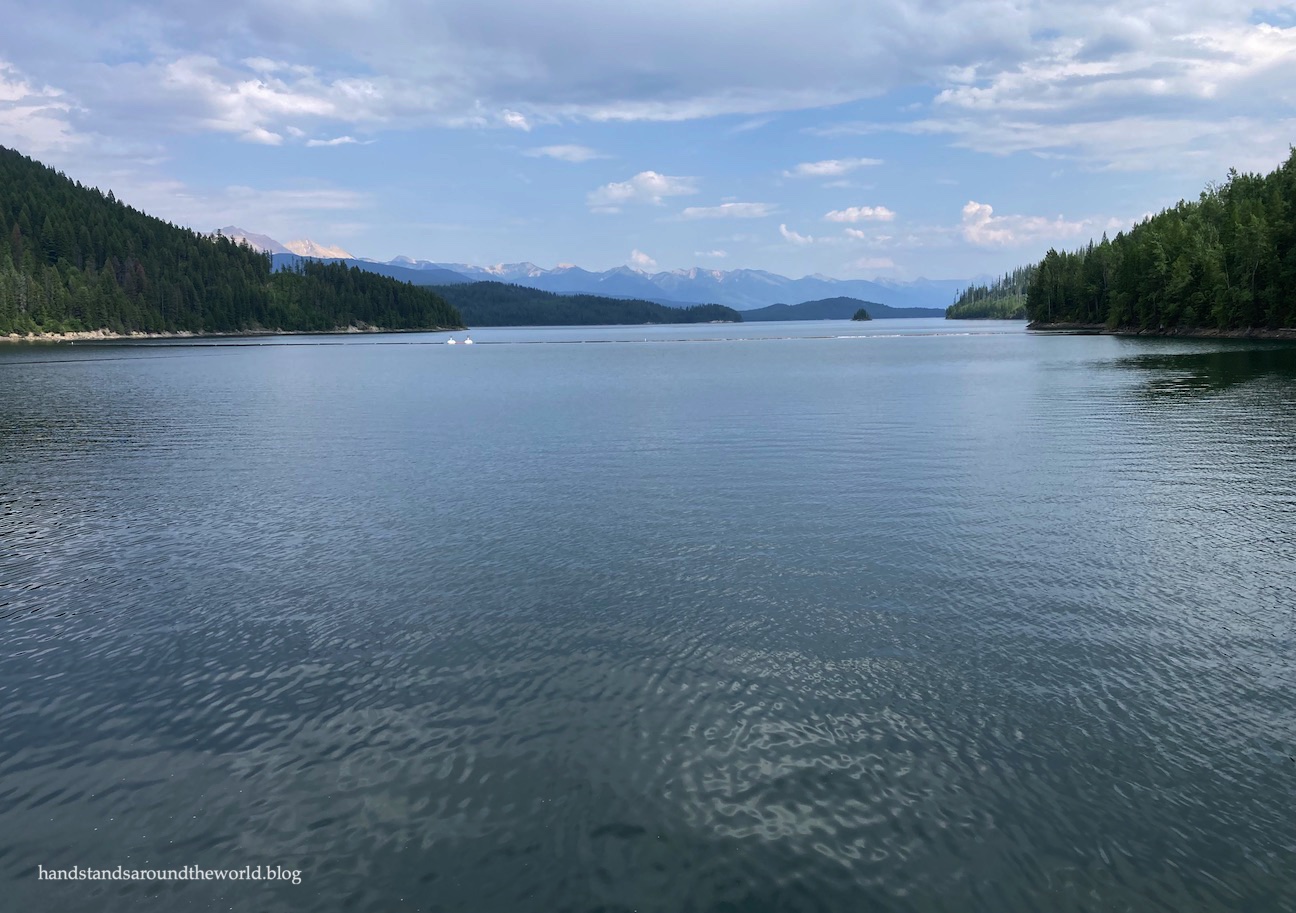
And then, after four days in the Flathead Valley, we waved goodbye to this beautiful area of the state and headed east toward our final campsite of the trip on the west shore of Hungry Horse Reservoir. The reservoir was formed in 1953 by the completion of the Hungry Horse Dam, both of which are named after two freight horses who wandered away and became separated from their owner in the winter of 1900-1901. Miraculously, after a month they were found, starving and weak but alive, and were nursed back to health.

There’s a visitor center at the dam with information and photos of its construction. The dam was built in the mid-1940s from over 83 million cubic feet (2.4 million cubic meters) of concrete. It stands 564 feet (172 m) tall, 2115 feet (645 m) long, and is 330 feet (101 m) thick at the base. It’s truly enormous, and even as I was looking at it I had trouble comprehending its immensity.

We arrived in time to sign up for the last free tour of the day. This 20 minute tour took us all the way across the top of the dam, during which we learned how much we didn’t know about dams.
I was taught from a young age that dams are bad, and I’ve now realized how one dimensional that viewpoint is. Yes, dams can be problematic, especially when they block the reproduction and/or migration patterns of aquatic animals or bury important historical sites. But dams are also one of the greenest energy sources and can be used to control flooding and manage fish populations.


Our tour guide talked a lot about the challenges of balancing flood prevention and power generation with the demand for recreation on the reservoir and the river, as well as how they help protect fish populations. For example, the dam has many systems in place to allow it to release water in a way that mimics the natural fluctuations that would occur in the river if the dam wasn’t present.
It was a really damn interesting tour!
(You know I had to throw a dam pun in there somewhere.)
We spent the night at Lid Creek Campground on the west shore of the reservoir. The campground was… fine. I was a little worried about noise given the multiple larger groups, and there was one person who apparently thought it was cool to blast music from his boat at a volume loud enough to be heard even when he was all the way across the lake.
I don’t know that I’d stay here again.


And thus ends the saga of Montana roadtrip 2023.
My mom and I actually spent one more day out exploring, wrapping up our trip with a quick visit to Glacier National Park. But I’m going to hold off on talking about that for now, because I returned to Montana a few days later with my husband and we spent twelve days frolicking in the incredible beauty of Glacier.
So hopefully you’re enjoying traveling vicariously through northwestern Montana because the journey is going to continue for a while.
Stay tuned!


Leave a Reply to DianaCancel reply