About a year and a half ago, C and I concocted an idea: spend a day in Estes Park.
It’s a town we drive through frequently en route to our hikes in Rocky Mountain National Park. But aside from a quick stop for coffee or beer on the way home, neither of us has actually spent substantial amounts of time there.
Turns out, there are a handful of neat things to do in town.
Of course, we weren’t going to join the throngs of tourists who descend on the town in the summer months, so we decided this day would need to take place in the offseason. And Estes is almost always windy, so it would need to be a day when the breeze was manageable. On a Saturday in February, a good weather forecast finally aligned with our schedules… so off we went!
We didn’t end up having exactly the day we planned – more on that shortly – but we had a good time nonetheless.
We opted to begin our day with the most challenging of our planned activities – a jaunt up Prospect Mountain. C had actually hiked this trail once before, but it was so windy on the summit that she’d been pretty miserable, so she was looking for some redemption.
We arrived at the trailhead to find it empty and, after pausing to read the signs, headed off up the path. It’s a mixture of dirt and rocks (and snow this time of year) and in places it’s very steep. The entire hike gains about 1000 feet (305 m) in 1.5 miles (2.4 km). As we climbed the wind picked up a little, but the views became progressively better. The clouds were also really neat.


Unfortunately, about 0.7 miles (1.1 km) into the hike we rounded a bend to find ourselves staring at a “Private property, no access beyond this point” sign placed right in the middle of the trail. The sign had not been there when C hiked this trail previously, nor was the closure mentioned at the trailhead. So that was frustrating.


Now we know why we were the only ones here. Unless you’re a rock climber, I don’t know why you’d hike this trail. I mean, the views were fine. But you can find similar views on other nearby mountains, and you can actually climb all the way to the top of them, so…
Anyway.
Our next stop was Lake Estes, a long, narrow reservoir formed in the 1940s by construction of a dam on the Big Thompson River. It’s a centerpiece of the town, visible from almost every high point nearby. The highway into town also runs adjacent to the lake, so we’d seen it from the car many times. The plan for today was to walk the 3.8 mile (6.1 km) trail that circumnavigates it.

There are many access points to this paved walking and bike path. We parked (for free) at the town visitor center garage and followed the sidewalk for a short distance along the edge of a golf course to the western shore of the lake. From here, signs pointed us in a clockwise direction so we heeded this instruction. The lake was half frozen, which resulted in a unique dichotomy of photos. Despite the fact that it looks like two different seasons – or at least two different days – these were all taken within the same one hour window.


If I were to do this walk again – which I don’t necessarily feel the need to – I would go counterclockwise instead. When walking clockwise, the first half of the walk is much more pleasant while the second half is adjacent to the highway and fairly noisy. Going counterclockwise would get the noisy half out of the way first and end with the more peaceful and scenic portion.


Since it was winter, we’d gotten a later start than usual, so by the time we made it around the lake we were very much overdue for some lunch. It probably would have been more on brand with the whole ‘tourist for a day’ thing to choose a local restaurant, but we weren’t feeling that strongly about any of them (nor had we put any effort into researching them), so we opted for Subway.
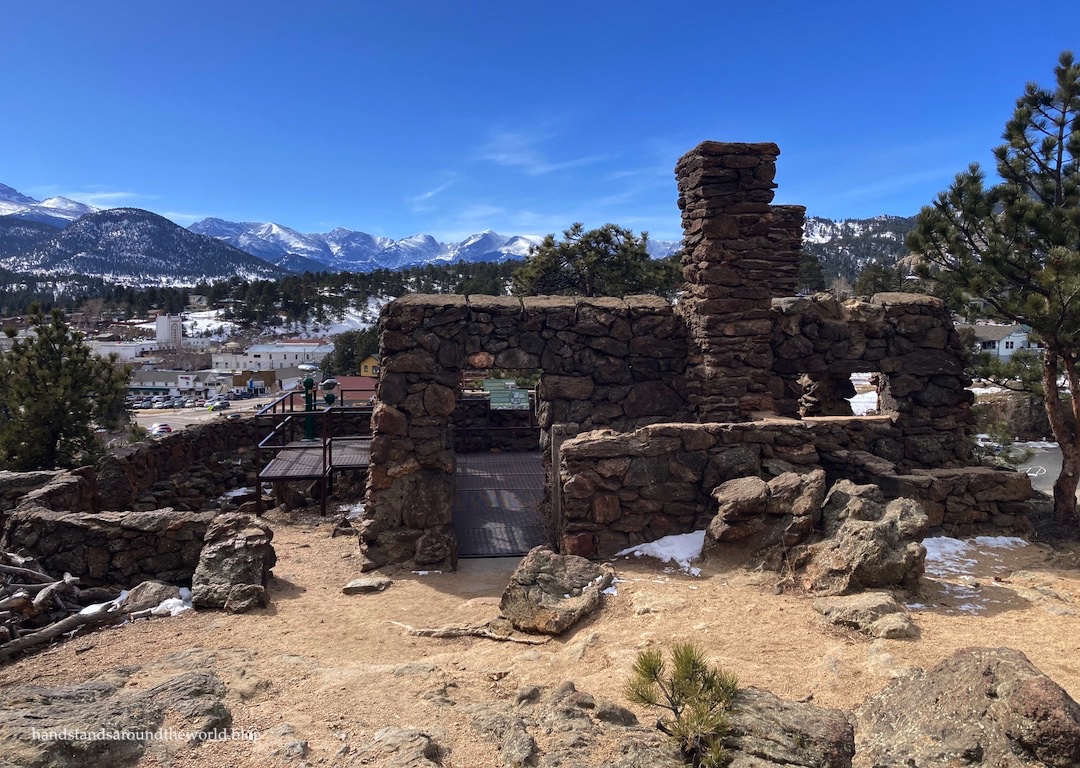
Up next on the itinerary was the Knoll-Willow Trailhead for a quick walk out to the remains of the Birch Cabin and Bungalow. Both were built in the early 1900s for Albert Birch, owner of the Denver Post (the local newspaper).
Unfortunately, just months after being built, the bungalow burned to the ground in the middle of the night. The cause of the blaze was later determined to be the result of a faulty fireplace. Fortunately, no one was hurt. Construction on the cabin began shortly after and it remained in the Birch family until the 1980s.


As you can see, the view from the bungalow was quite lovely. We spent a few minutes just standing here staring out at the very familiar mountains of the Continental Divide.

Our final stop of the day was the historic Stanley Hotel, known around the country (and possibly the world?) as the inspiration for Stephen King’s The Shining.
Although the movie was not filmed here, King was living in the hotel at the time he penned the novel. He was reportedly so displeased by the actual filming location and the script changes that he returned to Estes Park a few years later for the creation of The Shining TV miniseries, which was filmed at the hotel.
The movie Dumb and Dumber was also filmed at the Stanley.

Today, you can stay at the hotel when you visit Estes Park – if you dare. Apparently, it’s haunted. Even if you’re not an overnight guest, you can pay to take a tour of the hotel. This was our original plan. I checked the night before and there were plenty of tickets still available, so we opted not to purchase in advance so we had more flexibility.
By the time we showed up, all tours were sold out for the day.
Lesson learned.

However, you can walk around parts of the hotel on your own, free of charge, so we did that instead. We were able to wander through the first and second floors and around the grounds. We even solved the hedge maze out front. Admittedly, it was not challenging.


And that wraps up our day in Estes Park. It was fun to stop at some of the places that we always just drive right past, and to get to know the town a little better. So now, I will leave you with more of the many (too many) swirly cloud photos that are taking up space on my phone. Until next time!


Leave a Reply