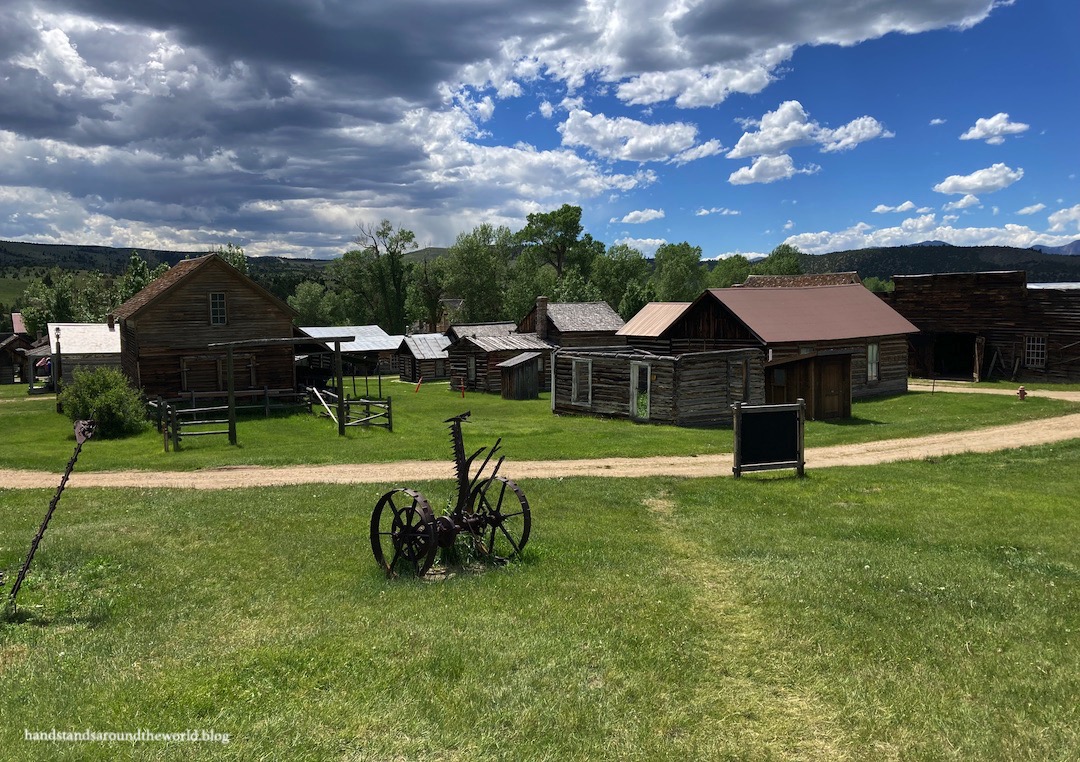
On May 26, 1863, six prospectors discovered gold in a region of southwest Montana known as Alder Gulch.
Almost overnight, the region went from a secret the men had intended to keep to themselves to a booming mining hub. Settlers rushed to the region, lured by the veins of quartz that contained large amounts of placer gold. In today’s dollars, between 1863 and 1889, over $40 billion in gold was mined in Alder Gulch!

During these years, a 14 mile (22.5 km) stretch of settlements popped up in Alder Gulch as a growing number of people settled the region. As mining technology advanced, the use of dredges became popular to accelerate the process. A dredge is an enormous piece of equipment that digs up the earth and facilitates the separation of minerals from the dirt and gravel. The dredge would slowly move downstream, leaving churned piles of dirt in its wake.
While it was an effective method of mining, it was also terribly destructive. For example, the entire settlement known as Western Nevada City was completely destroyed by dredging when gold was found beneath it. Even today, large piles of debris are still visible all throughout Alder Gulch.
As is the case with most former mining towns, eventually the gold dwindled and people left. By the mid 1900s, the settlements were mostly ghost towns. Around this time, a man named Charles Bovey visited Alder Gulch. Bovey was already a fairly prominent Montanan with a keen interest in preserving the state’s history.
As soon as they saw the crumbling remains of Virginia City and Nevada City – two of the remaining ghost towns – he and his wife Sue set about preserving them. They funded the effort largely with their own money and worked tirelessly for years to restore Virginia City. What remained of Nevada City was largely unsalvageable, so instead it was reconstructed using old buildings the Boveys had previously preserved elsewhere in the state.
And to think… Charles Bovey was originally scheduled to be aboard the Titanic on its fateful voyage. Who knows what would have become of these towns had he perished at sea.
Today, Virginia City is actually not completely a ghost town. About 200 people still live there (which is substantially less than the 30,000 people who lived in Alder Gulch during its heyday). The town survives on tourism, and the old buildings along the main street have been maintained and/or renovated and turned into shops.
You could maybe consider it a tourist trap. But we still enjoyed walking through town reading about all the old buildings and life here during the mining days. The photos below give a general idea of Virginia City, but it is much more expansive than what you see here.


I also really enjoyed the huckleberry honey lavender ice cream from the Virginia City Creamery!

There is free parking along the main street in town but, rather than drive, we elected to indulge our inner tourists and take the Alder Gulch Shortline Railroad from Nevada City to Virginia City. It costs $10/person and lasts about 35 minutes. A tour guide narrated the journey, and we enjoyed learning more about the history of the area. Interestingly, the railroad originally did not connect these two cities; the tracks of the Northern Pacific Railroad ended at Alder. This shortline railroad was built by Charles Bovey in the 1960s.


One particularly interesting tidbit we learned during the ride was about Sarah Bickford. A Black woman, she was born into slavery but traveled west after the Civil War. She worked as a nanny, then for local judge, and later opened a bakery and a lodge in Virginia City. Her second husband owned two thirds of the Virginia City Water Company at the time of his death; this was passed on to her, at which point she became one of the only women and Black people in the US to own a utility company.
After spending nearly 3 hours in Virginia City, we rode the train back to Nevada City for the afternoon.
Nevada City is different… it is not inhabited and visiting requires an admission fee (which I believe was also $10/person). It’s essentially an outdoor living history museum. There are more than 70 buildings here, some of which are original to Nevada City but most of which were salvaged from elsewhere in the state and moved here by the Boveys. Below is a handful of photos that will give you the gist of Nevada City but, again, this shows only a small portion of the museum.


On a high point above Virginia City is Boot Hill, the town’s original cemetery. Late that afternoon, we drove up to see the gravestones and read the signs, at which point it started raining (again) and lightning flashed in the distance… so we quickly hopped in the car and headed back down the hill so we weren’t the highest thing around.


We spent the night at Rambling Moose Campground just outside Virginia City, and we found it a suitable location. Our tent site had a gazebo for the picnic table, which was very useful when it started to rain again around dinner time. By dusk, the clouds were beginning to clear and we were treated to a rather colorful sunset.

As the colors vanished from the sky, we retired to our tent for the night. My mom’s fitbit had clocked over 17,000 steps; we were exhausted. And we still had one full day of our trip ahead of us. Stay tuned!
The Important Stuff:
- Getting there: Virginia and Nevada Cities are located about 2 miles (3.2 km) apart along Montana Highway 287 in Madison County.
- Fees and passes: There is no fee to park in Virginia City and walk around the entire town. There are a few things to see in Nevada City for free, but entry into the main area requires a $10/person admission fee. The Alder Gulch Shortline Railroad also costs $10/person. There are multiple departures per day from both towns. Tickets are first-come-first-served.
- Where to stay: There is one historic hotel in Virginia City (The Fairweather)… we looked around and it seems nice, but we didn’t actually stay here so I can’t provide any insight. We stayed at the Rambling Moose Campground outside Virginia City and it was pretty good. Other than that, lodging is limited. The nearest hotels are 20 minutes east in Ennis.
- Other: Wear good shoes and pack sun and rain gear for this… we spent almost the entire day outside and walked a lot. It was hot and sunny at times, and cool and rainy at others. Basically, be prepared for any and all weather. This is especially true if you take the train, because you may be a couple miles from your car. Also, bring water and snacks, unless you feel like paying an arm and a leg for food.


Leave a Reply to leightontravelsCancel reply