The Cub Lake trail is one we neglected for years.
It wasn’t intentional. It just never seemed to be at the top of my list.
In the summer, I prefer to take advantage of the nice weather and hike in the tundra. In the spring, this trail is a muddy mess. And shortly after I realized this would be a good winter hike, a forest fire burned through the area and the trail was closed for many months.
It has since reopened so, on a sunny winter day, we made our way down Fern Lake Road to the Cub Lake Trailhead. Initially the road is paved but eventually it turns to dirt. It has some bumps and potholes but should be passable by any car in good weather.
We’d gotten a much later start than normal on this particular morning, and with our 10:00am arrival we secured the very last parking spot at the trailhead overflow lot. Thank goodness for our Subaru and its clearance, allowing us to roll up and over the edge of the snowbank and into the lopsided space.


The trail begins in Moraine Park, a large and beautiful meadow. We crossed the Big Thompson River on a bridge and continued across the meadow on a flat trail. This area receives a lot of sun; it was warm and the snow was beginning to melt. After about 0.5 miles (0.8 km), the trail curves 90° to the west and roughly parallels the river as it begins to gradually gain elevation. This area is very marshy.


Eventually, the trail makes another 90° curve and begins to climb in earnest. The total elevation gain for this hike is 765 feet (233 m), most of which is in this final 0.5 miles (0.8 km). The trail enters the trees – at which point it became much snowier – and zigzags its way up and around a hill to Cub Lake.


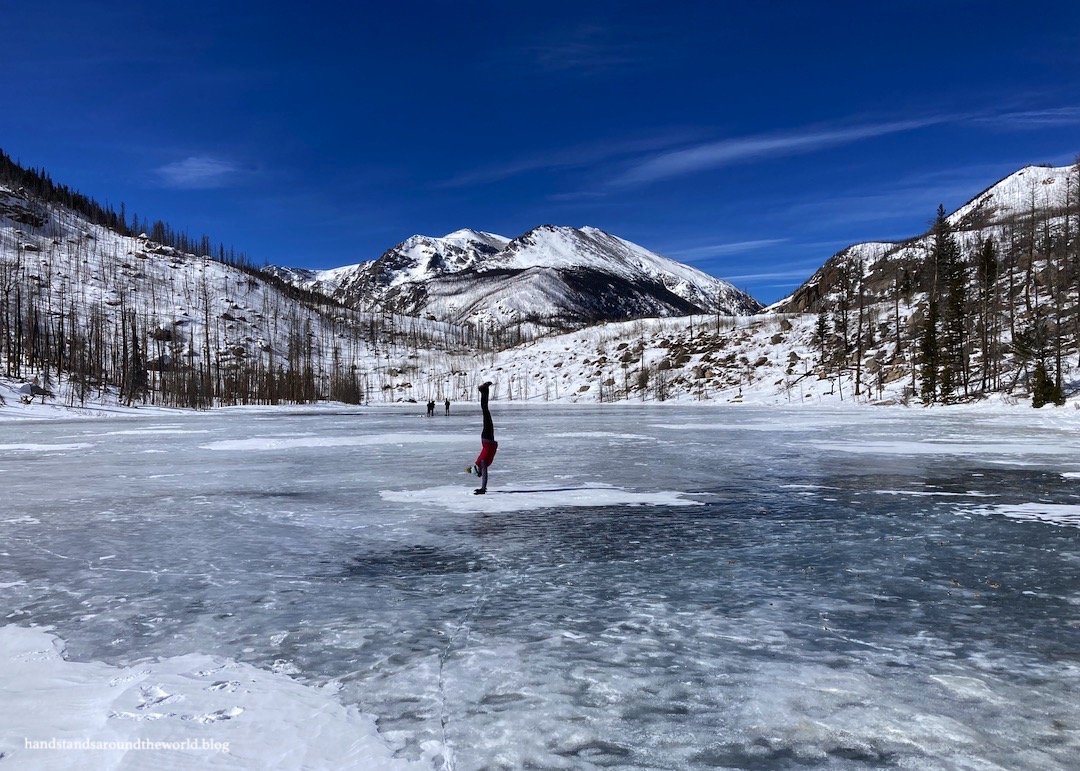
As usual, I assumed that because this was a shorter hike to a lower elevation lake, it would lack the ‘wow’ factor of the higher elevation lakes in Rocky. And, as usual, I was proven wrong. Cub Lake is a lovely destination, even with the remnants of the fire along one shore.

The lake was frozen solid; we stepped out onto the ice beneath the backdrop of snow-covered mountains and bright blue skies. I absolutely love walking on frozen alpine lakes (but only when we know it’s safe to do so… in this case, we could see the ice was at least a foot (30 cm) thick). It’s such a fun feeling to walk across the frozen surface, and the patterns in the ice are so neat.
In some areas, the ice is clear and you can look down and see air bubbles and other patterns. In the summer, Cub Lake is covered in lilypads. In the winter, the ice freezes around the lilypad stems in circular patterns.


It was a relatively warm and calm day so we spent about twenty minutes walking across the lake admiring the ice and taking photos. Despite all the cars at the trailhead, there were only two other groups at the lake. Clearly most people either don’t come all the way to Cub Lake or take one of the other trails in the area. I wasn’t complaining. It’s always nice to have some solitude.
I love that we’ve been visiting Rocky for so many years and there are still new things to see. And I’m glad we finally gave this trail a chance, because we didn’t realize what we were missing.
The Important Stuff
- Getting there: the Cub Lake hike begins at Cub Lake trailhead off Fern Lake Road; there is limited parking which fills by 8:00am in the summer and 10:00am in the winter. In the summer, consider taking the free park shuttle to the trailhead.
- Fees and passes: there is a $30/car daily or $35/car weekly entrance fee to RMNP; America the Beautiful passes are accepted. From May-Oct, if you arrive after 5:00am you will also need a timed entry permit to access this trailhead.
- Hiking: if you do this hike as an out-and-back as we did, round trip distance is 5.4 miles (8.7 km) with about 765 feet (235 m) of elevation gain. This trail can also be combined with the Fern Lake Trail to form a loop
- Other: especially in the winter, pack lots of layers for this hike. The first half of the trail is sunny and exposed. The second half is shady and snowy. It’s windy at the lake. You’ll need a variety of clothes to maintain the proper temperature
For more information, see my posts on visiting Rocky Mountain National Park and winter hiking tips and safety.


Leave a Reply to Jeff HairfieldCancel reply