Handstands Around the World

a former gymnast with a neverending case of wanderlust


Montana road trip 2021, part II: Fort Benton & the Missouri River Breaks

If you know me – or you’ve been following this blog for a while – you know I’m a planner. Some might say I’m an overplanner. I usually have a lengthy and well-researched list of things to do at each destination.

Such was not the case for these first couple days of our road trip. We had a full day to spend in Great Falls and only a couple things on our to-do list. We realized quite quickly that we were going to have a bunch of extra time… so we looked at our map, found Fort Benton National Historic Landmark about 30 mins northeast, and decided to go check it out.

We had no idea what to expect and were pleasantly surprised!

Missouri River overlook on the drive between Great Falls and Fort Benton

Fort Benton is located at the western edge of the Missouri River Breaks, named for the badlands-type terrain and the appearance that the ground simply breaks away to the river. In 2001, a 149 mile (240 km) section of river and the surrounding land was designated Upper Missouri River Breaks National Monument and placed under the control of the BLM. While most of this enormous monument (377,000 acres) is primitive and accessible only by boat, there is an interpretive center in Fort Benton. This was our first stop.

Western end of the Missouri River Breaks

From here, a 0.75 mile (1.2 km) trail meanders along the riverfront through the town of Fort Benton. There are informational signs all along the way discussing history of the region. This includes the passage of the Lewis & Clark expedition, the many Native American tribes (Assiniboine, Crow, Blackfeet, and Gros Ventre) who originally inhabited this land, and the founding of Fort Benton by white settlers.

Fort Benton was established in 1846 and is the oldest continuously inhabited white settlement in Montana. It was originally a trading post for fur trappers but morphed into a major transportation hub with the arrival of steamboats up the Missouri River. For nearly 30 years, 75% of all goods being shipped to the northwest came through Fort Benton. Although steamboats were unable to proceed any further upriver due to the terrain, cargo was transferred to wagons and stagecoaches here and transported as far as Idaho, Washington, and Canada.

Prospectors traveling west for the gold rush also came through Fort Benton and continued west on the Mullan Road, a 500 mile (805 km) path to Washington and the first federal highway in the region. Departing from Fort Benton and heading north was the Whoop-Up Trail to Alberta, a trading route for bison furs and whiskey (the whiskey part was illegal but persisted for many years before police put an end to it).

The Nez Perce, under the lead of Chief Joseph, also fled through this area in 1877 during the Nez Perce War. By the 1850s, the US government had already stolen some of their native homeland and forced them onto a reservation. Ten years later, the government sought to drastically decrease the size of this reservation, laying claim to about 90% of the land.

While some of the Nez Perce agreed to the terms of this new agreement, others did not and attempted to flee to Canada to seek asylum. They were pursued by the US army and ultimately cornered not far from the Canadian border, at which time they surrendered under the impression that they would be able to return to their reservation in Idaho. Unsurprisingly, the US government did not uphold their end of this agreement.

The rifle Chief Joseph offered in surrender is on display in Fort Benton, along with his famous speech. Some of you may have heard it before; I know I learned it in school.

Chief Joseph’s surrender
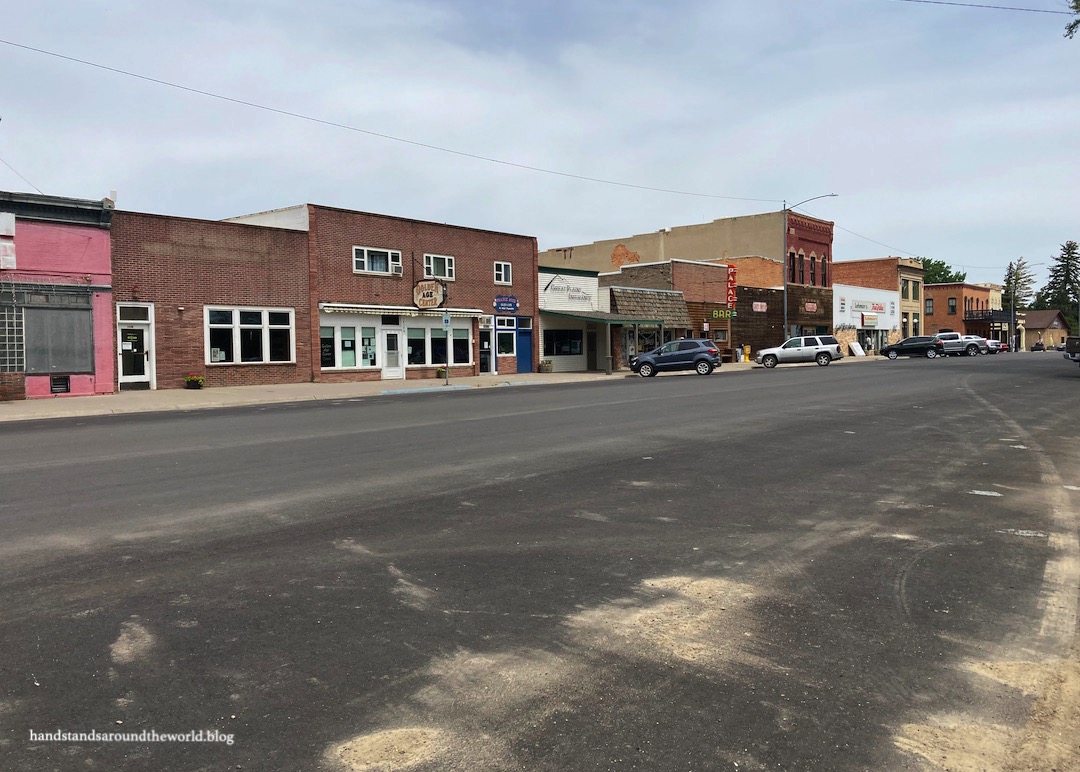
Downtown Fort Benton definitely still has the appearance of an old western town
Missouri River and the Grand Union Hotel (red building on the right)
Fort Benton bridge – the first steel bridge across the Missouri in Montana, opening a trade pathway with a newly-established town to the south. The bridge rotated to allow passage of steamboats.
View from the bridge
Had to do a handstand on the bridge, of course
George Montgomery: born near Fort Benton, he built homes, sculptures, and furniture, and was also a Hollywood movie and TV star
Thomas Meagher (pronunciation: ‘mar’): an Irishman, Civil War hero, and the first acting governor of Montana. He drowned in the Missouri River at Fort Benton in 1867 but whether his death was murder, suicide, or accidental was never determined and his body was never found
The Montana Memorial, built for the national bicentennial in 1976 by Bob Scriver, one of the greatest sculptors from the American west. It depicts – with remarkable accuracy and attention to detail – Lewis, Clark, and Sacagawea

At the east end of town is Old Fort Benton… the original trading post. After trading declined it was sold to the military, which ultimately abandoned it due to a rat infestation (I can only imagine how horrifying that must have been). It fell into disrepair for 30 years until money was finally appropriated to repair it.

Only one small part of what is there today is the original structure; it’s actually the oldest original building in Montana. It’s called the Blockhouse and is made of logs and adobe.

Blockhouse

The rest of the fort has been rebuilt and you can tour it and the adjacent museum. By this point in the day we had done a lot of reading and our brains were incapable of soaking in any more information, so we didn’t spend all that much time here. But it was neat to see some of the old artifacts and walk around the fort.

Fort Benton
Inside the walls of the fort
The rooms were filled with artifacts from the era

Fully armed with all this newly-acquired knowledge of the history of the region, we then made our way back along the river to the car and headed back to Great Falls for the night.


The Important Stuff:

  • Getting there: Fort Benton is located in north-central Montana on US Highway 87.

  • Fees and passes: one combined $5/person admission fee will get you into both the Missouri River Breaks Interpretive Center and Historic Old Fort Benton (and I believe a couple other things in town); America the Beautiful passes are accepted at both locations.

  • Hiking: a flat, paved trail travels about 0.75 miles (1.2 km) along the waterfront in town from the interpretive center to the fort.

  • Where to stay: there are a couple hotels in Fort Benton and a handful of campgrounds in the area; you could also stay in Great Falls and do this as a day trip.

  • Other: If you’re planning to explore the town, come prepared with good walking shoes and be ready to read lots of signs. If you’re looking to explore Missouri River Breaks, you’ll need a boat and the know-how to navigate the canyons (more info here).

17 responses to “Montana road trip 2021, part II: Fort Benton & the Missouri River Breaks”

  1. So much bloodshed and so much history in this part of the world. Allan

  2. Thanks for sharing this..I would love to visit Montana.so much to see…especially Fort Benton ..very historic site .

  3. Excellent write-up and photos! Thanks for the tour … and the handstand!

    1. Thank you!

  4. Isn’t it great when you stumble upon an attraction that wasn’t even on your radar when trip planning? This looks like a neat area to explore and learn more about its history. P.S. as someone who enjoys trip planning too, all I can say is that there is no such thing as overplanning 🙂

    1. Ahahah so glad I’m not the only highly detailed planner out there. And yes, I love it when you happen upon a gem of a destination 😊

  5. I have great friends in Eureka, Montana. We’ve travelled to Peru together, and did a two week paddling trip from the Yukon to the Gulf of Alaska. If you go, check out Jax’s Cafe.

    1. Oh neat! I’ve never made it as far east as Eureka… perhaps a destination for a future Montana roadtrip.

  6. I know what you mean, Diana – when I am in the midst of planning a vacation, it’s so easy to get carried away, especially as I am trawling through guide books and blog posts conducting research. That’s why, over the last few years, I try to take it easier, otherwise it can be overwhelming that there is simply not enough time to do everything I want to do.

    And – what an interesting place to squeeze in to explore on your visit around Montana. I love the wild and scenic location of Fort Benton on the Missouri River that seems to offer plenty of beauty and solitude. Thanks for sharing and have a good day 🙂 Aiva

    1. I’ve been trying to plan less as well… it’s a work in progress, admittedly. I’m learning I’m not good at not having a plan. But as proved here, it can be fun to just stumble upon things as you go. Thanks so much for stopping by 😊

  7. I’d never heard of Fort Benton or Chief Joseph before – thank you for educating me 🙂

  8. Loved this story. I have read extensively of Chief Joseph and the Nez Perce. You know he was a leader but not a war chief…. more of a medicine man. He was thrust into the role of Chief after Looking Glass and Toolhoolzote were killed. They were the fighters. Joseph just wanted to live in the Wallowa Valley of eastern Washington as his band of the Nez Perce were originally promised they could. We call this the Nez Perce War but after the deaths of Looking Glass and Toolhoolzote they only battled when they were attacked. Joseph was trying reach Sitting Bull and the Sioux in Canada for protection as all the other tribes had turned against them.
    If you want to learn more read “Thunder in the Mountains” by Daniel Sharfstein. Joseph’s native name, Hinmatóowyalahtq̓it, means “Thunder rolls down the Mountain”. Great story!

  9. Thanks for your thorough explanation of the history of this region and the important role that Fort Benton Benton played for many years.

    And it is important that we learn from the history of this sad chapter with the tragic treatment of Chief Joseph and his people contrary to those who assert that schools should not include these kinds of facts in the curriculum.

  10. I’m with you on overplanning; I tend to do the same, so when there isn’t much on the itinerary, I’m at a loss as to what to do with all of that spare time! Fort Benton was definitely good choice to stop by at: the history of white settlers essentially stealing Native land (as well as throughout the rest of North America) is a tragic and unjust event, and it’s humbling to check out how the place has since changed throughout those past times. Fort Benson is certainly a piece of history that we did not learn from US history textbooks!

    1. I don’t remember ever learning about it either. My mom also had no idea. It’s clearly overlooked. And yes, the way settlers treated Natives is truly awful. I’ve been to a couple other places this last year where I learned more pieces of history in regards to colonization and it’s very upsetting.

  11. I like Fort Benton. In Canada at that time forts were usually built of wood, it’s interesting to see how adobe is used here.

    1. Yes, I was surprised to see adobe… in the southern US it’s common but it isn’t usually used this far north.

Leave a Reply to denisebushphotoCancel reply