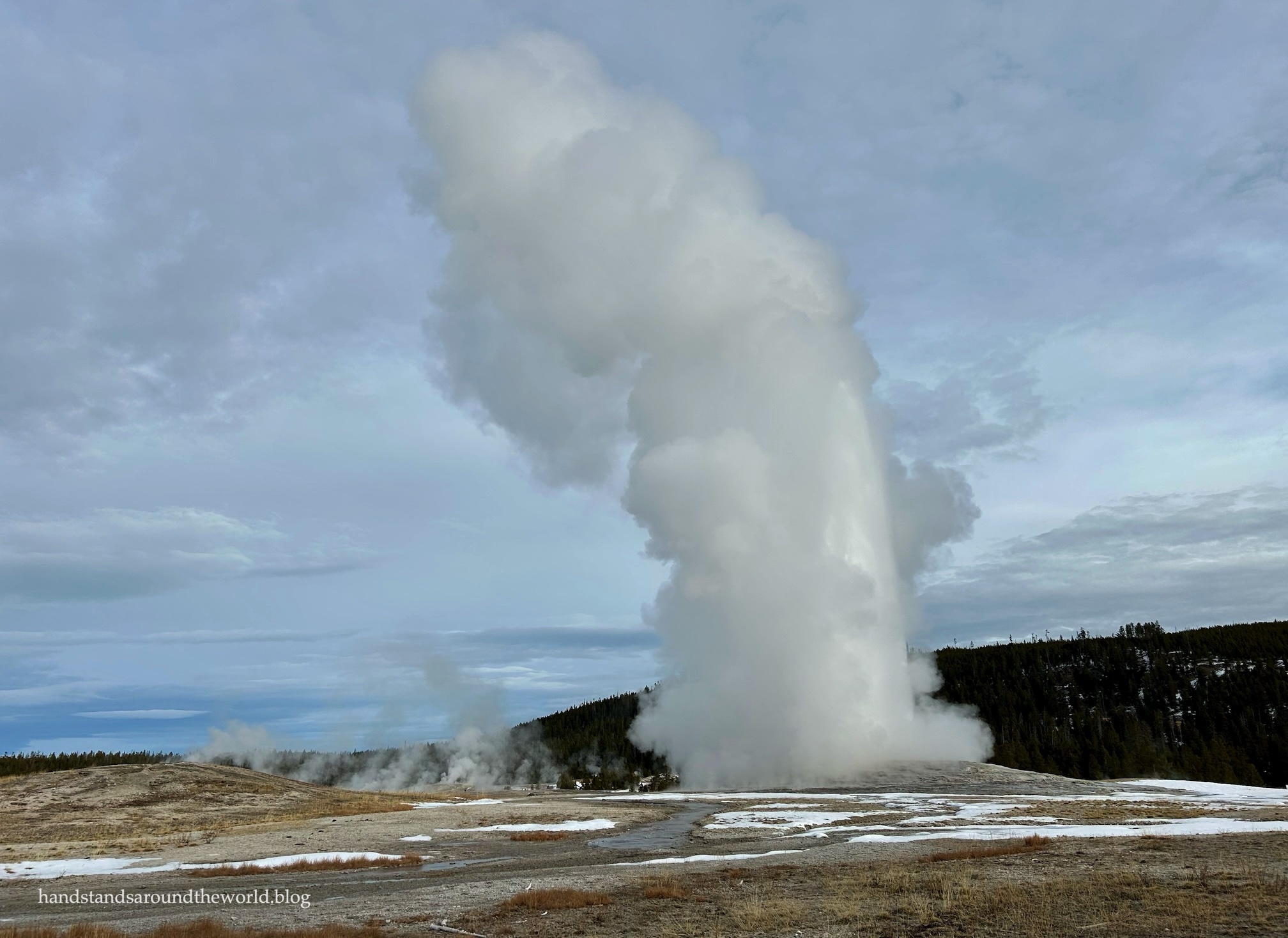
In last week’s edition of this Yellowstone saga, we traveled a decent distance and stopped at multiple geyser basins. In today’s edition, we’ll pretty much be staying in one location: Upper Geyser Basin, home to the famous Old Faithful Geyser.
Of course, this is the main reason people visit Upper Basin. But I think what most people don’t realize is that Upper is actually the largest geyser basin in the park and, in fact, home to more active geysers than anywhere else in the world!
There’s so much more to see here than just Old Faithful. So grab your backpack, load it up with food, water, sunscreen, rain gear, and a camera, and let’s head out for a thorough exploration of Upper Geyser Basin.
(There are multiple routes through the basin; some are boardwalks or gravel paths and are for foot travel only. However, a paved path runs along the west edge of the basin and is also open to cycling, so you could grab your bike for this as well. Just beware that you’ll have to periodically park your bike and walk if you want to see the geysers and hot springs that are along the boardwalks.)
Here is a map of Upper Basin.
Table of contents
Old Faithful
Like all geysers in the park, Old Faithful is at the mercy of the underground plumbing systems that accumulate hot water, steam, and pressure until the threshold is reached and an eruption occurs. Because these plumbing systems shift over time, Old Faithful’s eruption schedule changes, too. Just in the course of my lifetime, its eruptions have become more variable and less frequent.
Currently, Old Faithful cycles between long and short eruptions, with a gap of approximately 70 minutes after a long eruption (meaning the next one will be short) and approximately 95 minutes after a short eruption (meaning the next one will be long). Eruption predictions are not exact but, for Old Faithful, most will occur within ±10 minutes of the predicted time.
If you find yourself with some time to kill before the next eruption, the visitor center is about a 3 minute walk from the geyser and is a great place to learn more about Yellowstone’s geothermal features. There are also gift shops, restaurants, a picnic area, and other amenities in the Old Faithful area, so there’s no shortage of things to do while you wait.

The boardwalks surrounding Old Faithful are the main place to watch an eruption, and to get the best seat, you’ll need to get there early. During the summer you can expect at least 500 other people to join you.
If you’ve never seen Old Faithful before, it is pretty neat to watch it erupt from up close, because you can see it and hear it and smell it and, if the wind is blowing toward you, you may even get sprayed with some of the water. It’s a unique experience.
But if you’ve seen it erupt before, or you’re sticking around long enough to watch it erupt a second time, I recommend one of the alternative viewing options.
If you follow the path around behind Old Faithful and cross the Firehole River, you’ll find yourself at Geyser Hill. In addition to a couple dozen hot springs and geysers, there’s also a nice spot here (near Anemone Geyser) to watch Old Faithful erupt from afar.

For the most solitude, you can climb to Observation Point. This past summer, we watched the geyser erupt from the main boardwalk, headed into the visitor center in between eruptions, and then braved the steep climb to Observation Point to watch it erupt again.
The trail to Observation Point branches off to the right just before Geyser Hill and climbs about 270 feet (80 m) in 0.5 miles (0.8 km) to a viewpoint.

From here, you can head back down the same way or make it a 1.2 mile (2 km) loop with a visit to Solitary Geyser, which experiences small eruptions every 4-8 minutes.
Geyser Hill
From Solitary Geyser, we descend into the heart of Geyser Hill, home to an array of hot springs and geysers. Some are small with frequent eruptions. Others are large with taller but infrequent eruptions. And some are in between. Despite my many visits, I’ve only actually seen a couple of these erupt.


Also of note in this group is Beehive Geyser, which currently erupts approximately once per day. Every once in a while, it erupts at the same time as Old Faithful!


Grand Group
Continuing around the basin in a counter clockwise (ish) direction, we come to the Grand Group – home to another couple dozen geysers and hot springs. The centerpiece is Grand Geyser which I personally think – and I realize this is a controversial thing to say – is better than Old Faithful.
Its eruptions aren’t quite as tall, but they last much longer. It’s one of my favorite geysers in the park.


Giant Group
From here, the boardwalk descends, crosses the Firehole River, and climbs to the Giant Group. The main attraction here is Giant Geyser, which erupts on an extremely infrequent and irregular schedule. Its eruptions are among the tallest in Yellowstone; I’d love to witness an eruption one day, though it will require a pretty hefty dose of luck.


We rejoin the paved path at Grotto Geyser, which is my personal favorite due to its shape. It’s hypothesized that the structure of Grotto Geyser formed through mineral accumulation on dead tree trunks.


Morning Glory Group
Just ahead is Riverside Geyser which, as the name suggests, is located on the banks of the Firehole River. I witnessed an eruption last year for the first time ever, and it was really unique to watch a geyser spew water into the air and then down into the river.

Riverside geyser is on the far end of the Morning Glory group. Unlike the other groups, this one is not named for a geyser but rather for a hot spring.
Morning Glory Pool is a hot spring with a sad history. This hot spring got its name from its brilliant blue color. However, this color is no longer present. As one of Yellowstone’s main attractions, Morning Glory Pool has always received a lot of visitors. It used to be much more accessible (I believe you could drive right up to it), which meant even more visitors.
Sadly, many of these visitors decided the pool would make a good wishing well and threw not just coins, but also larger objects (including a wooden chair) into it over the years. Some of these objects partially clogged the vents, lowering the water temperature and forever altering the pool.
Though it’s still pretty, it will never again look the same as it once did.


Daisy Group
From the Morning Glory area, you can continue on the path and eventually reach Biscuit Basin (which is currently closed). Instead, we’re going to turn around and head back to the car, this time on the lower portion of the pathway through Upper Basin.
Off to the west (right) is the Daisy Group, home to Daisy Geyser (which erupts fairly frequently, and at a distinct angle) as well as a few other hot springs and geysers.

If you continue past Daisy Geyser, following the trail toward Black Sand Basin, you’ll come to my favorite hot spring in the entire park: Punchbowl Spring. It’s a bit out of the way, and kind of on its own, but it’s definitely worth the walk.


Castle Group
Lastly, as we make our way back toward Old Faithful, is the distinctly large cone of Castle Geyser and the Castle Group. I’m not sure I’ve ever witnessed the full eruption of this geyser (it’s about 75 feet/23m tall), but I’ve seen smaller eruptions.


And that completes our tour of Upper Geyser Basin! Hopefully this post has convinced you to devote at least a half day to seeing not just Old Faithful, but all the other hot springs and geysers here as well. Thousands of people visit Upper Basin each day to watch Old Faithful, but so few ever venture beyond.
Even though most of the other geysers here erupt less frequently – meaning you might not actually see many other eruptions – I think it’s still worth the walk. Geysers and hot springs come in all shapes and sizes, and nowhere is that more visible than here at Upper Geyser Basin.
Up next: Yellowstone National Park, part IV: Old Faithful to Canyon Village


Leave a Reply to ShellyCancel reply