I never know what will be the next trigger that sends me into a travel planning spiral, nor can I predict when it will happen. But it does seem – with at least some frequency – to happen after my husband has gone to bed.
Such was the case with our recent long weekend trip to Nebraska.
It all started with an instagram post about one of my favorite bands – who, as it just so happened, would be performing a concert in Nebraska in a couple months time. Less than an hour later, it had morphed into an entire four-day getaway.
This was not the first time my husband has woken to find an entire possible trip itinerary in his inbox, and it probably won’t be the last time.
Oh, who are we kidding? It definitely won’t be the last time.
Anyway. If we were going to drive all the way across Nebraska to attend a concert, we were going to make a weekend out of it. So my husband swapped shifts with a coworker and I packed my work laptop, and by sunrise on Friday morning we were already approaching the Colorado-Nebraska border.

We’d been to Nebraska before, but only the western edge, so this was all new territory for us. Once we crossed the border, it turned into a very grey and gloomy day. I’m not sure if that’s typical for Nebraska at this time of year, but it was certainly our experience. In fact, most of our drive looked like this:

Even though we were now in Nebraska, it was still a long drive across the state to Omaha, and we planned to make it even longer with a couple stops along the way.
First up: Fort Kearny.
Fort Kearny State Historical Park
As travel on the Oregon Trail increased, so too did the need for military and supply posts. Fort Kearny, built in 1848 along the Platte River in central Nebraska, was the first.
While many travelers headed to Oregon, some also branched off to the south and made their way to California during the gold rush. Mormon pioneers also followed this section of the Oregon Trail on their way to Utah in search of freedom from religious persecution. By the 1860s, the fort had also become a stop along the Pony Express.
It was also briefly used during the Indian Wars of the mid-1860s, though it lacked fortifications and never came under fire. Its final job was protection of workers building the transcontinental railroad. By 1871, the fort had mostly fallen into disuse.
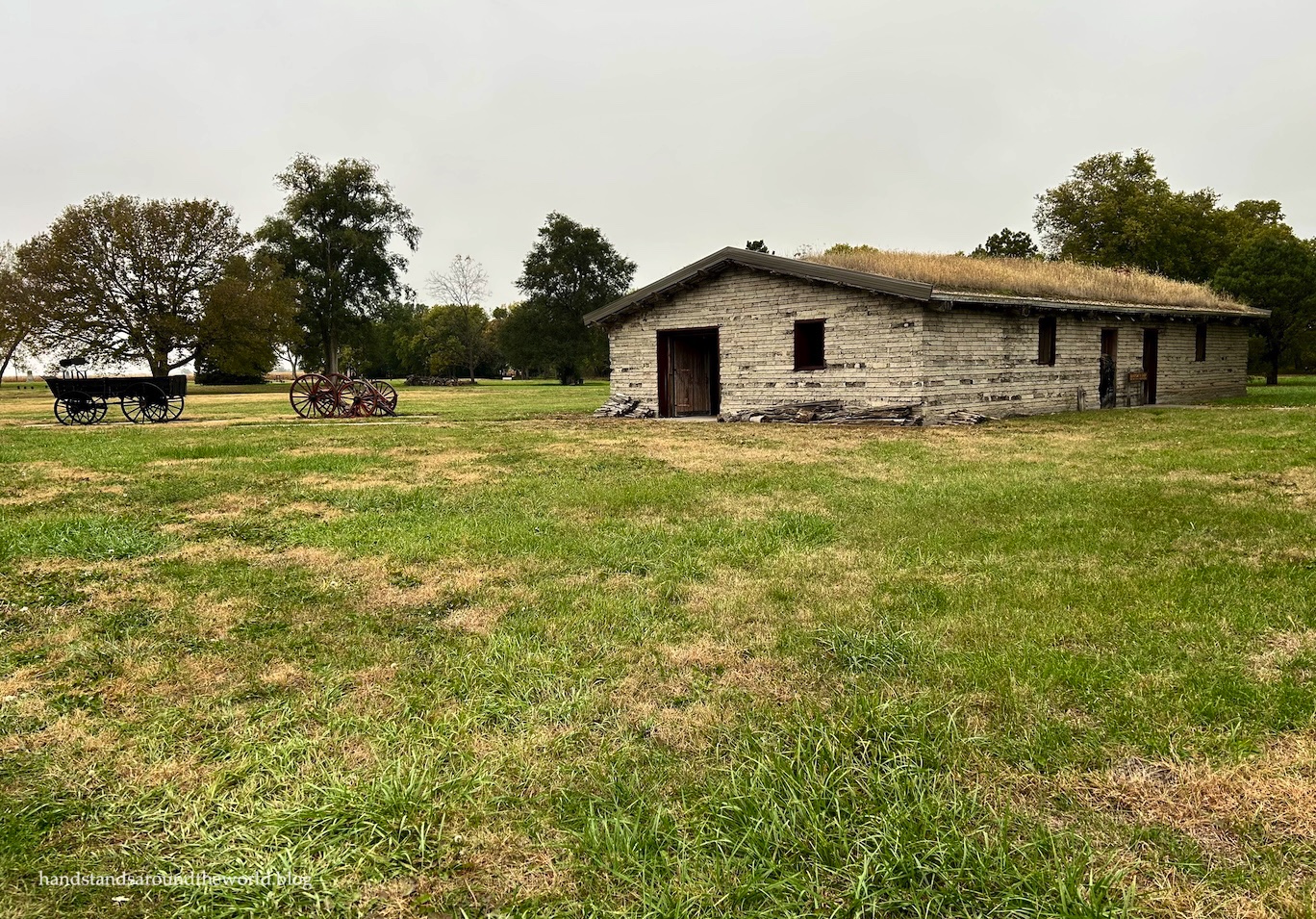
Today, very little remains of the fort. There are outlines of the original buildings, and a reconstructed blacksmith shop, powder magazine, and stockade.


Because it was the off-season, the visitor center was closed. The fort charges admission, but there were no envelopes or instructions for payment, so we took that to mean that fees are only charged in the summer. It’s just as well; it wasn’t worth the $14/car price for out-of-state vehicles. Pretty much all we were able to do was eat lunch (in the car, because it was cold and drizzly), use the bathroom, and wander around the grounds.
We couldn’t even really read the signs, because most of them looked like this:

Oh well. It was a good opportunity to stop and stretch our legs, and to see what remains of Fort Kearny.

It took us less than 30 minutes to walk through the entire fort, and then we were back in the car and continuing the journey to Omaha.
Lincoln
My coworker actually also recently drove all the way to Nebraska to attend a concert, though in his case the performance was in Lincoln. In the aftermath of his trip, I gathered that there are quite a few things to do in Nebraska’s capitol city.
Since we only had an hour, we chose just one: touring the Capitol.

It was nearing 4:00pm and the last guided tour of the day as we finally exited the highway and found ourselves on the streets of Lincoln. By the time we found parking and navigated our way into the building, we figured we’d be too late and would just do a self-guided tour.
But luck was on our side. We found free 2-hour parking right in front of the building and made it to the visitor information desk with 8 minutes to spare. And I’m so glad we did, because our tour guide was phenomenal (honestly, she was one of the best guides I’ve had on any tour ever) and we learned so much about the design of the building that we otherwise wouldn’t have.
I’ve been to half a dozen US capitol buildings, and Nebraska’s just might be my favorite. It’s certainly the most artistic. Every single detail of the building was carefully designed to tell a piece of Nebraska’s story, from the indigenous populations to the pioneers to the modern-day residents of the state.
The architect carefully selected a muralist (a woman, and relatively unknown at the time) and a sculptor – all from New York – to bring the art to life. Also on board was a Nebraska philosophy professor who was tasked with ensuring the artists’ designs accurately captured each piece of Nebraska’s history.


Right: columns in the entryway, with bison heads and ears of corn carved into the top


Venetian glass murals in the foyer commemorate important moments of Nebraska’s history. The mosaics on the ceiling above show people taking part in every day societal activities such as religion and labor.


Right: doorway into the East Chamber, decorated to represent Nebraska’s indigenous populations
Wikipedia has a surprisingly detailed overview of the remaining artistic elements of the building, if you’re interested in learning more.


Right: looking back down the foyer, with floor mosaics depicting earth, plant life, and animal life.
After our tour ended, we had about 30 minutes to wander around on our own. We headed up to the balconies overlooking the rotunda (photos above) and then ended our tour with a walk around the exterior of the building to check out all the carvings our guide had mentioned. As with the interior, the exterior tells a story. In this case, the reliefs capture events throughout history that represent “Government and Law in the Western World,” spanning from ancient Greece to pivotal moments in United States history.


The building – and by the way, this is the third iteration; the first two were of subpar quality – was completed in 1932 and is the second-tallest capitol building in the US.

Sadly, this was all we had time for. We still had about an hour drive to our hotel in Omaha, and we’d lost an hour due to the time zone change, which meant it was getting late. So we bade goodbye to Nebraska’s capital city and finished the remainder of our journey.
More to come on Omaha next week!


Leave a Reply to ShereeCancel reply