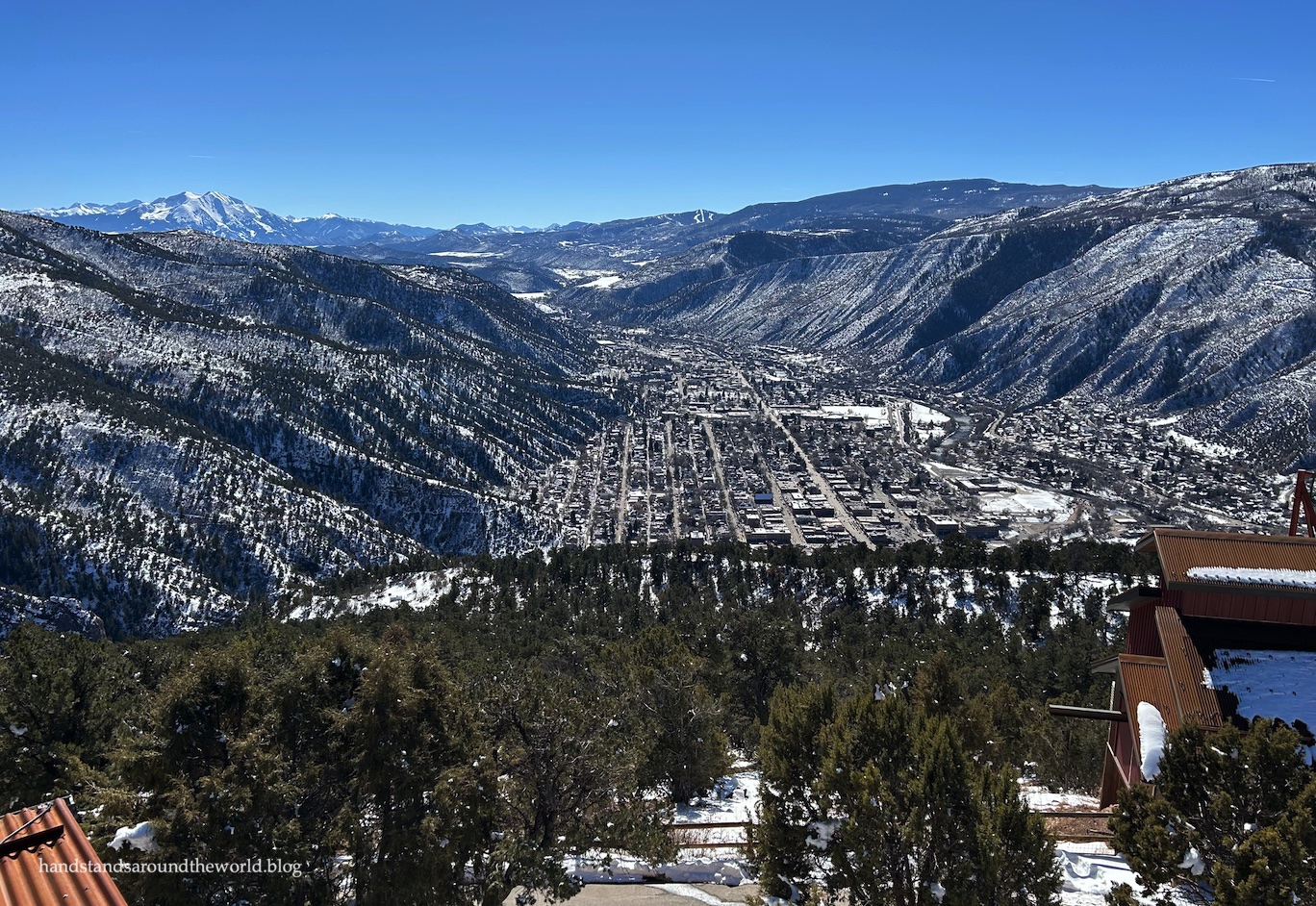
Glenwood Springs is a town we’ve driven through many times, and we always comment on the lovely scenery and the historic buildings and the allure of the steaming hot springs.
But getting to Glenwood Springs in the winter means navigating the horrors of snowy roads and weekend ski traffic, and that’s enough to deter us from pretty much anything.
This year, though, we were able to travel there and back outside of peak ski traffic hours, and that – combined with the ability to cancel our reservation up to 48 hours in advance should the weather forecast be unfavorable – is what convinced me to book the trip.
As it turned out, getting there wasn’t exactly smooth sailing, thanks to the wave of snowstorms that pummeled the Colorado mountains in the days leading up to our trip. While the main roads were drying out by the time we headed off, some of the highways were still closed and that resulted in quite a lengthy delay.
But we made it, checking into Glenwood Hot Springs Resort on Friday afternoon for a sunny weekend of exploring the town. In all, we spent about 48 hours in Glenwood Springs, and we felt like that was a good amount of time to see everything on our list and still have plenty of time for relaxation.
Table of contents
- Glenwood Hot Springs
- Glenwood Caverns Adventure Park
- Doc Holliday Grave Interpretive Trail
- Glenwood Canyon
- Food and Drink
Glenwood Hot Springs
Home to the world’s largest hot spring pool, Glenwood Hot Springs Resort is located just off the interstate on the eastern edge of Glenwood Springs. It’s impossible to miss, with plumes of steam rising from a series of pools and the distinct smell of sulfur filling the air.


Glenwood Hot Springs Resort opened in 1888, but prior to this the mineral-rich water had been used by local indigenous populations for many years. It was known as Yampah, or Big Medicine, and revered for its healing properties.
Three and a half million gallons (13.2 million liters) of water, containing fifteen minerals, bubbles up each day to feed the pools at Glenwood Hot Springs. The water temperature when it emerges from the ground is a scalding 122°F (51°C), and must therefore be cooled to an appropriate soaking temperature.
There are seven pools of various temperatures, open year round, with an additional splash zone that’s open only in the summer.

Our two-night stay at the resort came with unlimited access to the pools for all three days, including before check-in and after check-out.
I’m glad we stayed the night, versus just purchasing a day pass, because I don’t think we’d actually get our money’s worth out of a day pass. Even with the cool air temperature, we never lasted more than an hour at a time in the hot water. It was nice to have the option to soak for a while and then head back up to our room.
It was a lot of back and forth – and a lot of changing into and out of our swimsuits – but it allowed us to thoroughly enjoy all the pools, interspersed with all the other places around town we wanted to visit. It was a lot more relaxation than our typical travels but, truth be told, we both needed it.

Glenwood Caverns Adventure Park
During the resort booking process, there was a package deal that included discounted admission to the Glenwood Caverns Adventure Park, so I added that on.
The adventure park is located on top of Glenwood Canyon, and reaching it requires a very scenic gondola ride. We arrived just after opening, parked (for free), and walked right in. There was no line for check-in or the gondola, so within a few minutes we were on our way. It takes about 10 minutes to reach the top.


We exited the gondola and found ourselves staring at somewhat of a tourist trap. Which, to be fair, is what I expected. Glenwood Caverns Adventure Park is in fact home to a couple caves, but it’s also an amusement park. In the summer, there’s a roller coaster and various other activities such as panning for gold. There’s also a restaurant and various shops on site.
In the winter, most of these things are closed. This was fine with us; we were mostly just there for the caves.
We began with the Historic Fairy Caves tour, which involves a relatively short walk through the underground passageways, past numerous cave features and then out onto a platform with excellent views of Glenwood Springs and Glenwood Canyon.


Back inside, we looped back around to the entrance, stopping periodically to view the cave features and learn some information about the caves from our guide.


Further down the path is the entrance for the Kings Row tour. This tour is somewhat more strenuous, as it involves 120 stairs (and you’re at an elevation of over 7000 feet/2130 m).


The lowest point of the tour, approximately 150 feet (45 m) beneath the surface, is the Kings Room, named for its chess board-like appearance. Here, the guide switched on a black light so we could observe the glow of the cave – a property that can also be traced back to the mineral-rich rock.


While neither tour involves extremely small passages, if you’re strongly claustrophobic you may not enjoy these caverns.
Also, on both tours the guides turn out the lights for a short period of time so visitors can experience the pitch black inside a cave; therefore, these tours may not be appropriate for anyone who is afraid of the dark.
Lastly, the website and signs say no backpacks or bags are allowed in the caves. We both had small backpacks with us, so we rented a locker before the tours… only to arrive and find others taking small bags inside with them, so I’m not sure to what extent they enforce this rule. It wasn’t a huge deal, as the locker only cost $1, but I was still annoyed by the inconsistency.
After the cave tours, we wandered around the rest of the park. We weren’t interested in shopping, but we were very much interested in the alpine slide, so we each took a turn on that.
We ended our visit with delicious hot chocolates and then rode the gondola back down into town.
Doc Holliday Grave Interpretive Trail
On the eastern edge of Glenwood Springs is a 1 mile (1.6 km) loop trail up to the old Linwood Cemetery and Potter’s Field.
A Potter’s Field is the section of many cemeteries where those who could not afford a proper burial, or those who died with no family or friends to provide one, were buried. Many of the gravesites here at Linwood Cemetery are unmarked, and the last known map is from the 1940s, with only about half of the sites labeled.
While his name does not appear on this map, Linwood Cemetery is best known as the likely final resting place of dentist-turned-outlaw Doc Holliday.
After coming down with tuberculosis and losing his ability to practice dentistry, Holliday turned to gambling as a source of income. This led to a life of crime and several arrests over the next few years until, at the age of just 36 and dying of tuberculosis, he arrived in Glenwood Springs under the belief that the mineral water would cure him.
It didn’t, and Glenwood Springs is where he died.


It is not known with 100% certainty that Doc Holliday is buried in the Potter’s Field at Linwood Cemetery. However, by most accounts he had no money when he died, therefore it’s likely this is where he was laid to rest.
Today, a stone marker has been erected with his name, and signs at the cemetery recount his life story.


Also buried here is Harvey Logan, AKA Kid Curry, a notorious outlaw who ran with Butch Cassidy and the Sundance Kid. However, his crimes eventually caught up with him, and he died in a shootout following a train robbery in central Colorado.
Glenwood Canyon
I would be remiss if I didn’t also mention the gorgeous Glenwood Canyon which, if you’re coming from the east, you’ll drive through on your way to Glenwood Springs.
This deep, narrow canyon is cut by the Colorado River, with the interstate and train tracks running through as well. Both thoroughfares – but especially the interstate – were challenging to build due to the width of the canyon. Multiple tunnels have been blasted through the rock walls, and for part of the journey, one lane of the interstate rises well above the other.

We didn’t stop in Glenwood Canyon on this trip, but we have before, and it would be an easy addition to a long weekend in Glenwood Springs. A bike path runs along the river, you can raft the river during certain times of year, and the trail to the well-known Hanging Lake departs from the parking area off Exit 125.

(The trail is currently closed for construction, but is slated to reopen summer 2025. Permits are required and can be purchased here.)
Food and Drink
And, of course, no trip of ours would be complete without checking out the local craft beer scene. There are two breweries in town, and we visited both.
Glenwood Canyon Brewpub is located in downtown Glenwood Springs in the historic Hotel Denver and has a great selection of beers on tap plus a food menu.

It’s just a short walk across the river from the hot springs, so we headed over for an early dinner on our first night in town. We ordered two flights plus food, and all the beers were solid but the stout (unfortunately I can’t remember what kind) was the definite winner.

The next afternoon, we popped into Casey Brewing, also in downtown Glenwood Springs. They have a large tap list but no food, though you can bring your own. Once again, we ordered two flights and, to be honest, it was hard to pick a favorite. If I had to choose, though, I think I’d go with the blood orange vanilla seltzer.

And that wraps up our weekend in Glenwood Springs. Lots of sunshine, lots of relaxation, and some outdoor adventures.
It was the perfect winter getaway!


Leave a Reply to The Travel ArchitectCancel reply