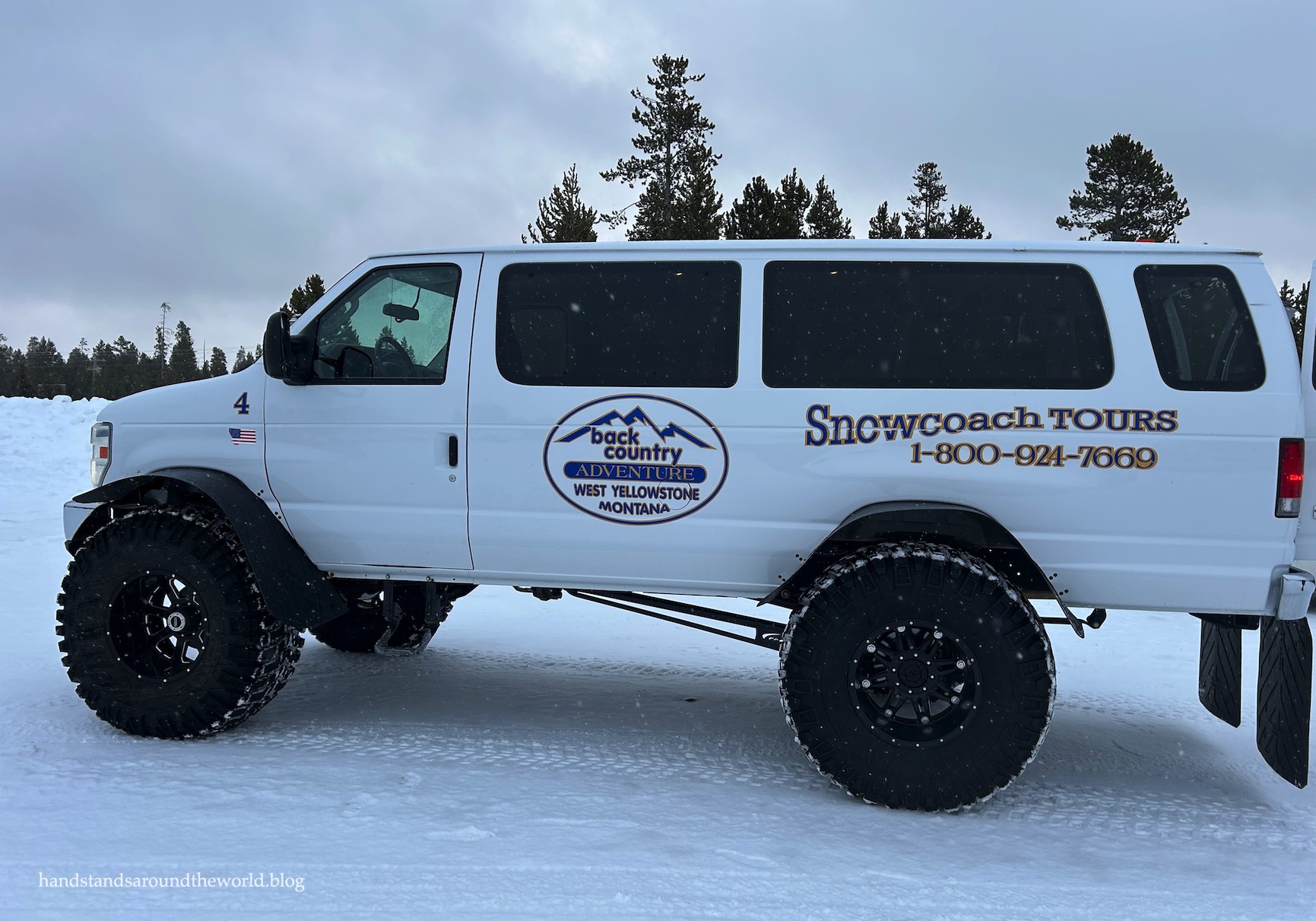
As mentioned in a couple previous posts, this past Christmas we eschewed traditional gift-giving in favor of travel. Specifically, an overnight trip into the heart of Yellowstone National Park.
Despite visiting many times, a winter overnight was something we’d never done, largely due to the expense. Only the northernmost road in Yellowstone remains open to cars in the winter, leaving the rest of the park accessible via oversnow travel only – in other words, guided trips on snow-covered roads via snowmobile or snowcoach.
Moreover, only one hotel in the center of the park remains open: Old Faithful Snow Lodge.
To spend a night in the park, then, requires traveling to the park, roundtrip snowcoach fare, and a room at the lodge, preferably reserved well in advance, though there was some last-minute availability when we were there.
To give ourselves a buffer in case of bad weather, we drove to West Yellowstone the night before. Luckily, the roads were in pretty good shape, and we arrived with plenty of time for board games, nachos, and happy hour at Yellowstone Beer Company. My family enjoyed huckleberry margaritas while my husband and I shared two flights, and while we enjoyed all eight beers, the Mexican chocolate stout was the winner, followed closely by the white stout and the salted caramel brown ale.

Our snowcoach trip began at 9:00am the following morning, and on this particular day we were the only people who had booked with this specific company meaning we got a private tour! We chatted with our guide as she drove, stopping at a few places to enjoy the view while opting not to stop for the herd of bison – something we’ve all seen many times. However, she would have stopped if we’d asked; there’s some flexibility built into the journey.
Since we only made a couple brief stops, we arrived at Snow Lodge ahead of schedule. It was too early to check in, but we were able to leave our luggage and spend the rest of the daylight hours exploring.

Snow Lodge is about a 5 minute walk from the famous Old Faithful. And while it’s one of the larger and more predictable geysers in the park, it’s one of just many geysers and hotsprings in the expansive thermal area known as Upper Basin. So many people don’t venture beyond Old Faithful, but I’m here to tell you that you absolutely should.
Our initial plan was to rent skis and travel through all of Upper Basin and into the adjacent Black Sand Basin – and possibly even beyond – but the unseasonable lack of snow put the kibosh on that. Instead, we set off on foot.

My sister – a geyser enthusiast for as long as I can remember – immediately made note of all the predicted geyser eruption times and started plotting our itinerary. First up: Riverside Geyser, predicted to erupt in about an hour (±45 minutes, because no geysers are 100% predictable).
So off we went, making our way along the paved (but partially snow-covered) path, only to be turned around by a small group of bison standing right in the middle of it. Thankfully, there are multiple routes through Upper Basin, so we were able to backtrack and head around to the bison-free boardwalks.
We crossed the Firehole River – named for its warmer-than-average water temperature, fed by hot water runoff from the hot springs and geysers – and ascended slightly to Geyser Hill, home to a collection of geysers and hot springs that were not predicted to erupt any time soon.
(I should clarify: many of the geysers do not erupt regularly enough for the park to actually make a prediction.)


We continued along the path, thankful for our microspikes on the icy boardwalks, and eventually dropped down and crossed the river back to the paved path, now well beyond the bison. From here, it was just a short walk to Riverside Geyser, named for its location right on the bank of the Firehole River.
We arrived about 5 minutes after the predicted eruption time, but the number of people sitting on the benches let us know we hadn’t missed it. Knowing we might have to wait as much as 40 minutes, we settled in and pulled out our snacks. Ten minutes later, the eruption began. This was – to my recollection – the first time I’d ever seen Riverside Geyser erupt.
And for all of us, it was our first ever winter geyser eruption!


After the eruption we continued along the path, heading north out of Upper Basin on the trail toward Biscuit Basin. Though we couldn’t go all the way to Biscuit Basin – it’s still closed after last summer’s hydrothermal explosion – there were a few hot springs along the path we wanted to see.


From here, we retraced our steps a short distance and then branched off to the west toward the Daisy Group and Black Sand Basin.

Daisy Geyser is one of the more predictable ones in the park and was expected to erupt around the time of our arrival, so we once again settled onto the benches to wait. And once again, within about 10 minutes, it began to erupt.
(If you’re sensing a theme here, you are correct. It was a day of unbelievably lucky timing.)


From here, we continued west toward Black Sand Basin, passing what is quite possibly my favorite hot spring in Yellowstone – Punchbowl Spring.


Black Sand Basin is accurately named and, in fact, if you walk the trail between Upper and Black Sand Basins you’ll walk right through the transition from tan to black. The black “sand” is actually small pieces of obsidian, a glassy volcanic rock found in a fairly high concentration here.


Black Sand Basin is relatively small, which worked out well because we were quite a distance from the lodge at this point and it was already mid-afternoon. So back we went, this time having to detour around the back side of Daisy Geyser thanks to another bison.

Back on the paved path through Upper Basin, we passed Castle Geyser, not predicted to erupt until well after dark, and Sawmill Geyser, which erupts almost constantly.


As we continued meandering back toward the lodge, we found ourselves not far from Grand Geyser and right in the middle of its predicted eruption window. However, it’s a big window. Three hours, to be exact, meaning we might still have to wait as much as 90 minutes. We didn’t have time for that, but we decided we’d give it 20 minutes.
We found an empty bench, set our backpacks down… and suddenly there was water shooting nearly 200 feet (60 m) into the air.
Grand Geyser erupts for up to 12 minutes, with the adjacent Turban and Vent Geysers often erupting simultaneously. Sure enough, the other two soon began spurting water too, though they were very much dwarfed by the immensity of Grand Geyser.


(Pudgey was, of course, there to watch it as well)
I might get some flack for saying this but, while Old Faithful is the most famous geyser – largely due to its fairly frequent and predictable eruptions – I don’t think it’s the best geyser in Yellowstone. It’s not the tallest or the largest or any other superlative.
For me, at least on this particular trip, Grand Geyser was the highlight.
That being said, we watched Old Faithful erupt five times due to the frequency of its eruptions and the fact that it was just a five minute walk from Snow Lodge.


Because access to this area of the park is so limited in the winter, there were substantially fewer people everywhere, but nowhere was this more evident than at Old Faithful. During the summer, there would be at least 500 people crowded onto the boardwalks to watch each eruption. When we popped back out to see it again after dinner, there were maybe 20 people. Same with the following morning.
And when we watched it erupt just after 10:00pm, it was the four of us plus one photographer, and that was it!
Speaking of nighttime and photography and Yellowstone, we also booked a starlight snowcoach tour. Our guide picked us (and 4 others) up from the lodge at 6:45pm and off we went to experience the park at night. Our first stop was Midway Geyser Basin, home to Grand Prismatic Spring – the largest hot spring in the US and one of the largest in the world – as well as various other hot springs and geysers. We couldn’t see much even with our headlamps, mostly owing to the thick clouds of steam, but in the darkness all our other senses were elevated.

And when we weren’t shrouded in steam, we were surrounded by stars. We’d spent the day in and out of the clouds, and more clouds moved back in later, but the sky cleared just in time for our tour and I even managed to capture some semi-decent iphone photos!


Right: the Milky Way
We also stopped briefly at Black Sand Basin, and then returned to the snowcoach to warm up with hot chocolate in souvenir thermoses as we made the drive back to Snow Lodge.
The aforementioned nighttime eruption of Old Faithful was our final experience of the night, and then we retired to our room.

As we were getting ready to head down to breakfast the following morning, I glanced outside and saw streaks of pink coloring the sky, so I quickly threw on my jacket and boots, grabbed my phone, and ran outside to capture what I could. I even made the short walk over to Old Faithful. It was between eruptions so all that was coming out was steam, but when else am I going to have an opportunity to capture the famous Old Faithful backlit by the beautiful sunrise sky?


In between breakfast, packing up, and relaxing in the lobby of Snow Lodge, we watched Old Faithful erupt two more times that morning.

And then it was time to hop back in the snowcoach and head back to West Yellowstone. Our driver had spotted wolves on his way in, so we were on the lookout. And – as the cherry on top of an already amazing trip – we found them! They were surrounding a closely-packed herd of bison, clearly observing and planning their next target but not yet ready to make a move.
They were far enough away that I couldn’t get a good photo with my phone, but with the help of binoculars we were able to get a decent view. I hadn’t seen wolves in Yellowstone in years, and this was my husband’s first ever wolf sighting.
From there, it was back to our car and then back home in time for Christmas Eve. We spent Christmas Day relaxing and reminiscing, all in agreement that a Christmas trip is going to become our new tradition!
Up next: a guide to visiting Yellowstone National Park in the winter
The Important Stuff:
- Getting there: most snowcoaches depart from Mammoth Hot Springs, but a handful of private companies have departures from West Yellowstone. We chose West Yellowstone because it was cheaper and also a less treacherous drive in the winter. Regardless of where you depart from or which company you choose, you should book in advance.
- Fees and passes: snowcoach cost varies by location and company, but you should expect to pay at least $250/person for a roundtrip journey, plus the park entrance fee ($20-35 per vehicle; America the Beautiful passes are accepted). Snowcoach trips from Snow Lodge to other areas within Yellowstone are operated only by Xanterra and cost extra. Be sure to bring cash to tip your guide.
- Where to stay: Snow Lodge is the only option in the interior of the park from December-March. When you book a room, they will email you to confirm that you also reserved oversnow transportation.
- What to see: once you’re at Snow Lodge, you can sign up for half or full-day snowcoach tours to other parts of the park, or you can set off on foot (microspikes, snowshoes, and skis available for rental at Snow Lodge, or you can bring your own) through Upper Basin. There are groomed trails as well as boardwalks around and through the surrounding area, including paths to Biscuit and Black Sand Basins. With cross-country skis and an early start, you might be able to make it all the way to Midway Basin and back, but it would be a very long, tiring day.
- Other: Yellowstone can be brutally cold in the winter. We got lucky, with partial sunshine and only a light breeze, but it’s often well below zero and can be very snowy and windy. Keep an eye on the weather as your trip approaches, and be sure to pack lots of layers, hand warmers, wool socks and snow boots, and anything else you’ll need to stay warm.


Leave a Reply to WanderingCanadiansCancel reply