If you say the words “San Antonio” and “missions,” the first thing to come to mind for most people would probably be the Alamo. And while the Alamo is indeed a former mission, it’s just one of the more than twenty Catholic missions built by the Spanish in the early 1700s.
It’s also – and I’m probably going to get some flack for saying this – the least impressive of the ones that remain.
These missions were built with the goal of teaching the local indigenous populations the Spanish language, the Catholic religion, and the necessary daily tasks to create a fully functioning village and eventually grant them Spanish citizenship. Many of the tribes ultimately “agreed” to this; however, most historical accounts make it sound like this was a mutually beneficial arrangement when, in reality, the natives were essentially forced into it. They were being displaced from their land, and diseases introduced from Europe were decimating their populations, which left joining the missions as the only realistic path for survival.
While joining the missions did provide protection, it also resulted in these populations losing large pieces of their culture, including their own languages and religions. However, their knowledge of the land and their hunting, farming, pottery-making, and other similar skills were retained and assimilated into life at the missions, creating a sort of hybrid society. Historians now collectively refer to these many indigenous groups as the Coahuiltecans (ko-ah-WEEL-tay-kahns), though they were not all from the same tribe. Today, many local residents trace their heritage back to these missions.
The missions remained active for approximately 85 years, until Mexico declared its independence from Spain. Given the Spanish origin of the missions, Mexico did not want anything to do with them and they were largely abandoned and allowed to fall into a state of disrepair. Some were also partially dismantled so the stones could be used to build other structures, including some of the original houses in San Antonio.
Today, four of these missions, all located along the San Antonio River, are preserved within the San Antonio Missions National Historical Park. The missions are in various states of ruin, which makes a visit to all four of them well worth it. The fifth – the Alamo – is managed separately. You’ll need a car or a bike and at least half a day in order to see all five.
Table of Contents
- Mission San José
- Mission San Juan
- Mission Espada
- Espada Aqueduct
- Mission Concepción
- The Alamo
- San Antonio River Walk
Mission San José
Though it would make more sense, geographically-speaking, to start at one end of the line of missions, we began in the middle because this is where the visitor center is located.
We just barely arrived at Mission San José y San Miguel de Aguayo in time for the first tour of the day. As in, we were those idiots sprinting from our car to the bathrooms to the meeting point for the tour at the very last minute. But we made it!

Because the visitor center is here, this is the most visited of the four missions and therefore the only one offering guided tours. It was a good place to start, because as we walked through the outer walls and then encircled the interior perimeter of the mission, we learned about the history and construction of all the missions, as well as and the various rooms and other features of this specific mission. Some of the old living quarters have been turned into a small museum that can be viewed after the conclusion of the guided tour.


This is the largest and most restored of the missions. At its heyday, about 300-350 people lived at Mission San José. In addition to a Catholic church, there are living quarters, the first grist mill in Texas, a granary, and an acequia (ah-SAY-key-ah) – in other words, an aqueduct – that diverted water from the San Antonio River to operate the mill. This mill produced wheat flour for residents of the mission (which, by the way, was not part of the traditional indigenous diet) as well as others in the region.


Note that the church (here and at the other missions as well) is still in use and may be closed during funerals, weddings, and other services. Otherwise, entry is allowed.
Mission San Juan
From Mission San José, we headed toward the two southern missions before working our way back north. First up: Mission San Juan.
Mission San Juan Capistrano was not originally built here, but by 1760 the community was thriving at the present-day location. Though the church is still in use, the remainder of the mission has fallen into disrepair. A trail encircles the mission, allowing for entry into the church and close-up views of the walls and what remains of the other structures.


The church facade is actually a false front. Interestingly, this building was not originally a church but rather, if I recall correctly, a granary. It is a long, narrow building and because of the location of the door you must – rather unusually – turn immediately to the left upon entry to view the altar.


Mission Espada
Mission San Francisco de la Espada was actually the first mission in present-day Texas, though it was not built in this location. However, it was moved here in 1731 and is now the southernmost of the San Antonio missions. It is in similar condition to Mission San Juan, with a restored church but largely unrestored walls and other structures.


Espada Aqueduct
Water, of course, was necessary for life at the missions. Though all were built near the San Antonio River, none were immediately adjacent. Therefore, construction of dams and aqueducts was necessary. The Espada Aqueduct is the oldest Spanish aqueduct in the US and can be visited en route to Mission Espada and Mission San Juan.


Mission Concepción
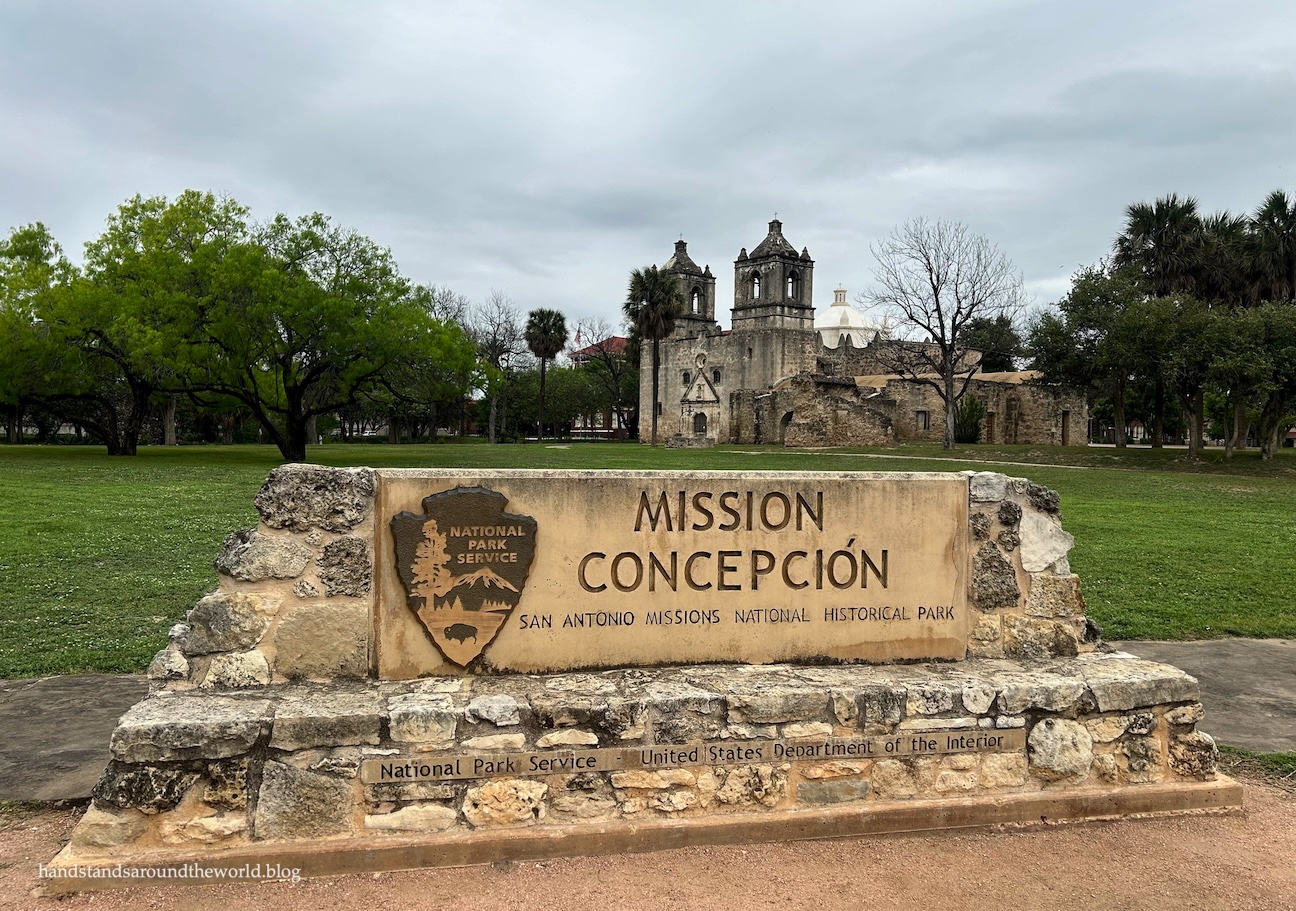
The final mission within the national historical park is Mission Nuestra Señora de la Purísima Concepción de Acuña, shortened to Mission Concepción. This is the northernmost of the missions, and home to the oldest unrestored stone church in the US. This mission was my favorite of the four!


We wandered through the exterior portions first, including the crumbling stone walls. From the outside, the mission looks every bit its 260 years of age. It’s certainly the least intact of the four. Even upon entry into the church, the age and lack of restoration is clear in the crumbling walls and fading frescoes.


That is, until you walk into the sanctuary.

Some preservation has been done on the interior, which is part of the reason for the difference. However, the structural components of the church are original. Another thing original to this church is the occurrence of a double solar illumination each year on the Feast of Assumption of St. Mary. You can read more about this phenomenon here.
The Alamo
And finally, that brings us to Mission San Antonio de Valero, known today as the Alamo.
Unlike the other four, the Alamo is right smack in the middle of downtown San Antonio. It’s very bizarre to have an old stone mission in front of you and high rises behind you. Add in a giant construction project, traffic, a gift shop that’s probably larger than the church itself, and about 500 people all crammed into the same city block, and you get the Alamo.
The contrast was especially stark after spending the day at the other four missions which, as you can probably tell from my photos, were not crowded at all. Had this been our first stop of the day, without having all the other missions to compare it to, I might have enjoyed it more. But since we were planning to go out to dinner in the city, it made more sense to save it for last, which then served to emphasize the lack of authenticity as compared to the others.

That being said, I did learn quite a lot here.
Like most Americans, I knew the phrase “remember the Alamo.”
But I never knew what actually happened there or why I was supposed to remember it. Now I know at least one side of the story, though a quick google search will reveal plenty of controversy surrounding the version of events that is most commonly recounted.
Mission San Antonio de Valero was originally a mission but later became a fort, at which point it was renamed Pueblo del Alamo. It was the site of battles between the Spanish and Mexicans during the Mexican fight for independence and, later, the site of a battle between Texas and Mexico during the Texas Revolution. The 13-day Battle of the Alamo took place in February and March 1836, during which time Texas was massively outnumbered and sustained heavy casualties. However, a strengthened Texas army went on to win independence just a few weeks later.
Today, all that remains of the original mission and subsequent fort is the church. Monuments, statues, and informational signs are spread throughout the grounds.


San Antonio River Walk
After visiting all five missions, we finished out our day with dinner on the San Antonio River Walk followed by a boat tour along the river. Cheesy and touristy? Perhaps. But it was a fun way to see the downtown area and learn a bit of its history.
This isn’t part of the San Antonio Missions, but it’s the only other thing we did in the city so I’m just going to add a few photos here.


Up next: hiking in Texas Hill Country


Leave a Reply to rick0427Cancel reply