Despite our best efforts, we moved away from the east coast with quite a few things left on our east coast to-do list. We just ran out of time to see everything. But we usually head back at least once a year for one reason or another. This year, it was for a wedding.
As we started looking at plane tickets for the trip, I decided if we were gonna pay to fly all the way across the country on a holiday weekend, we were gonna make the most of it.
So we added two days to our trip and, the morning after the wedding, we piled into the car with my inlaws and headed off to Philadelphia. It’s a place none of us had ever been and we were excited to spend the next two days exploring.
But before heading into the city, we stopped for a few hours just outside at Valley Forge, a former hub of iron production that would later become a storage site for supplies during the Revolutionary War, and finally the winter encampment for the Continental Army during the winter of 1777.
This was the third year of what would become an eight-year fight for independence from British rule. With the way things were going at the time, though, a win for the colonies was looking less and less likely by the minute. Money and support for the war were lacking, the army’s training was somewhere between exceptionally subpar and non-existent, and malnutrition and illness were weakening their ability to fight – or even survive.
Back in the day, wars were essentially paused during winter months due to the harsh weather. So in December of 1777, General George Washington (the same guy who would eventually become president) chose this location for the Continental Army’s winter encampment because it was strategically located on a hillside overlooking Philadelphia (which the British had just captured), protected from the other side by the Schuylkill River, and with plenty of trees available for building accommodations and burning for warmth.
(Schuylkill, by the way, is pronounced SKOO-kill, which wouldn’t have been my first guess. Or second or third. It’s apparently one of those things you just know if you live in the area – and mispronouncing it is therefore an immediate giveaway that you don’t.)


Anyway. Over the next couple weeks, nearly 12,000 soldiers arrived at Valley Forge and erected 1500 wooden huts and other structures. They spent the next few months struggling to survive.
But despite the fact that over 2000 people died before winter’s end, the army emerged much stronger thanks to a mass smallpox inoculation campaign followed by the arrival of Prussian Inspector General Friedrich Wilhelm von Steuben, who instigated a training regimen that actually prepared the army to fight. In fact, some of his methods are still used today, thus Valley Forge is considered the birthplace of the modern US Army.
We were all shocked to have never heard of this man without whom the US very well may have lost the Revolutionary War.

When the soldiers moved on in June 1778, Valley Forge was left in ruins. Thousands of trees had been cut down and the remaining open spaces turned to mud when it rained. The soil was so damaged it could no longer be used to grow crops, leaving many of the resident farmers struggling to survive. Luckily, they were able to rehabilitate the land and tear down most of the huts to repurpose the lumber, though the former took many years.
After the war, iron production also continued here until the 1820s, at which time it fell out of use. What remains has since been excavated and renovated, and today, Valley Forge is maintained as a National Historical Park.

If we’d had a full day to spend here, we would have enjoyed biking some of the 35 miles (56 km) of trails through the park. Since we only had a few hours, we took the 10 mile (16 km) driving tour instead.
That being said, while some things are visible from the car, if you truly want to see the highlights you’ll need to get out and walk around. You can pay for a self-guided audio tour, but we opted to just use the information available on the free NPS app.
We began at the visitor center (stop 1) to watch the informational film. From here, the driving tour begins in a clockwise direction. Stop 2 requires some walking around to see the redoubt (pictured previously) and some reconstructed log huts.


Stops 3 and 4 were much quicker, involving just a short walk from the parking area to a single attraction.


The other one that requires quite a bit of walking is stop 5, which is the site of the house that General Washington used as his headquarters that winter. The house was originally built in 1768 for ironmaster Isaac Potts, though his aunt was living there at the time the Army marched into Valley Forge. Upon arrival, Washington began paying Potts for the use of the house for himself, his wife, and approximately 20 staff.

This is not a reconstruction; it’s the original house! The only thing missing, structurally speaking, is an exterior wooden addition he had built to accommodate his staff. The interior furnishings are not original, but are era-appropriate. We enjoyed walking through the house, and we made sure to use the handrail as we climbed the stairs, as it’s the original wooden railing used by the Washingtons.


Some remnants of Valley Forge’s ironworking past can be seen at stop 5 as well, including an old carriage house that is now a history exhibit on the forge. Once the low-flying bird found its way out the door, I enjoyed walking through the exhibit and learning about the enormous contributions of Valley Forge to the iron industry both before and after the war.

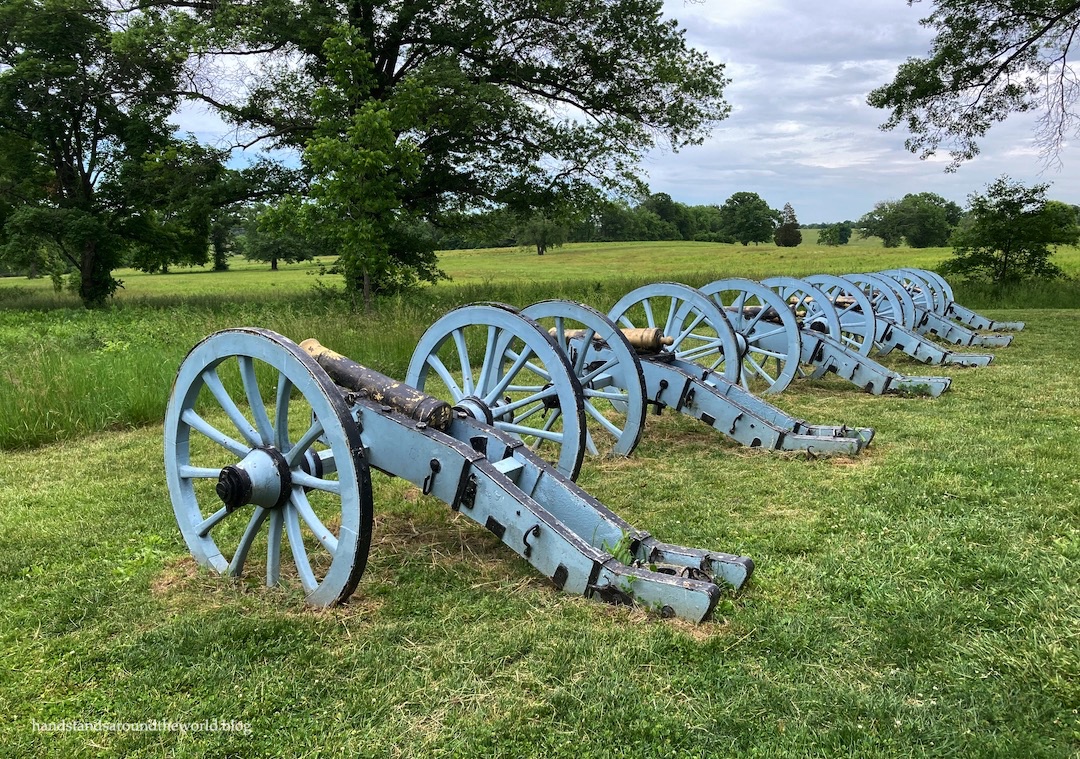
We spent nearly 45 minutes at stop 5, and were therefore running a little short on time in the aftermath. Stop 6 on the driving tour is another redoubt, which we skipped since we’d already seen one. We spent a couple minutes at stop 7 – Artillery Park – which was the site of an artillery repair shop and where most of the cannons were stored.

We tossed a glance at the statue of von Steuben (stop 8) and the Washington Memorial Chapel (stop 9) as we passed by, which wrapped up the driving tour. I do wish we’d had time to stop at the chapel because it looked lovely, but we were trying to make it into the city in time to visit another historic site before it closed, so we had to just enjoy these last couple stops from the road.

Despite feeling rushed at the end, we departed Valley Forge fairly satisfied with our visit. We’d learned a ton of history, seen a majority of the old structures, gained an understanding of the importance of Valley Forge, and used the same handrail as George Washington.
Really, what more can you ask for?

Stay tuned for our adventures in Philadelphia!
The Important Stuff:
- Getting there: the main entrance to Valley Forge, including the visitor center, is off US Highway 422 just northwest of King of Prussia, Pennsylvania.
- Fees and passes: none, the park is free to enter.
- What to do: stop at the visitor center, walk, jog, or bike any of the 35 miles (56 km) of trails, or take the 10 mile (16 km) driving tour though the park. Allow 2-3 hours minimum for your visit.
- Where to stay: no overnight lodging is available in the park, but there are campgrounds about 30-40 minutes northwest and plenty of lodging is available in and around Philadelphia.
- Other: regardless of how you travel through the park, be sure to plan ahead; bathrooms and water spigots are available only at a few of the stops, no food is available past the visitor center, and there’s really no shelter from the elements.


Leave a Reply to NortheastAllieCancel reply