We haven’t had a lot of luck with this hike.
The first time, we began our hike under blue skies, but as soon as we sat down at Lake Helene to eat a snack it began to rain. Between the precipitation and the low-hanging clouds obscuring the mountains, it wasn’t very enjoyable and we couldn’t see a whole lot.

Our second attempt was in the winter, and it was off to a rocky start from the moment we woke up thanks to an alarm clock snafu. We dashed out of bed and probably set a speed record for getting ready to go, and ended up reaching the trailhead only about an hour later than planned.
We were looking forward to what – according to the weather forecast – should have been a lovely outing. This is a lesser-traveled route in the off-season, and we were excited for a relatively windless day on the trail with sunshine and lots of solitude. One of those three things came to fruition, and it wasn’t the sunshine or the lack of wind.
Nonetheless, we strapped on our snowshoes and set off from the Bear Lake Trailhead, figuring since the trail was mostly in the trees, the wind would be bearable. And it was… until we reached an exposed section about 1 mile (1.6 km) shy of the lakes.
In the summer, this is a talus slope with a visible trail across. On this particular day, there was so much blowing snow we couldn’t even see the trail, let alone the other side of the slope. Also, the wind was flinging snow into our faces and the strongest gusts were knocking us off balance, so for purposes of safety (and not being miserable), we decided to turn around.


And now, for the time we actually made it to the lakes.
This time, the weather forecast was accurate; partial sun and some wind, but not nearly as much as last time. We set off with microspikes on our feet and snowshoes strapped to our packs, following signs for Odessa and Fern Lakes (note that Lake Helene is not actually on any of the trail signs). The trail was well-packed and easy to follow for the first 2.5 miles (4 km), and all the trail junction signs were visible. In a snowier winter, keep in mind the signs might be buried.
Eventually, we reached the point where we’d turned around last time. Periodic gusts of wind were whipping down the slope of Flattop Mountain and sending snow swirling through the air, but even during the strongest gusts we could easily see all the way across. The actual trail was obscured by blowing snow, though, so we had to just point our feet in the approximate direction of the route and make our way across. We postholed a few times, and once we reached the other side we decided it was time for snowshoes.


The trail then re-enters the forest, gradually gaining elevation and staying just below tree line before reaching another wide open slope. The snowpack has been extremely unstable in Colorado this winter, leading to very high avalanche danger. I’d checked the slope angles prior to setting out (I use Caltopo for this purpose) and knew this particular slope was just on the edge of being steep enough for there to be reasonable risk. To be safe, we stayed as close to the bottom of the slope as possible and walked across one at a time.

From here, it was just another twenty minutes (and one very steep climb) to Two Rivers Lake. There are no signs, but the trail will travel through a rocky low spot and then turn sharply left to reach the lake. If the trail veers right and begins to descend, you’ve overshot both lakes.


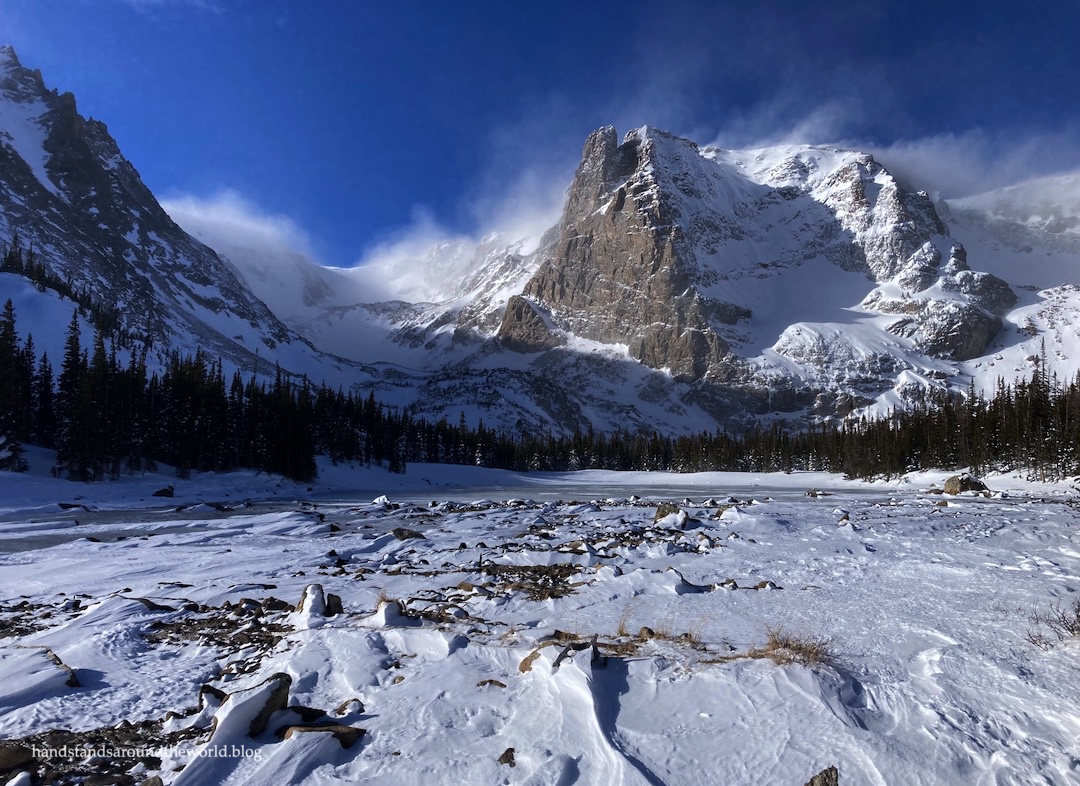
Two Rivers Lake is larger and a little more open than Lake Helene, and was therefore my favorite of the two. Both lakes were beautiful, though. And we had them all to ourselves!


After basking in the beauty of Two Rivers Lake, we made our way across the ice and through the patch of trees separating it from Lake Helene. Lake Helene is so close to the mountains that the sun hadn’t reached it yet; it was substantially colder so we didn’t stay too long. We did, however, take the time to walk across the lake and admire the smooth surface of the ice. I don’t understand the physics of freezing lakes well enough to understand why half the lake froze in a textured pattern and half froze smoothly. It was really weird… and really neat.


It… didn’t work
We then made our way back to Two Rivers Lake – and by the way, our snowshoe tracks were already mostly buried by blowing snow after just ten minutes – where we stopped for a snack. One of the many fun things about winter hiking: the ability to have a picnic in the middle of a lake!

One of the annoying things about winter hiking: it was too windy to take our gloves off for more than a few seconds at a time, which made eating a challenge. But with gloves on, we were able to stay warm and spend some time enjoying the view before retracing our steps back to the car.
On the way down, we encountered many backcountry skiers headed up the trail (and a few coming down). Fortunately, everyone was courteous and we didn’t have any incidents. That being said, beware that this trail is popular amongst skiers in the winter.
And there we have it. Third time was the charm for us on this one, and I’m glad we finally got to enjoy Lake Helene and Two Rivers Lake!
The Important Stuff:
- Getting there: this hike departs from the Bear Lake Trailhead at the end of Bear Lake Road; in the summer, consider leaving your car at the park-n-ride and taking the free shuttle to the trailhead. Once at Bear Lake, follow signs for Fern and Odessa Lakes (note that Two Rivers Lake and Lake Helene are not on any signs, and you will need a map or GPS tracking app so you can locate the turnoff to both lakes).
- Fees and passes: there is a $30/car daily or $35/car weekly entrance fee to RMNP; America the Beautiful passes are accepted. From May-Oct, if you arrive after 5:00am you will also need a timed entry permit to access this trailhead.
- Hiking: round trip distance to both lakes from the Bear Lake Trailhead is approximately 5.8 miles (9.3km) with 1240 feet (380 m) of elevation gain. You can also reach these lakes from the Fern Lake Trailhead, though I believe it’s longer and steeper from that direction, and is a much sketchier route in the winter.
- Other: these lakes are somewhat of a hidden gem in Rocky; most people at Bear Lake head off in another direction, so this is one of the few places you might get a little bit of solitude (especially in the winter). If there is snow on the ground when you do this hike, be sure you have microspikes and snowshoes, a map/GPS, and are familiar with the route; the path will likely be buried in spots and you may have to break trail. Stay low on the wide open slopes and take appropriate avalanche precautions.
For more information, see my posts on visiting Rocky Mountain National Park and winter hiking tips and safety.


Leave a Reply to rick0427Cancel reply