Since moving to Colorado, we have managed to go cross-country skiing about once a year. I wish we could go more often, but we don’t have our own gear (yet). Fortunately, there’s a place not too far away that rents gear for a decent price, and there are some trails in the mountains that are well suited to our ability levels.
This past winter, we headed off one Saturday morning for our annual XC ski day in the mountains. Our previous outings had been a lot of fun and the weather forecast looked gorgeous, so we were pretty excited.
Sadly, the excitement was short-lived.
First, the rental shop gave me skis that were longer than I requested, a fact I didn’t notice until we’d already left. In retrospect, we should have gone back. I figured the extra 10cm wouldn’t make that much difference, but it did. I’m not a graceful person in general, and having longer-than-usual skis certainly didn’t help.
We arrived at our destination – the Wild Basin area of Rocky Mountain National Park – and drove in to the winter parking area, about halfway up the road. From here, the plan was to ski 1.5 miles (2.4 km) up the road to the trailhead and continue up to some frozen waterfalls.
We figured this would be an ideal ski location; wide, not too steep, and somewhat less popular than the main area of the park. And while the road and parts of the trail were indeed pretty wide and flat, other sections turned out to be very narrow this time of year.
Most problematic, though, was how icy the snow was. From the very beginning, we were slipping and sliding (and falling) all over the place. We couldn’t get any traction, and it was even a struggle in some places to plant my poles firmly into the snow. It was absolutely the worst snow I’ve ever attempted to ski on.

We pressed on, figuring once we reached the trail it would be better. It was not. So we threw in the towel. We were both beyond frustrated and having a miserable time of it. And the worst was yet to come… we had to retrace our icy steps back to the car, except this time in a downhill direction. This was when we discovered problem #2: we wanted to take our skis off and just walk back but we couldn’t figure out how to unclip from the bindings.
In a million years, this wasn’t a problem I ever would have foreseen. I’ve been skiing my entire life, and we’d rented skis from this shop multiple times before. I didn’t bother to ask any questions because of course I knew how to use the equipment.
Except, as it turns out, these stupid newfangled bindings.
So we had no choice but to ski back down the icy trail to the car.

We may as well have been on an ice skating rink in high heels for all the traction and control we had. Thank goodness there weren’t many people on the trail. It was really scary, and I’m honestly surprised we made it back in one piece. At one point I face-planted. Literally. As in, I fell forward and my chin came into contact with the ground. It was brutal, and we both ended up with multiple bruises. I haven’t fallen that hard that many times since I was a kid.

Back at the car, we now had to take off our boots – which we still couldn’t figure out how to unclip from the skis. When we got back into cell service, I was able to look it up… turns out we had to reach down and twist the front of the bindings. Why someone thought that was a good idea, I don’t know. I’ve never seen bindings you can’t pop open with your ski pole, and I think it’s safe to say we never would have figured it out on our own.
Lesson learned: always ask about the gear, even if you’ve used it before.
If we hadn’t rented the skis, we probably would have just given up at this point and headed home. But since we’d paid for them, we stubbornly decided to find a plan B in an attempt to get our money’s worth. I’m glad we did, because the second half of the day was much improved!
We drove a short distance south to Brainard Lake Rec Area – a place we’d been many times before and knew was a good option for skiing. It was 11am now – a very late start by Colorado standards – but we were lucky enough to find an overflow parking spot that wasn’t far from the main lot. Boots and skis now able to be separated, we headed up to the Lefthand Reservoir Road which is closed to cars in the winter but open to skiing and snowshoeing.
Lefthand Reservoir Road was perfect for our ability level! It’s wide, the elevation gain is gradual, the snow was in good condition, and we saw very few people in the 2 miles (3.2 km) to the reservoir.


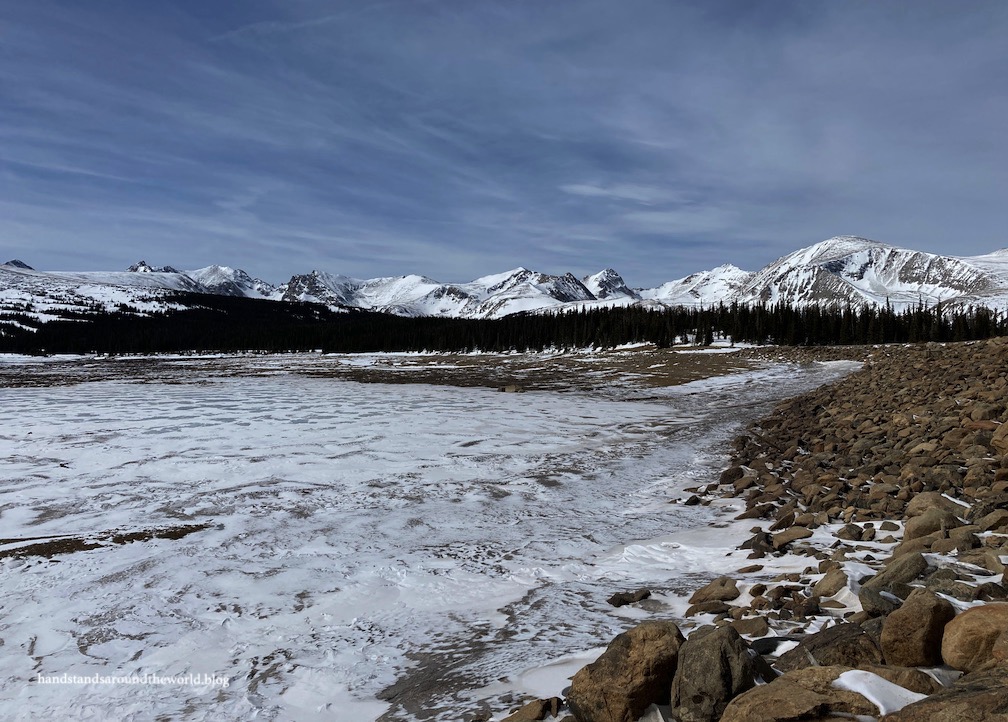
And while the reservoir was almost empty and the ground around it a little barren, the mountains behind it were pretty spectacular!


I’m glad we persevered. If we hadn’t, if we’d ended on such a bad note, I think it would have dampened our future enthusiasm for skiing. Instead, we came home bruised, sore, and exhausted – but also looking forward to returning to Lefthand Reservoir on our next ski outing!
The Important Stuff:
- Getting there: Lefthand Reservoir Road departs to the left just before the Brainard Lake Rec Area entrance station; in the winter, park outside the entrance station at the winter lot and ski/snowshoe up the road. In the summer, you can drive all the way to the reservoir.
- Fees and passes: none.
- Hiking: in the summer no hiking is needed to reach the reservoir; in the winter it’s about 2 miles (3.2 km) each way with about 400 feet (120 m) of elevation gain.
- Where to stay: Lefthand Reservoir is day use only, but there is one campground up Brainard Lake Road (reservations required) or you can do this as a day trip from the Denver, Boulder, or Fort Collins area.
- Other: Lefthand Reservoir provides drinking water for nearby areas, so please do all you can to avoid contaminating it (e.g. don’t let your dog splash around in it, don’t enter the water with sunscreen or lotion on, use the bathroom far from the water’s edge, and don’t leave anything behind).


Leave a Reply to Monkey’s TaleCancel reply