Summer hiking season was abruptly and heartbreakingly interrupted late last year, thanks to four large, rapidly spreading wildfires that prompted many closures and blanketed Colorado with thick smoke.
Just as firefighters began to make significant progress, the west coast caught fire and the smoke from those states was blown all the way to Colorado and beyond. Then four more fires erupted in Colorado in mid-October. Everything here was just a brown haze and the mountains would vanish from view for a week at a time.
Two weekends after the fires began, we had plans to hike with our friends. We had scheduled this hike months in advance – not because it required advanced planning, but simply to set aside a weekend for it before our summers filled up. Unfortunately, it was pretty close to one of the fires, pretty remote and rugged, and would require us to drive a route that would need to be used by locals should they need to evacuate. So we scrapped that plan. It was disappointing, after looking forward to it for so long… but it will still be there next summer.
Plan B was to hike to Heart Lake and Rogers Pass in the James Peak Wilderness. Located about 70 minutes northwest of Denver, this hike was relatively far from the fires and evacuation routes, popular, and not difficult or remote – thus minimizing the chance of anything happening that would require first responders to leave the fires and come rescue us. The Colorado air quality map rated the location as moderate, so off we went, excited to escape the suffocating smoke for a few hours in the wilderness.
The air quality map was a giant lie.
The sun was cresting the horizon as we set off from East Portal Trailhead toward Heart Lake, casting the forest in streaky shadows and an orange glow. You’ll probably notice that most of my photos have a pinkish-orange tint. In a couple locations we were even able to smell the smoke.

In retrospect, we probably shouldn’t have been exerting ourselves in such poor air quality… though it did get slightly better as we moved west. Nonetheless, we ended up cutting our hike short because of it, stopping at Heart Lake rather than climbing all the way to Rogers Pass.


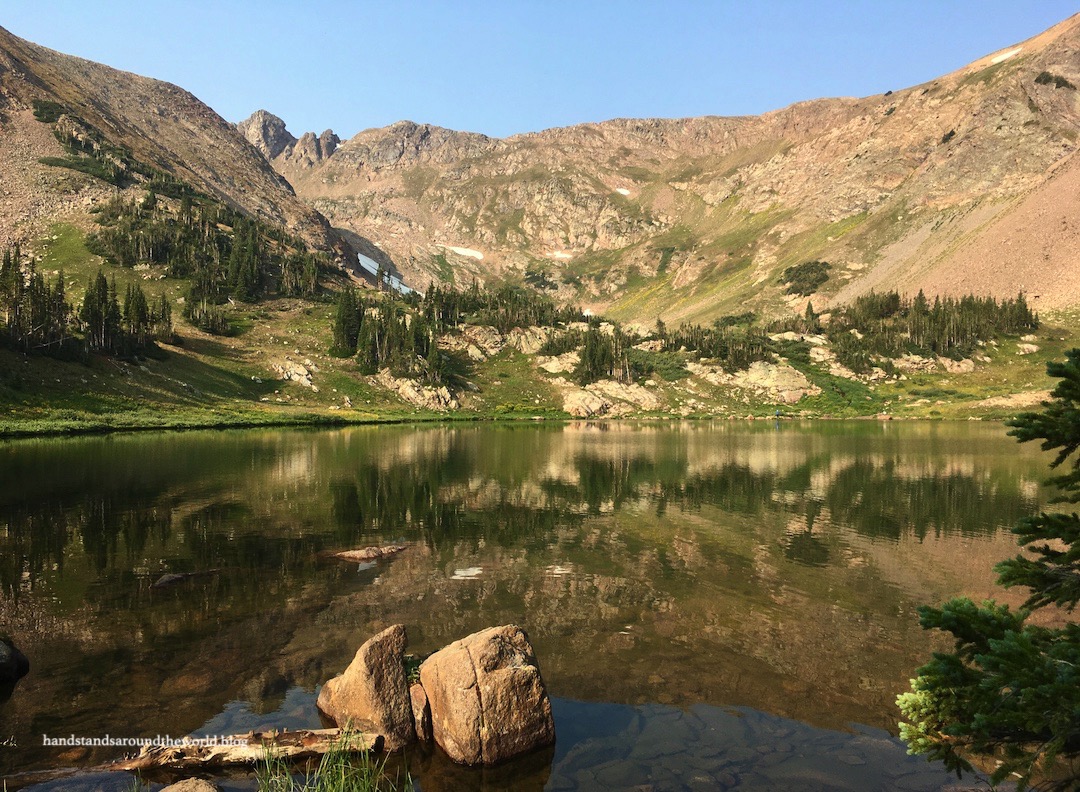
Honestly, for us, this hike was somewhat underwhelming. The lakes were pretty… as you can see. And maybe had we climbed all the way to the pass and had views in all directions, we would have enjoyed this hike more. Maybe it was the sore throats and headaches we came home with that dampened our enthusiasm. Or maybe it was the stupid o-clock wake-up call (parking at East Portal fills by 6:30am on weekends). I’m not sure. I just didn’t love this trail as much as I expected to.
The rest of the summer and fall was hit-and-miss as far as fires and smoke. For the remainder of August and all of September and October, we were at the whim of the wind. If it blew the smoke a different direction, we were able to get out and explore. If not, it was a weekend spent indoors.
It ended up being about a 50/50 split; we still pulled off the epic Labor Day weekend backpacking trip that we’d been looking forward to all summer (next week’s post!), but my planned overnight trip with two friends got postponed and ultimately rescheduled for next summer due to smoke, and we spent a handful of weekends stuck inside avoiding the unhealthy air quality.
More than anything, the fires and smoke were a reminder that climate change is happening, and its happening now. Three of these fires became the largest three in state history, collectively burning over 500,000 acres. Due to unseasonably warm temperatures and extreme drought, one of the fires grew by 140,000 acres in 24 hours, sending people fleeing from their homes in the middle of the night and subsequently burning dozens of these homes to the ground.
It was a frightening and heartbreaking few months here in Colorado. It was a reminder that the choices we make on a daily basis matter. And it was a reminder of all we stand to lose if we don’t do more to protect this beautiful state and the planet we all call home.
The Important Stuff:
- Getting there: the trail departs from East Portal Trailhead (also known as Moffat Tunnel), located at the end of CO Route 16 near the tiny town of Rollinsville, Colorado.
- Fees and passes: none.
- Hiking: 8.6 miles (13.8 km) round-trip with about 2300 feet (700 m) of elevation gain to reach Heart Lake… add about 1 mile (1.6 km) round-trip and 600 feet (185 m) of elevation gain if you plan to continue up to the pass.
- Camping: I saw a couple of dispersed camping spots along the road, and a handful of groups were backpacking near the lakes, but there aren’t any official campgrounds along CO 16.
- Other: as mentioned above, this parking lot fills very early… and we saw several cars in no parking zones that had been ticketed, so be sure to have a backup plan if you arrive and there are no spaces left.


Leave a Reply to The Travel ArchitectCancel reply