By the time we left the east coast a couple months back, I’d lived there for multiple years, and in that time I only managed to spend about 24 hours in New York City. Total.
My main excuse is that it’s expensive – at least from the perspective of a broke young adult. Also, 6+ hours total travel time is pretty far for a day trip. So I really didn’t spend as much time in the city as I would’ve liked.
One day, I’ll go back and give New York the exploration it deserves. For now, I have the memories and photos and experiences from my 3 brief trips to the Big Apple.
My first thought upon arrival in NYC: wow, this is a whole different world!
Hundreds of skyscrapers and thousands of yellow cabs, pedestrians and neon signs, and that bustling energy that’s almost addictive. It’s unlike anything else I’ve ever experienced, and while I can say with absolute certainty that I’d never want to live there, it’s definitely a place I want to spend more time exploring.
Table of contents
- Times Square
- Central Park
- The High Line
- 9/11 Memorial
- Statue of Liberty and Ellis Island
- Food and Drink
Times Square
My first visit to the city lasted about 2 hours. I was taking the train to North Carolina to visit a friend and had a moderately lengthy layover at Penn Station. I messaged another friend asking what I could do in 2 hours with my luggage and it turned out she worked about 2 blocks away at the time and was able to meet up with me and give me a mini tour.
So we grabbed some coffee (it was a chilly November day) and she led me through the throngs of people to Times Square and the Empire State Building.


Central Park
A couple years later, my friend/roommate offered to take me into the city for a day. She’s very familiar with New York so she was basically my tour guide. We were on the road early on a Sunday and miraculously managed to get into the city without hitting any traffic. We parked and proceeded to walk about 13 miles (21 km) as we explored the highlights of Central Park and Midtown Manhattan.


The High Line
We also went for a stroll along The High Line, which is an old elevated rail line that sits about 30 feet above Manhattan, parallel to 10th Ave. It’s from here that I caught my first ever glimpse of the Statue of Liberty, way off in the distance!


9/11 Memorial
I never visited NYC as a child and therefore I never saw the World Trade Centers outside of a television screen. But even though I’d never seen them, and even though I was – in many ways – pretty far removed from the events of that terrible day, I always knew I wanted to visit Ground Zero. I think it’s a place everyone should visit. A place we should go to remember and reflect.
I finally had the opportunity to during one of my trips to Manhattan. We saw the statues and monuments and gazed up at the new One World Trade Center building. We didn’t go into the museum, but we did walk the perimeter of the reflecting pools, engraved with the names of everyone who lost their life that day. Did you know they place roses in each person’s name every year on his/her birthday?


It was somber. Sobering. A reminder of all the ways the world was forever changed by that day.
It’s a place no visit to New York City is complete without.
Statue of Liberty and Ellis Island
Fast forward three years, and our time out east was winding down, and we were frantically trying to get through our “Before We Leave” to-do list – which was already a much-narrowed-down version of all the places I’d like to eventually go.
“Visit the Statue of Liberty” remained unaccomplished. So, in one of my spur of the moment travel planning sessions, I looked up boat tickets for the Statue of Liberty/Ellis Island tour. They were selling out quickly, and months in advance, so we decided we better pick a weekend and just book them.
I was pleasantly surprised that it was only $21.50 per person for round-trip boat fare plus entry into both attractions (including a climb to Lady Liberty’s crown), and – as it turns out – an extremely in-depth self-guided audio tour of both locations.


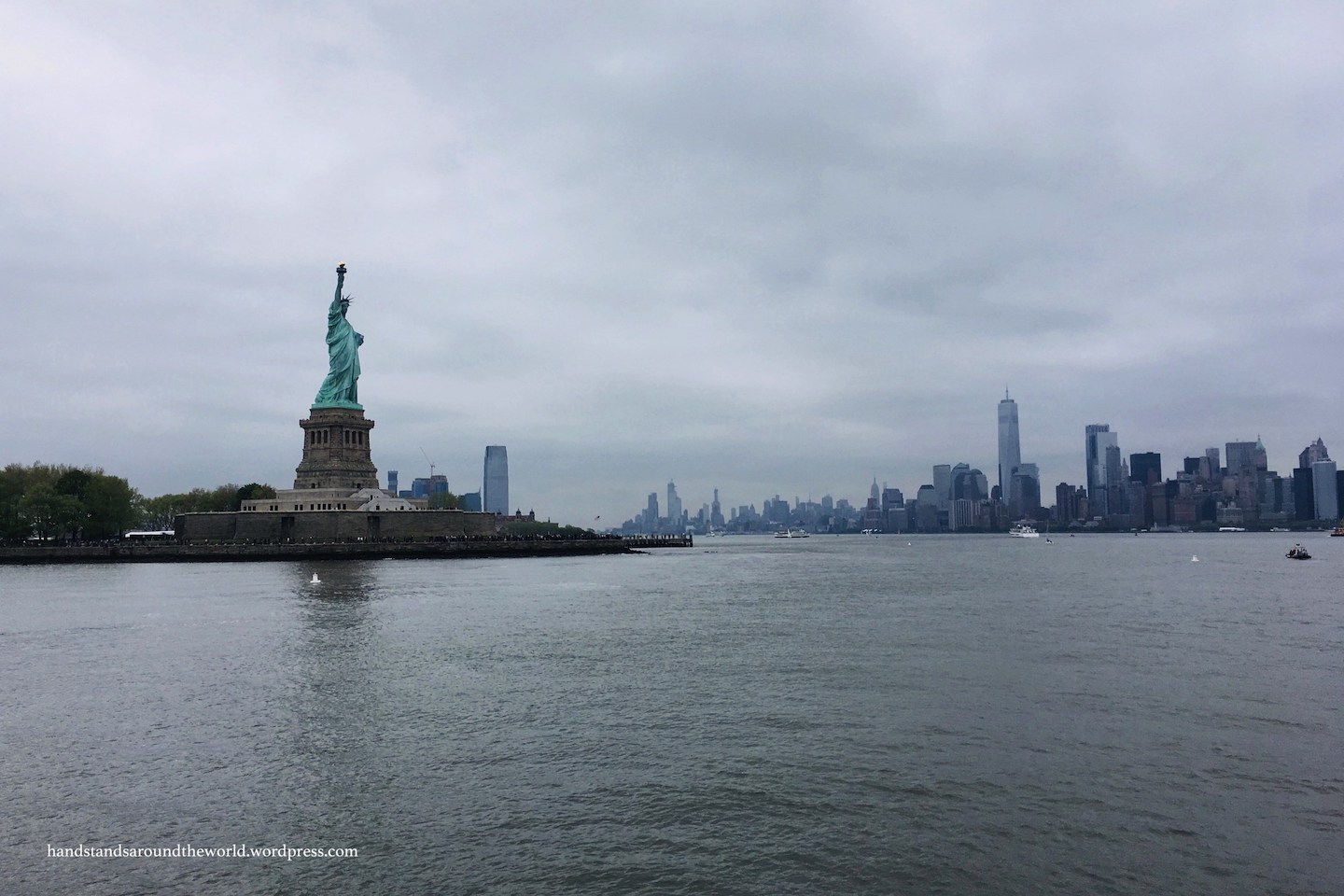
We were on an early ferry out of Battery Park in Manhattan (tours also depart from Liberty State Park in New Jersey) and got thoroughly drenched with rain on the 20 minute ride out to Liberty Island. We seem to have developed a nearly-flawless track record when it comes to booking things in advance and then having terrible weather when the day finally arrives.
It’s a trend I’m eager to break.
Anyway, once on the islands you’re left to your own devices. Ferries depart every 20 minutes, so we took our time to walk through the museum and climb the statue and then simply hopped on the next available boat to depart for Ellis Island.


I highly recommend taking time to walk through the Liberty Island museum – it was fascinating to learn about the origins, design, building, and transport of the Statue. History knowledge has never been a strong point for me, but I knew even less about the Statue of Liberty than I realized.
The same can be said for Ellis Island.
I was under the impression that all arriving immigrants landed at Ellis Island but, in reality, the boat docked at New York Harbor first. First- and second-class passengers were screened on board the ship while en route and then allowed to disembark upon arrival. Third-class and steerage passengers (in other words, most of them) were ferried to Ellis Island for screening and then ferried back to the mainland once they were cleared for entry.
The museum at Ellis Island is enormous, and we easily could have spent most of the day there. I read somewhere that 3 hours was a good amount of time for this entire trip, but I’d say that’s only accurate if you’re not interested in the museums.
The Ellis Island National Museum of Immigration has three different self-guided tours, complete with audio narration (free and available in many languages) if you’d like. We only had time for one, so we followed the Immigrant Experience tour. This tour walked us through the process of arriving at Ellis Island and being screened for entry into the US.
We began in the main room, where we would’ve been asked to deposit our baggage before ascending the stairs to the Registry Room. This enormous room was where screening began.

The screening process was, at times, very different from what would be considered appropriate today. They would do a brief medical exam to check for communicable diseases, and you were quarantined in the Ellis Island hospital if you had one. They also checked mental health with various reading and/or visual tests.
Anyone deemed physically or mentally unwell was detained for further questioning to ensure they wouldn’t become a burden on society. Additional screening protocols included watching a person ascend the stairs and timing their completion of various puzzles (which were used because most immigrants didn’t speak English, therefore watching them complete such tasks was a “better” way to test their mental capacity).
Unmarried women were not allowed entry unless a family member already in the US could vouch for them. Anyone without at least $25 was also not allowed to pass the screening checkpoint (though in the audio tour, one immigrant recalled how his family had only $25 between them so the first in line would present the money and then place it in their back pocket so the next family member could grab it, and this is how they gained entry).
A small percentage of immigrants were detained for further questioning due to various other reasons as well; if they were suspected of breaking immigration laws, for example. I took a mock test to see if I’d be allowed entry, but I was denied – because I live with my boyfriend out of wedlock, already have a job (contract laborers were not allowed), and admitted to singing/talking to myself on occasion (who doesn’t, right? But apparently that raises questions about my mental sanity).
In total, only 2% of immigrants were actually turned away during the entirety of Ellis Island’s operations (although, 2% of 12 million still equates to thousands of individuals being placed on steam ships back to their original port) and a couple thousand died in the hospital on the island, mostly of communicable diseases.
Long story short, the Ellis Island museum and audio tours are very in depth and informative, and I highly recommend taking the time to do at least one of them.


Food and drink
After returning to the mainland, we took a 2 mile walk up to McSorley’s Old Ale House, a mid-19th century Irish Tavern and the last New York City bar to prohibit entry to women (they held out until it became illegal in 1970).
They serve only light ale and dark ale, in 2 half pint glasses (and no, you cannot just order 1 half pint). We had the dark ale, and it was pretty darn good. McSorley’s is certainly the place to go if you’re looking for some good beer and a hefty dose of history.

Apparently everyone feels this way, because it was standing room only when we arrived, and even that was scarce. It would’ve been nice to sit at a table and have some time to look at everything hanging from the walls, but we ended up just chugging our beers and moving on.

Hungry and full of beer, we ended up around the corner at a small pizza place called Ray’s. It wasn’t crowded but had an ‘A’ health rating, so we figured that was good enough for us. It probably wasn’t New York’s best pizza, but it was reasonably priced, and we enjoyed our meal.
And that pretty much wrapped up our day in the city. But just before we hopped on the train, my second most unbelievable ‘small world’ moment occurred.
Some of you may recall my detailing of my most unbelievable ‘small world’ encounter: the time I ran into my former teacher at a lake in the Canadian Rockies (if not, you can read that tale here).
Well, this time I was the teacher and one of my students was… well, the student.
In a city of 8.5 million people, a former student of mine – who was likewise not from New York City – just so happened to be descending a set of stairs in Grand Central Station at the exact same time I was ascending them.
Big freaking city, small freaking world.


Leave a Reply to AnupriyaCancel reply