After seven wonderful days exploring the red rock desert of Utah, our trip was coming to an end. We would be spending the night at a hotel in Green River, setting us up for an early morning start for our drive back home.
But before checking in for our final night away from home, we had one more stop to make: Little Wild Horse Canyon.
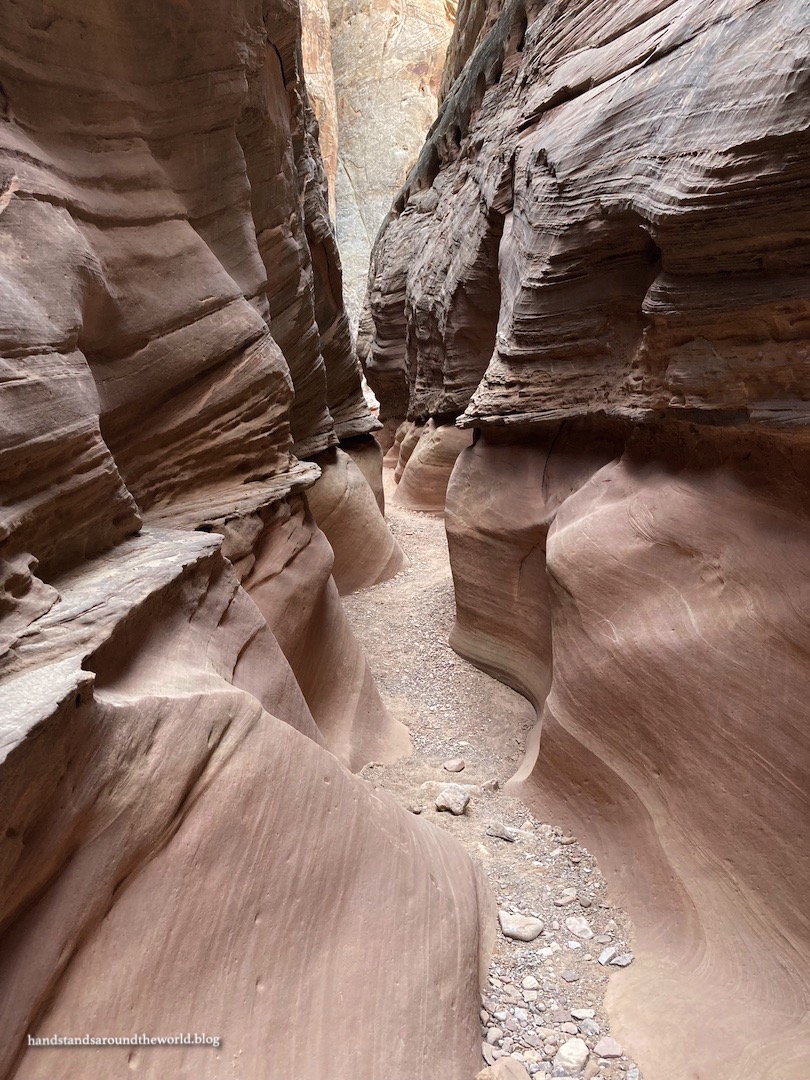
Little Wild Horse Canyon is a slot canyon… a narrow gorge with near-vertical rock walls. Slot canyons are formed by water, which rushes over the landscape during storms and flash floods, carving out a path through relatively soft rock — in this case, sandstone — on its way. With repeated events, the gorge cut by the water grows deeper and deeper but remains very narrow.
In the case of Little Wild Horse Canyon, the narrowest sections were barely wide enough to fit through.
Little Wild Horse is one of many slot canyons in the San Rafael Swell, a geologically odd region of south-central Utah. The Swell formed between 40-60 million years ago in a process of faulting and uplift, resulting in a 3000 square mile (7770 square km) rock dome. Due to the highly tilted angle of the uplift and the subsequent years of erosion, there are often older rock layers visible above the younger layers. It’s a strange landscape.

Goblin Valley State Park is also located within the San Rafael Swell, as are many recreation areas maintained by the Bureau of Land Management. In addition to slot canyons and other strange geological features, one can find petroglyphs and pictographs here. We did not see any rock art on this visit, but I would love to return see that and other parts of the Swell.
For now, though, it was time to hike through a slot canyon!
We pulled into the parking area just after noon and secured one of the few remaining spots. This is one of the most accessible and family-friendly slot canyons in Utah so it’s pretty popular. From the parking area, the trail is initially just a sandy walk through the desert with no indication of the slot canyon that lies ahead.


After 0.5 miles (0.8 km), we reached a fork in the trail. This trail can be hiked as an out-and-back or as a loop. The loop is about 8 miles (12.9 km) long and also includes Bell Canyon, a shorter and wider slot canyon. As we’d already hiked 5 miles (8 km) in Goblin Valley that morning, we opted to do the shorter out-and-back version and bypass Bell Canyon. We turned right at the fork.
Not long after, we found ourselves at the entrance to the slot canyon.


Because slot canyons are tall and narrow, they are an exceptionally dangerous place to be during a rainstorm. Even if it’s not raining overhead, rain falling upstream can funnel into a slot canyon, forming a flash flood. In a flash flood, torrents of water, often many feet deep, come rushing through a canyon very quickly, often with no warning. Even if there is some warning, there’s nowhere to escape the onslaught. Hence the danger. Never ever ever enter a slot canyon if there is a chance of rain.
The weather forecast was dry and the sky was clear as far as the eye could see on this November day, so we excitedly stepped into the canyon.


This was our first time ever hiking a slot canyon, and it was even more fun than I expected! We really enjoyed squeezing through all the narrow spaces and poking our heads around the corners, excited to see what came next. I also really liked the wave-like way in which the rock has been eroded and the many curved, twisted, and slanted layers visible in the canyon walls.


We hiked about 1.5 miles (2.4 km) through the canyon until the walls opened and the canyon widened, at which point we decided to turn around and head back through.

At times we encountered people traveling the opposite direction and, in many places, there wasn’t room for two people to pass through side by side. Fortunately, everyone we met was courteous and one party would backtrack to a location where they could step aside, allowing the other party to pass.


And that was it. All too soon, we were back to the car and our week in the Utah desert was in the rearview mirror. What a week it was. Hoodoos, potholes, petrified wood, slot canyons, and an endless expanse of colorful and bizarre geology.
Utah is amazing and I know we’ll be back soon!
The Important Stuff:
- Getting there: from Utah Highway 24, turn west onto Temple Mountain Road, then south onto Goblin Valley Road. At the turnoff for Goblin Valley State Park, stay right and drive 5 miles (8 km) to the signed parking area. The road is dirt but passable by any car in good weather.
- Fees and passes: none, as far as I can tell (we weren’t sure, so we hung our America the Beautiful pass just in case).
- Hiking: options include walking through Little Wild Horse Canyon as far as you want and then turning around and heading back to the trailhead (could range from 1-6 miles/1.6-9.6 km round trip), or combining Little Wild Horse with adjacent Bell Canyon to form an 8 mile (12.9 km) loop.
- Where to stay: developed and dispersed camping is allowed in certain areas on the surrounding BLM land (here is a map that shows the trailhead as well as camping options). Goblin Valley State Park also has a campground. For hotels, the closest option is either Green River or Torrey, both of which are about 90 minutes away.
- Other: I really can’t say it enough… don’t do this hike if it’s raining. Don’t do this hike if it’s about to rain. Don’t try to beat the storm. Don’t do this hike if there’s a chance of rain anywhere in the area. Flash floods are extremely dangerous and getting caught in one can be fatal. Be sure to check the weather before setting out and remember that once you’re in the slot canyon, you won’t be able to see if a storm is coming.


Leave a Reply