Five of the six days of our Montana road trip were beautiful – warm, sunny, no rain to speak of. Perfect weather for exploring.
But naturally, the one cold rainy day of our entire trip was the day of our boat tour. Just the kind of weather you want when you’ll be sitting on a boat for two hours.
We departed Great Falls bright and early (well actually, ‘cloudy and grey and early’ is more accurate) en route to Gates of the Mountains for our tour. On the way, we made brief stops at two small state parks.
Stop #1 was First Peoples Buffalo Jump State Park, located a few minutes southwest of Great Falls. We began at the visitor center, which outlines some of the Indigenous history of the area. According to the park, the Salish Kootenai, Blackfeet, Shoshone, and Kalispel were the original stewards of this land. Other sources and oral histories show that the Gros Ventre, Assiniboine, Cree, and Sioux also used this buffalo jump.


Using a buffalo jump was a highly complex and organized process that required a great deal of skill and stamina. The bison needed to be lured to the edge of the cliff, often from quite a distance away, a process which required young men to run alongside and in front of the herd while draped in buffalo hides. As they approached the cliff, the men would have to jump out of the way at the last minute to avoid being trampled in the stampede.
Other members of the tribe would wait at the bottom of the cliff to kill any animals that survived the fall and begin processing them. Most parts of the animal were used and virtually nothing went to waste. Here is an interesting article with more information about buffalo jumps.

Both a road and a trail lead to the top of the buffalo jump. This particular jump is among the largest and most heavily utilized buffalo jumps in the country and perhaps even the world. Carbon dating of artifacts and bones found here suggest that the jump was used for roughly 1200 years. Some of these artifacts remain in place at the park… please respect the land and its history and don’t touch or remove them.


Our second stop was Tower Rock, a very tiny, largely undeveloped state park. It’s really only notable as a landmark along the river for Lewis & Clark, marking the transition from plains to mountains. It wasn’t the most exciting stop. There’s a parking area, bathroom, a couple of signs, and that’s about it.

The drive south from Great Falls along I-15 is one I’ve always enjoyed as the road winds through a rocky canyon cut by the Missouri River. The present-day road sits along a route called the Old North Trail, which spans from Mexico to Canada and has been used for 12,000 years.

And finally – Gates of the Mountains.
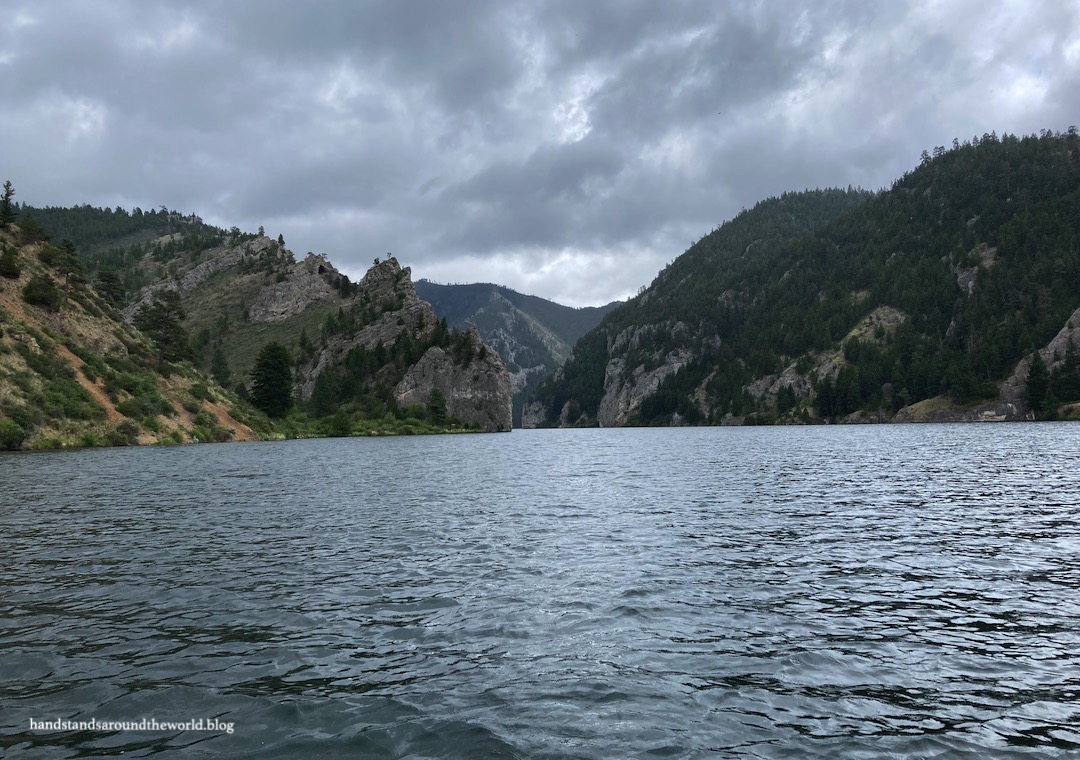
Located in the Big Belt Mountains northeast of Helena, Gates of the Mountains Recreation and Wilderness Areas get their name from the Lewis & Clark expedition. Upon reaching this stretch of the Missouri River in 1805, a deep canyon surrounded by towering cliffs, Meriwether Lewis referred to it in his journal as “the gates of the mountains.” Indeed, as you approach, the cliffs give the appearance of an enormous gate swinging open.
Today, Gates of the Mountains is part of the Lewis & Clark National Historic Trail and is open to various forms of recreation. You can take your own boat up the canyon. You can hike or backpack in from trailheads on the other side of the mountains. Or, like we did, you can take a guided boat tour.
Boat tours have actually been operating in Gates of the Mountains for 135 years; it’s one of the oldest continuously-operating tours in the country. The first trips were started by a man named Nicolas Hilger who traversed the canyon himself, noted how challenging and spectacular it was, and decided he could start charging people to take the trip on his newly-purchased steamboat.


Our tour began at the marina on the north end of Upper Holter Lake. We loaded up beneath skies that appeared to be clearing and headed off up the 1000+ foot (305 m) deep canyon cut by the mighty Missouri. Each time I see the Missouri River up close, I’m more and more amazed that the Lewis & Clark expedition was able to make it all the way to the west coast.
(Actually, Clark never traveled this section of river; he walked the Old North Trail to make contact with locals and gather intel on their route, while Lewis continued upriver.)
Due to dams downstream, the flow of the river through the canyon today is somewhat calmer than it once was. We enjoyed a smooth trip, although the rain did return about halfway through our tour. Our driver-slash-narrator was absolutely fantastic; she recounted a detailed history of Gates of the Mountains, explained the geology of the canyon, and pointed out various rock features and pictographs.
We also spotted 5 bald eagles, a flock of pelicans, and a couple mergansers! (Of course, I have no good photos of them because I only had my phone with me.)


Our turnaround point was Mann Gulch. Mann Gulch was home to a 1949 firefighting tragedy, in which 16 smokejumpers got trapped in the gulch when a wildfire rapidly expanded. Thirteen of them died trying to outrun the flames. This event is commemorated today with a large sign at the base of the gulch, and the tragic outcome also altered firefighting strategies in ways that are still used today.

In the three photos below, you can see the “gates of the mountains” swinging open as we turned around to head back through the canyon.


On the way back we stopped to explore Meriwether Picnic Area, so-named because, according to his journals, this is where Lewis and his men spent the night. About 15 years ago, after a fire burned through the mountains above, an enormous landslide almost entirely buried the picnic area. The top of an old drinking fountain is still visible today, showing just how much mud came tumbling down the mountainside.


And from here, we re-embarked and made our way back out to Upper Holter Lake.

It was still fairly early in the afternoon, so we drove into Helena to sample some craft beer. Well, I had beer. My mom, who finds beer completely disgusting, had hard seltzer. If you’re looking for a brewery that sells both, I recommend Lewis & Clark Brewing. We enjoyed our beverages, an appetizer, and the rustic wooden interior.

And then we wrapped up a pretty great day by pitching our tent at a great campsite!


The Important Stuff:
- Getting there: the boat dock (for your own boat or for the tour) is located on Upper Holter Lake; leave I-15 at exit 209 and travel east on Gates of the Mountains Road.
- Fees and passes: the tour costs $16/person and advance booking is necessary; here is the website.
- State parks: the parks are free for Montana residents or $8/car for non-residents.
- Where to stay: Gates of the Mountains is only about 30 minutes from Helena and 60 minutes from Great Falls, where various lodging options are available. There are a handful of nearby campgrounds as well.
- Other: thanks to the 13 species of bats that live in caves in the canyon, there are virtually no mosquitos here. No bug spray needed… but sunscreen, rain gear, layers, food, and water are all good things to pack for the tour.


Leave a Reply to The Travel ArchitectCancel reply